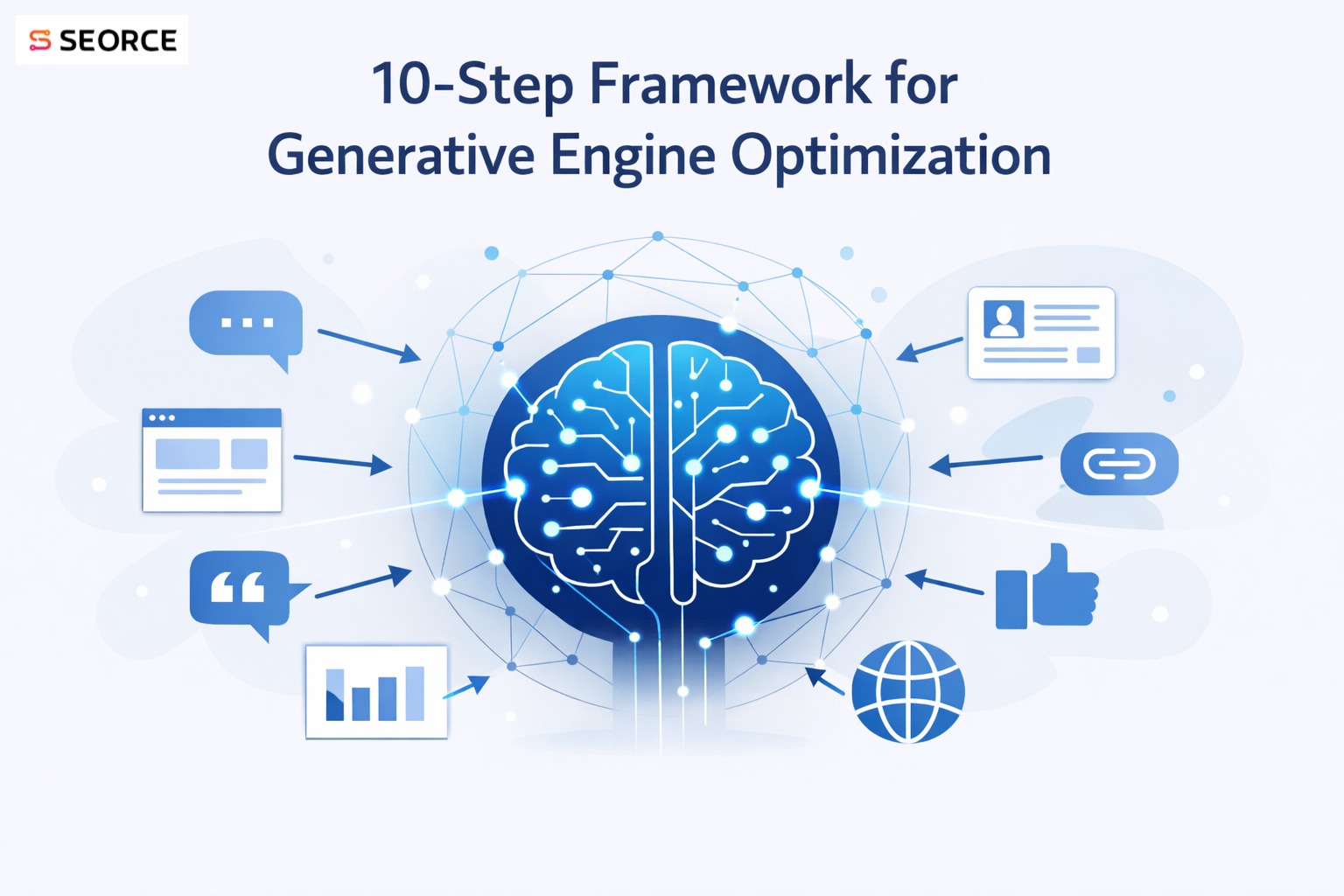
10-Step Framework for Generative Engine Optimization (GEO)
Imagine you’re planning a weekend getaway and you fire up your favourite travel assistant, maybe it’s an AI chatbot.
You ask: “Best hidden beach near Goa for families with kids?” And almost instantly you receive a crisp answer with recommendations, facts, and a couple of links. You don’t scroll through page after page of search results.
The answer lands straight in front of you.
That shift is real: Moving from digging through search engine pages to getting instant and well-structured answers.
It means the way you reach your audience is also changing. Instead of just climbing to the top of a list of links, you now need your content to be part of the answer itself, ready for generative engine platforms, not just traditional search. Here, optimizing your content isn’t enough. It must be “engine-friendly” in a whole new way.
According to current research, what we call Generative Engine Optimization (GEO) is all about purposefully designing content so AI systems pick it up, use it and cite it.
Think of it this way: If traditional SEO got you to page one on Google, great. But now imagine your brand being the source quoted in an AI chat response when someone asks a relevant question. That is the next frontier. You still write great content. You still build trust. But now you also build “citation readiness” for AI engines.
In a moment we’ll walk you through a full 10-Step Framework for GEO, showing you exactly how to structure your content, map your topics, signal authority, and engage with the new prompt-driven world.
What is Generative Engine Optimization (GEO)?
Generative Engine Optimization (GEO) is the process of optimizing your content so that AI tools like ChatGPT, Google SGE, or Microsoft Copilot can recognize, understand, and mention your brand or website in their responses.
This isn't just about ranking high in Google anymore. Think about how users now ask questions directly to AI, and the AI answers without showing a list of links. GEO helps you appear inside those answers. That means your brand becomes part of the AI’s knowledge, not just a blue link on a search result page.
You’re no longer optimizing just for search engines. You’re optimizing for generative engines such as AI models that scan millions of webpages, absorb patterns, and decide which sources to cite or pull information from.
At its core, GEO is about:
- Writing clearly so that AI can easily understand your point.
- Using structure like headings, lists, and Q&A formats to guide AI in summarizing or extracting key insights.
- Building authority so your name or site gets trusted enough to be quoted or referenced in the AI’s output.
- Making content semantically rich with named entities, facts, relationships, and structured data because AI understands meaning, not just keywords.
It also means shifting how you measure success. Instead of just focusing on traffic or clicks, you look at how often your brand is mentioned or cited by AI in answers. That visibility, even without a click, is powerful.
So if you're creating content today, GEO ensures you're not just shouting into the void. You're actually being heard by the systems that answer millions of questions every day.
Key Differences Between GEO and Traditional SEO
GEO focuses on helping your brand or content appear inside AI-generated answers, while traditional SEO aims to rank your pages on search results. In short, GEO is about being referenced by AI systems, not just ranked by search engines.
To make this clearer, here’s a simple comparison:
Feature | Traditional SEO | GEO |
Target Platform | Search engines like Google and Bing. You optimize for listing and ranking links. | Generative AI driven engines such as chatbots or LLMs that synthesise and present answers directly. |
Result Format | Multiple clickable links on a search engine results page where the user chooses what to click. | A single summarised answer or a few generated by an AI, often without requiring a click. |
Content Focus | Optimising for keywords, backlinks, metadata, ranking position, structure and user experience. | Optimising for machine comprehension, structured content, context and entity clarity so AI can reference you. |
User Intent & Query Style | Users type keywords or short phrases and expect a list of pages. Queries can be shorter and more generic. | Users often ask full questions in conversational style. Generative models handle long form, natural language input. |
Measurement of Success | Metrics include ranking position, click through rate, and organic traffic from search results. | Metrics are evolving such as inclusion in AI generated answers, citations by models, and brand presence without direct clicks. |
Now that you know how these two strategies stack up, let’s walk through the step-by-step breakdown of the 10-step GEO framework so you can start applying it smartly.
The 10-Step Generative Engine Optimization Framework
If you want your brand or content to show up in AI-generated answers (not just traditional search) then this 10-step GEO framework is exactly what you need. Think of it as your roadmap for becoming visible in the world of ChatGPT, Gemini, Perplexity, and other LLM-based tools.
Let’s break it down, one clear step at a time:
1. Clarify Your GEO Goals and Audience
To start strong with GEO, you need to define exactly what success looks like and who you are trying to reach.
Your goals should not be vague like “more visibility.” Instead, you should be clear about the outcomes you want from generative engine optimization.
Do you want AI tools to mention your brand name when people ask industry questions? Or maybe you want your product descriptions to show up when someone queries a comparison? Your intention drives everything from the way you create content to how you structure it.
So first, get specific with your GEO goals. A few examples:
- Increase brand mentions in AI generated answers
- Be cited as a source when a user asks a specific question in your domain
- Improve share of voice in AI driven summaries across platforms
- Get your FAQ content lifted directly in AI responses
Each of these goals leads to different types of content, structure and outreach.
Next, turn to your audience. Who are they, and what are they asking for generative engines?
Think like your reader. What kind of problems are they trying to solve using chatbots or AI search? The more accurately you profile your audience’s behavior, the better your targeting becomes.
This is not just about keyword research. It is about prompt anticipation. You are guessing how real users phrase questions when they talk to a generative model.
Once you lock in your goals and audience, define your KPIs.
These help you measure what is working and what is not. Depending on your GEO goals, good KPIs might include:
- Number of times your brand appears in AI generated content
- Volume of citations from generative engines
- Engagement driven by generative answer appearances such as clicks or shares
- Share of voice for high value prompts in your industry
With this foundation in place, you will be ready to move confidently through the next steps of the framework.
Everything you build should align with these two essentials: a crystal clear goal and a well defined audience.
Step 2: Research Generative Query Intents & Prompts
You now take those researched prompts and break them into clear intent categories. This means grouping similar queries by what the user really wants, whether they are asking for a definition, comparison, how to, list, or recommendation.
That simple act helps you align your content more accurately with the mental model users bring when they ask those questions.
For example, a question like “How does a generative engine work?” reflects an informational intent.
But “Best platforms for generative engine optimisation” is more navigational or commercial, because the user wants options. You need to address both the surface wording and the underlying goal behind the prompt.
Here is a helpful structure to organise and prioritise these:
Intent Type | User Prompt Examples | Content Approach |
Informational | What is GEO? How does it help brands? | Answer with clear, short explanations |
Comparative | GEO vs SEO? Which is better for visibility? | Use side by side analysis or tables |
How To | How to optimise content for AI engines? | Step by step guides or checklists |
Recommendation | Best GEO tools? Trusted GEO agencies? | Curated lists with brief pros and cons |
Troubleshooting | Why isn’t my content cited in AI answers? | Explain common issues and fixes |
You now match your researched prompts to one of these intents. This lets you create targeted content blocks that actually answer the question, not just circle around it.
And when AI engines crawl that, they can clearly detect your intent aligned answer and cite it cleanly.
Once you have mapped intents across 20 to 50 prompts, you have a strong foundation. From there, you decide what content to create, what to revise, and what to feature. This makes sure your efforts are not random and are focused exactly where users and generative engines intersect.
Step 3: Map Your Topic & Entity Landscape
You need to list out all the key topics, entities, and subtopics that are relevant to your brand, industry, or expertise. Then, connect them in a way that generative engines can understand the relationships between them.
Start by naming the main entities. These can be your brand, your product categories, service types, or industry terms. Think of each as a central node. From there, branch out into related questions, issues, comparisons, or use-cases your audience may ask about.
For example, if one entity is “AI-powered CRM”, the related topics could be: how it improves sales, what tools use it, pricing concerns, or user onboarding. Write these down. You’re basically building a semantic map that shows what you're an expert in.
Once you’ve created this web of entities and ideas, make sure your content reflects this structure. Create content clusters. One strong page for the core entity, and supporting articles for each sub-topic.
Also, use schema markup to tell AI how everything connects. For example, when writing about a product, mark it clearly as a “Product” and link it to the brand entity. This makes it easier for generative engines to pick up the right associations.
Keep expanding this map as you grow. The more clearly you define your topic space and anchor your expertise, the more likely AI engines will recognise and cite your content.
Step 4: Create GEO‑Ready Content Architecture
Structure your content with clear sections, direct answers, and machine-readable formatting so that generative engines can easily extract, understand, and cite it.
Start every page with a strong, concise introduction that answers the core question or explains the topic in simple words. Follow that with well-organized subheadings, short paragraphs, and clear formatting. Avoid long, cluttered blocks of text. Think scannable, not verbose.
Use bolded questions, summary points, and clear topic shifts. Generative engines prefer structured flows that mimic how they format responses. So, design your content with that in mind.
One good way to do this:
- Use H2 and H3 headers to break down sections
- Add bullet points or numbered lists to highlight steps or key ideas
- Write short, factual statements with clear context
- Include Q&A blocks if possible (answer the question right after asking it)
Also, implement Schema.org markup using JSON LD for content types like FAQs, How Tos, Products, or Articles. This helps machines connect your content to specific entities, making it easier to show up in generative answers.
Don’t forget metadata. Add publish dates, author bios, page titles, and internal linking that ties into your topic clusters. Keep the design clean. No distractions, no keyword stuffing. Let clarity do the work.
If your page looks like something an AI could lift cleanly and credit without editing, you're on the right track.
Step 5: Signal Authority, Trust & Source Credibility
AI engines won't cite just anyone. They prefer sources that look credible, backed by real expertise, and trusted by others. You need to show them that your content is worth quoting. That means proving you know your stuff and that others trust what you say.
Start by making your content feel reliable on the surface. Always include an author name, ideally with credentials or a title. Add a short bio or byline at the end, even if it is just “Data Analyst at XYZ.” Mention when it was last updated, especially if you are writing about fast changing topics.
If your article includes data or claims, back it up with citations. Link to government reports, academic sources, or high authority industry research. AI engines are trained on this kind of structure and will recognize when you are connecting the dots with proof.
Let’s say you are writing about “carbon emission trends in 2025.” If you casually say: “Global CO₂ levels rose dramatically” you might get ignored.
But if you write: “According to the IEA 2025 report, global CO₂ emissions increased by 2.1 percent year over year” you have now given AI a reason to quote you.
On top of that, build external trust signals. Generative engines do not just look at your article. They check if others are talking about you too.
Here is how you can boost that:
- Publish guest articles on respected blogs in your niche
- Get mentioned or listed on curated directories and resource lists
- Share insights in interviews, podcasts, or industry forums
- Use platforms like Substack or Medium where AI often pulls content from
These sources act like references in your resume. When they mention you, AI systems take note.
Also, be consistent with your brand entity. If your company is “Seorce Pvt. ltd.” do not write it five different ways across your content. AI engines treat inconsistent branding like a red flag.
Step 6: Optimise for Prompt‑Friendly Extraction & Citation
You make your content easy for AI to lift, quote, and reuse by giving clear answers first and then expanding with supporting points. This helps the model understand your message quickly and increases your chances of being cited whenever users ask related questions.
Think of it like placing the strongest answer right at the top. You keep it short, direct, and easy to recognise. Then you follow with details that connect smoothly and add depth without overwhelming the reader.
For example, if you are writing about “What is conversion rate optimisation”, you start with a clean answer such as:
“Conversion rate optimization is the process of improving how many users complete a desired action on your site. It focuses on understanding user behaviour and removing friction so results improve over time.”
Now the AI can easily extract that first sentence because it is self contained.
You then expand with connected lines like: “You can support this with structured tests, user research, and page level improvements.”
“When this structure appears consistently across your content, AI engines find it easier to quote the right block and use it directly in an answer.”
Using bullet points, compact paragraphs, and small tables further increases extractability.
These elements break information into neat chunks and reduce the effort required for the model to recognise what each section is saying.
Keeping the language unique also matters. If your lines sound too generic, the model may skip you and look for a fresher source.
So you stay specific, you stay clear, and you present your ideas in blocks that can stand on their own.
Step 7: Ensure Technical & Performance Foundations
This is where your content's visibility either gets supported or silently blocked. You’ve already optimized it for citation, but if your site is slow, broken, or unreadable to AI crawlers, it won’t even get picked up.
Generative engines need technically clean and high-performing pages. Not just smart content. Your site must load quickly, stay mobile-friendly, and follow core web vitals. It also needs to be machine-readable, so structured data and metadata must be in place.
For example, say you publish a Q&A guide on “How to choose the right CRM software.” It’s well-written, structured for extraction, and full of credible data.
But if you’ve missed structured schema or have broken canonical tags, AI engines like Perplexity or SGE may not know what the page is about or may skip it altogether.
Here’s what you need to double-check:
- Structured data: Add JSON-LD schema (e.g., FAQPage, Article, Product) so AI tools can identify your page type
- Sitemap & robots.txt: Keep these clean and updated so bots crawl the right pages
- Secure & fast hosting: HTTPS, image optimization, and lazy loading all help boost site speed
- Mobile-friendliness: AI engines are trained on responsive web content. If your site’s not mobile-ready, you’re behind
- Canonical URLs: Avoid duplicate signals by pointing AI crawlers to your preferred content version
Also, make sure your brand name, author details, and topic categories are consistent across the site. This helps generative engines connect dots between your content and its source.
Step 8: Distribute, Amplify & Acquire AI‑Relevant Mentions
AI tools don’t rely solely on what’s on your website. They look across the web to identify which sources are mentioned, linked, or trusted. So if you want AI to pull your content into its responses, your brand needs to show up in multiple external sources.
Let’s say you wrote a brilliant breakdown on “AI in Healthcare Billing” and structured it perfectly. But it’s still buried on your site.
Now imagine that same piece gets quoted in a Forbes Tech article, linked in an industry blog, and featured in a university newsletter. Suddenly, you’ve built credibility outside your own domain. AI engines that scan multiple datasets are far more likely to notice and cite you.
Here’s how you do it:
- Share your content with niche communities, newsletters, and forums where your audience and experts hang out
- Pitch mini versions to journalists, LinkedIn creators, or bloggers in your space
- Repurpose core ideas into visuals or charts and let others embed or reference them
- Collaborate with known names; get your ideas mentioned in their podcasts, case studies, or explainers
You don’t need 500 backlinks. You need 5 to 10 high-quality, topically aligned mentions in places that LLMs often treat as reference worthy.
And keep this in mind: AI doesn’t click, it scrapes.
So don’t just focus on driving traffic. Focus on creating citations. If your brand or page keeps showing up in respected corners of the internet, AI engines will eventually learn to include you.
Step 9: Measure GEO Metrics, Analyse & Iterate
Once you have distributed your content and earned AI relevant mentions, your next move is to track how often and how effectively generative engines are actually using your content. This step helps you understand what is working and where to improve.
You are not just checking for website clicks here. Instead, you are measuring things like how often your brand is cited in AI generated answers, which of your pages are getting quoted, and how your visibility compares with others in your niche.
Let us say you published a “Beginner’s Guide to Sustainable Investing” and distributed it through blogs and press mentions. A month later, you notice ChatGPT or Google’s AI Overview starts mentioning your brand when someone asks, “How to start ESG investing?” That is a win because you have earned generative visibility.
Now, track this systematically by using:
- AI answer monitoring platforms (some SEO suites are adding these features)
- Brand name and content phrase tracking inside generative search tools
- Manual prompt testing with your primary keywords to see if your content gets pulled by AI agents
*Also, include AI Beacon by Seorce, which provides real-time monitoring of your brand mentions across AI agents and Google’s AI Overviews.
Then, analyse. Ask:
- Which formats are getting cited most?
- Do bullet points or FAQs perform better than long essays?
- Which platforms gave me the highest citation lift?
This is not a one time report. GEO is still evolving, and AI engines change often. So, keep iterating.
Tweak your content structure, update outdated sections, add more trusted data, and test new prompts regularly.
Step 10: Scale & Institutionalise GEO Practices
Scale and institutionalise GEO by turning your one-time efforts into a repeatable, ongoing system built into your content operations.
That means you do not just optimize a few blog posts and hope for the best. You embed Generative Engine Optimization into your entire content workflow so that every new piece is AI ready from day one.
Start by creating internal GEO templates. This could be as simple as a standard content brief that includes fields for prompt friendly answers, entity mentions, and structured data. Build a checklist your team uses before publishing. Ask yourself: Is there a clean Q and A format? Are Schema markups added? Is the brand clearly cited?
Then, train your writers, editors, and SEO team on what GEO actually is. Most people still think in terms of keywords and backlinks. You will need to show them that AI citation works differently. It cares more about clarity, authority, and extractable snippets.
Let us say you run a personal finance website. Instead of just writing an article like “Top SIP Plans in India,” your scaled GEO process would include:
- Mapping relevant entities such as fund names, institutions, and investment terms
- Answering direct questions like “What is the best SIP for 2025”
- Structuring each answer in a way that AI can easily lift and cite
And when this process is baked into your editorial calendar, every content piece gets built with GEO in mind, not as an afterthought but as a default setting.
You will also want to track what is working. See which content is getting cited in AI tools. Identify the topics that are gaining visibility. Observe which formats such as FAQs, statistics, or how to guide perform best. Then use that insight to refine future templates.
Over time, your content machine becomes self improving. Your team gets faster, your citations grow, and your presence in AI answers becomes consistent.
Real-world Case Studies
Here are three real-world case studies illustrating how the framework for GEO plays out in practice. We will walk you through what each company did, why it worked, and how you can apply the same lessons.
Case Study 1: Go Fish Digital – 3× Leads via GEO
Case study: https://gofishdigital.com/blog/generative-engine-optimization-geo-case-study-driving-leads/
This case shows how an agency used GEO to boost both visibility and conversions in AI-driven environments.
What they did:
They started by mapping out prompt-based research queries relevant to their service (Step 2: define persona & intent).
Then they produced 5–8 “cornerstone” pages with fact-dense content and semantic structure (Step 5).
They also built “query fan-out” pages: long-tail content around adjacent prompts so as to cover the whole research journey (Step 4 & Step 8).
Why it worked:
Because they aligned content with how large language models (LLMs) retrieve and cite information. Traffic from AI referrals grew +43 % and conversions jumped +83 % in only three months. They treated the AI channel as a new engine rather than just a variant of traditional SEO (Step 1 & Step 9).
Case Study 2: The Rank Masters – +8,337% ChatGPT Referrals in 90 Days
Case study: https://www.therankmasters.com/blog/generative-engine-optimization-geo-case-study-trm-chatgpt
This case is dramatic in the numbers. They radically shifted their site to support GEO and saw huge growth.
What they did:
They relaunched the website and published 42 pages in 3 months: 12 core pages + 30 long-tail blog posts (Step 5).
They used modular content architecture for “problem > framework > proof > CTA” blocks (Step 3). They built semantic topic maps (Step 4) and used consistent terminology across pages (Step 8).
They also measured performance with GA4 filters to identify ChatGPT referrals (Step 9).
Why it worked:
Because they treated AI visibility as a distinct channel and built for both humans and machines.
Engagement from AI referrals soared: active users viewed around 48 pages each and spent ~5.7 minutes on site. This implies strong topical depth and content relevance. These are exactly what AI engines reward when citing sources.
Case Study 3: Broworks (B2B Webflow Agency) – 10% of Traffic from LLMs and 27% of That Converts to SQLs
Case study: https://www.broworks.net/blog/answer-engine-optimization-case-study
This B2B agency shifted to answer‑engine optimization (sometimes used interchangeably with GEO) and got pipeline‑driven results.
What they did:
They added structured schema markup (FAQ, Article, Organization) to make their content easier for AI systems to parse (Step 5 and Step 6). T
hey rewrote their content around natural question prompts (Step 2).
They prioritized semantic HTML, clear sections, and FAQ modules that an LLM could easily extract (Step 6).
Why it worked:
They catered directly to how LLMs source and cite information.
As a result, 10% of their organic traffic came from AI-based channels, and 27% of that traffic converted into Sales Qualified Leads (SQLs). This shows GEO isn’t just about visibility. It can lead to high‑intent conversions.
Key Takeaways from All Three Case Studies:
Takeaway | Explanation |
Build for both humans and machines | In GEO, your content must be structured and readable not just by people but by AI models. Clear formatting helps both. |
Use semantic structure and prompt‑native formatting | Define terms clearly, use question-based headers, include micro-answers and structured snippets. These are easier for LLMs to extract and trust. |
Track AI-referral traffic and behavior | Know how AI-based users engage with your content. Track time-on-site, pages visited, and conversions separately from regular SEO traffic. |
GEO leads to qualified conversions | AI visibility is not just about impressions. When done right, it brings users who are further down the decision funnel and more likely to convert. |
Start small and scale smart | Begin with basic audits, persona mapping, and snippets. Then expand into topic clusters, structured hubs, and monthly feedback loops for long-term gains. |
Action Plan / Implementation Roadmap
If you’re serious about Generative Engine Optimization, you need a clear, step-by-step rollout. This 30-60-90 day roadmap gives you just that. It will give a phased way to build visibility and authority across AI engines without burning out your team.
1. 30-Day Plan: Foundation Setup
Your main goal in the first 30 days is to set the foundation for long-term AI visibility by auditing your current presence, defining your narrative, building a few content hubs, and creating AI-friendly snippets.
This step is not about volume. It's about making sure the right structure and positioning are in place before you scale.
1. Audit Your AI Visibility Across Engines
Start by manually testing how your brand appears in engines like ChatGPT, Gemini, Claude, Bing, and Perplexity.
Use simple prompts that your target audience might ask, such as “Top CRM tools for small teams” or “What is the best AI writing tool?”
Note down how often you are mentioned, what kind of language the engines use to describe you, and if they show outdated, inaccurate, or missing information. This helps you benchmark your current position before you begin optimizing.
2. Build Your Core Narrative Sheet
Once you know how you are being interpreted, shift focus to how you want to be interpreted.
Your narrative sheet should include:
- What problems you solve
- Who you serve
- How you are different
- What makes you credible
This document will become your brand story for AI engines which you will consistently reuse across content hubs, snippets, and structured answers.
3. Start Creating GEO Snippets
Now create 20 to 30 high clarity snippets that AI engines can easily lift into responses.
These can include:
- Two line definitions
- Step by step process explainers
- If this then that formats
- Simple comparison lists
Make sure every snippet is short, factually accurate, and aligned with your narrative. The goal is to train engines to repeat what you want them to say.
4. Launch 2 to 3 AI First Content Hubs
Pick 2 or 3 high impact topics in your industry and build AI first content hubs around them.
These should be structured clearly, with headers, bolded keywords, internal linking, and unique value driven answers.
Each hub should serve as a central source of truth for that topic, designed for readers and also designed for generative engines to reference and reuse.
2. 60-Day Plan: Expansion and Structuring
In the second month, your goal is to expand your content library and structure your brand knowledge so that AI engines start connecting the dots more deeply and reliably.
You’ll build a complete knowledge graph, expand your snippet base, and fine-tune your content across different engines to increase consistency and retrieval quality.
1. Build a Complete Knowledge Graph
Start by mapping your entire domain of expertise. This means identifying your core topics, their supporting subtopics, related questions, processes, tools, and definitions.
Think of it as a mind map for AI. You are creating structured and interconnected pieces that generative engines can use to reason, explain, and reference you accurately.
Make sure your graph includes:
- Clear labels and definitions
- Differentiated terms that make your brand stand out
- Pages and snippets tied to each node on the graph
This structure helps engines understand your authority beyond surface-level mentions.
2. Expand Your Snippet Library
Now that you have structure, it is time to scale your GEO snippets.
Aim to build 100 to 200 short, clear, AI-readable pieces that engines can easily lift into responses.
These could be:
- One-liner definitions
- Quick comparisons
- Step-by-step how-to snippets
- Problem-solution blocks
- Short lists and decision trees
Each snippet should be precise, helpful, and repeatable, so that engines learn to associate it with your brand across similar queries.
3. Optimize Across Engines
Every AI engine has its own behavior pattern.
Some prefer longform reasoning, others prefer structured snippets, and some require a blend of conversational and fact-based input.
Use this phase to adjust your narrative formats slightly for each engine. Your definitions, explanations, and structured content should stay consistent in meaning, but the format can flex to suit the engine’s style of generation.
Also, track if any platform is missing you entirely or presenting incorrect facts, and adjust your snippet or content wording to guide the model’s response more reliably.
3. 90-Day Plan: Predictability and Governance
By this point, your foundational content and snippet systems are already in motion.
Now, your main goal is to bring structure, consistency, and predictability to your Generative Engine Optimization efforts.
You’re no longer guessing what works. You’re setting up systems to track and improve it continuously.
1. Build Your GEO Governance System
This is where things start running like clockwork. You need to assign clear roles across your team for who monitors AI visibility, who updates content hubs, and who owns the E-E-A-T signals.
Put together a repeatable GEO playbook so future updates don’t depend on memory or one person.
The idea is to make content maintenance a standardized process, not a random fix-it task.
2. Use a Monthly GEO Scorecard
Now that you are live across platforms, you must measure what AI models are actually doing with your content.
Create a simple scorecard that tracks your AI Share of Voice, brand accuracy, and inclusion in multi step answers.
You should also measure which snippets are getting picked, which queries you are missing, and how well your content represents your real expertise. This helps you spot blind spots, misrepresentations, or dropped mentions before they hurt your brand.
3. Establish Feedback and Update Cycles
Do not wait six months to refresh your content.
Instead, run monthly feedback loops to update outdated stats, refresh your narrative, and test how AI answers change after each tweak.
This way, you are actively shaping how AI sees your brand, instead of reacting late.
4. Drive Predictable Results with Less Guesswork
Do not wait six months to refresh your content.
Instead, run monthly feedback loops to update outdated stats, refresh your narrative, and test how AI answers change after each tweak.
This way, you are actively shaping how AI sees your brand, instead of reacting late.
Final Words
Generative Engine Optimization isn’t just a trend, it’s the new foundation for how your brand gets discovered across AI-powered platforms. If you want AI engines to talk about you accurately, consistently, and confidently, you need a clear system that trains them to see your expertise.
This 10-step framework gives you that structure.
From building GEO-ready narratives to creating knowledge graphs, snippets, and AI-first content hubs, every step helps you move from randomness to repeatability. Instead of waiting and guessing how AI will treat your brand, you start guiding the narrative.
Visibility in AI isn't luck anymore. It’s an output of structure.
Start now, build momentum early, and let your content work smarter across every generative platform that matters.
Frequently Asked Questions (FAQs)
1. What makes GEO different from traditional SEO?
GEO optimizes how AI engines interpret and present your brand, while traditional SEO targets search rankings. It focuses on training language models with structured narratives, knowledge graphs, and repeatable reasoning patterns.
2. Can small businesses benefit from GEO even without large content teams?
Yes. Even small teams can create strategic snippets, content hubs, and clear narratives that AI engines can learn from. GEO is not about size. It is about structured clarity and consistent messaging across touchpoints.
3. How often should I update my GEO content or strategy?
Revisit it every month for visibility testing and update quarterly to align with engine behavior, content shifts, and new LLMs. GEO is a continuous system, not a one-time checklist.
4. Do all AI engines interpret my content the same way?
Not at all. Each engine like ChatGPT, Gemini, or Perplexity uses different data signals. That is why multi-engine consistency is a core step in the GEO framework to ensure brand alignment everywhere.
5. What’s the quickest win when starting GEO from scratch?
Start by building GEO snippets. These are short, AI-digestible pieces that define your product, process, or brand. They are fast to create, easy for engines to index, and help you gain early visibility.