You rank #1 on Google.
AI recommends your
competitor. See it.
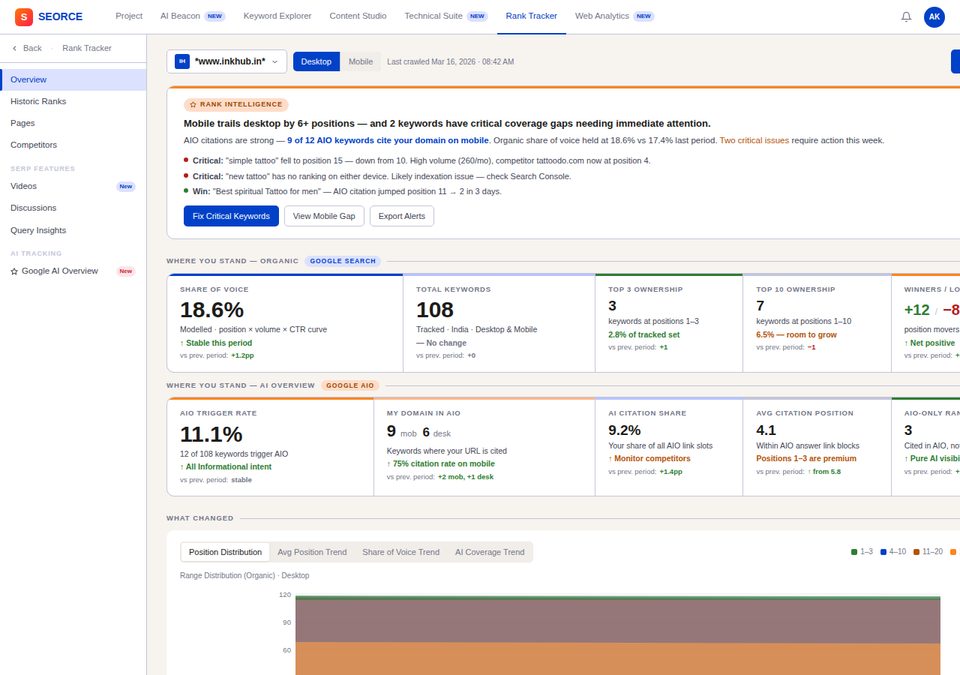
Every rank tracker shows your Google position. None of them show you that ChatGPT cites a competitor 90% of the time for the same keyword where you rank #1. That gap is real, it compounds, and it's invisible in your current tool. SEORCE shows both views, side by side, with alerts when either changes.
Ranking #1 on Google
doesn't mean AI agrees.
Buyers still use Google. They also start buying decisions in AI. A keyword where you rank #1 on Google but appear in 8% of AI responses is a vulnerability — one that's invisible in every traditional rank tracker. SEORCE shows both, side by side.
Every keyword. Google rank
and AI citation rate.
Track hundreds of keywords with both SERP position and AI citation rate shown side by side. Gaps between strong Google rankings and weak AI citations are automatically flagged.
See competitor moves in
both Google and AI.
Standard competitor tracking shows Google position changes. SEORCE also tracks when a competitor gains AI citation rates on your keywords — which often happens weeks before their Google position improves.
Know about rank drops
before they reach your traffic.
AI citation rates often move before Google positions do. When your citation rate drops on a keyword, a rank drop typically follows within 48–96 hours. SEORCE detects the early signal and alerts you while there's still time to act.
SERP tracking plus the AI layer
no other tracker has.
SEMrush and Ahrefs track
Google. SEORCE tracks everything.
Traditional rank trackers measure position data from Google and Bing. They're built for a world where discovery happens in search bars. SEORCE adds the AI layer: citation rates per keyword across ChatGPT, Gemini, Perplexity, Claude, Grok, and Google AI Overviews — in the same dashboard as your SERP positions.
Your current rank tracker
can't see half the picture.
Traditional rank trackers measure Google positions. They're good at it. What they can't do is show you what ChatGPT and Perplexity say about the same keywords — because those platforms don't have rank positions. They have citation rates.
Teams that found what their
previous tracker couldn't show them.
For teams tracking rankings in
a world that's moved beyond Google.
Everything about
Rank Tracker.
Track Google rankings
and AI citation rates. Both.
Add your keywords and see your Google positions alongside your AI citation rates in the same dashboard — immediately. Find which of your best-ranking keywords AI is ignoring, and get the specific content fix for each one.