
Getting your brand noticed by AI platforms like ChatGPT, Gemini, or Grok isn’t just a nice‑to‑have anymore. It’s becoming a core part of digital visibility.
You’re probably already tracking rankings on Google. But here’s a thought: what if your next customer asks an AI instead of searching on a browser?
That’s where most brands get stuck. Because visibility in traditional SEO and visibility in AI‑generated answers are completely different games.
Take LotusBotanicals, for example. Just a few weeks ago, their presence across AI platforms was close to zero. Fast forward 7 days, and they were showing up across 7 major AI models, including Deepseek, Claude, and even Grok.
So what changed?
Well, nothing much changed, but they used SEORCE’s AI Beacon, a real‑time tool that tracks how often your brand appears in AI answers. With this visibility data in hand, they didn’t just guess. They acted with precision.
And the results? Clear, trackable, and fast.
This guide will show you exactly how LotusBotanicals turned things around in 7 days using data, content tweaks, and some smart AI SEO thinking.
Meet the Brand and the AI Visibility Problem We Had to Solve
Before we dive into how LotusBotanicals made a smart move with AI visibility, let’s get clear about who they are and why AI visibility even matters for you.
LotusBotanicals is a modern natural skincare and beauty brand that focuses on vegan, cruelty-free products made with plant-derived ingredients and safe formulations. They believe in blending nature and science to deliver products that are gentle yet effective for everyday skincare routines. Their offerings span cleansers, serums, lotions, and targeted boosters designed for real skin concerns, all while keeping sustainability in mind.
Now, you might wonder, “This sounds like a regular brand, so what does SEO or AI visibility have to do with it?”
It is indeed a regular brand, but SEO or AI visibility definitely matter.
Let us explain without boring you.
Because the way customers discover brands has changed. It’s no longer just about ranking in Google search results. Millions of people now ask AI assistants questions like “What’s the best vegan face serum for dry skin?” or “Which natural skincare brand should I trust?” and that is where AI visibility comes in.
In today’s world, if your brand isn’t showing up in AI answers, then you’re simply not visible in the places where decisions are being made. That means missing out on discovery moments, trust signals, and the chance to be featured by AI when users ask relevant questions.
This shift is exactly why SEORCE built the AI Beacon feature. It lets you see, measure, and grow your visibility across AI platforms, not just traditional search rankings. AI Beacon is just like a radar in a world where discovery happens first in AI conversations, not blue links. It helps you track where your brand is being recommended or cited by major AI models and shows real-time data so you can act fast.
So when you read about LotusBotanicals’ visibility jump later in this article, you’ll understand it’s not just about better SEO. It’s about being present where modern discovery happens, in the answers that matter the most.
Data Snapshot: LotusBotanicals’ Visibility Score Trends
Let’s break down what actually happened when we tracked LotusBotanicals' performance inside SEORCE’s AI Beacon.
From July to October, visibility across AI platforms was completely flat. Zero. Nothing was showing up for LotusBotanicals in AI-generated answers. That meant if someone was asking Grok, ChatGPT, or Perplexity about skincare, herbal brands, or even specific ingredients that Lotus specializes in… the brand wasn’t making it into the conversation.
Let’s take a moment and see this graph
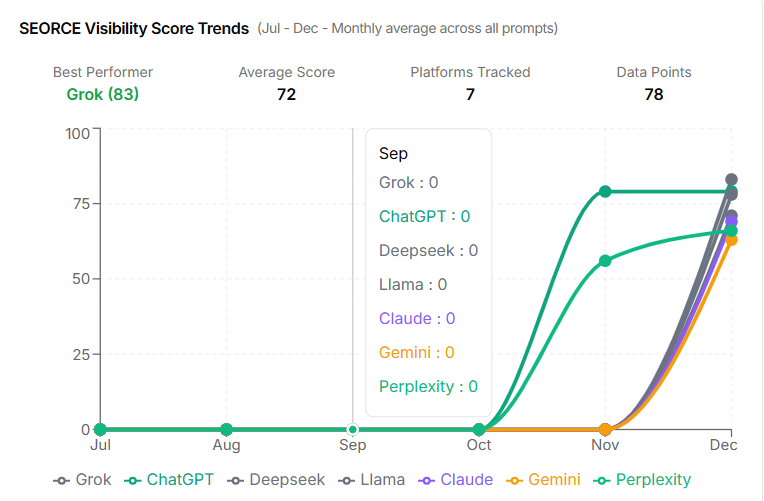
No visibility till September. But then something drastically changed.
Then Came November: The Spark
November changed the whole game.
Suddenly, LotusBotanicals started showing up in AI-generated answers.
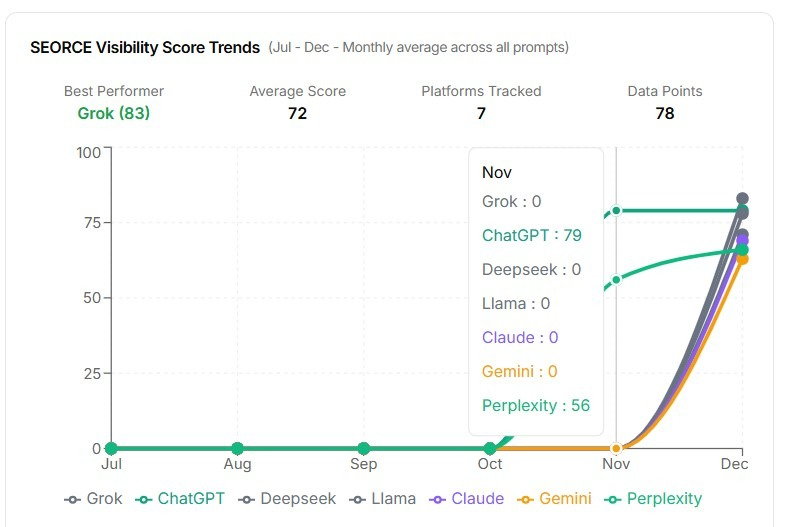
The first platform to pick up was ChatGPT, with a strong score of 79, which is well above the industry average.
At the time of writing this article, ChatGPT has over 800 million weekly active users and is projected to reach around 1 billion by the end of 2026. |
Now at the same time, Perplexity came in with a visibility score of 56, showing early traction on another emerging AI engine.
However, most other models, such as Grok, Deepseek, Gemini, Claude, and Llama, were still at zero. So the spark had started, but the fire had not spread yet.
December: Full‑Scale Visibility Boom
Fast forward a few days into December, and the AI Beacon told a very different story.
Now as you see the screenshot, all seven tracked platforms were showing visibility for LotusBotanicals:
- Grok: 83
- ChatGPT: 79
- Deepseek: 78
- Llama: 71
- Claude: 69
- Perplexity: 66
- Gemini: 63
This wasn’t a random lift. It was system-wide visibility growth.
More importantly, this shift happened in just one week. From isolated traction to full spectrum coverage across all major AI engines.
And this wasn’t just about visibility scores. It reflected real placement in LLM outputs, meaning users asking questions about skincare, herbal ingredients, or product comparisons were now getting LotusBotanicals as an answer.
And what this data proves is: With the right tracking, targeted prompts, and content refinements, your brand can make that leap in less than a week.
Why LotusBotanicals Was Missing from AI Results
When you first looked at LotusBotanicals’ visibility data, you saw something common but worrying. Almost no AI visibility at all.
As you saw in the graphs, For months, the brand was barely showing up in AI‑generated answers from major assistants like ChatGPT or Google’s AI Overviews.
You might wonder, why did that happen? The answer is simple: Visibility didn’t even exist in the first place.
You had great content, but AI models weren’t picking it up. That means when someone asked a question that LotusBotanicals should answer, AI bots weren’t using or mentioning the brand at all. That’s not just low visibility, that’s being invisible where decisions are being made.
This matters because AI visibility isn’t the same as traditional SEO visibility. In classic SEO, you can measure a rank position. But in AI‑first SEO, you need to know if AI actually surfaces your brand in the “answers”. SEORCE AI Beacon lets you see that in real time, across multiple engines. It shows you exactly how AI bots are treating your content and whether it’s being served at all.
At LotusBotanicals, the problem was twofold:
- Zero AI visibility early on: no mentions in most AI platforms. That meant AI engines didn’t see the brand as useful in answers people were asking.
- No prompt‑centric optimization or tracking: until SEORCE AI Beacon was used. Without real‑time feedback, there was no way to know what was missing or needed for AI agents to pick up the brand.
So the real issue wasn’t just low scores, it was not being part of the AI conversation at all.
Fixing that required action, insight, and a plan tied to real AI behaviour, not just hoping content gets discovered like old‑school SEO.
How SEORCE AI Beacon Powered the Turnaround
When LotusBotanicals first looked at their AI visibility, they realized something important: data alone isn’t enough unless it tells you what to do next. SEORCE AI Beacon did exactly that for them, by giving visibility scores across major AI models so they could act with confidence.
So they started with a step‑by‑step playbook that feels less like guessing and more like smart action.
Day 1: Measure the Reality
On the very first day, LotusBotanicals didn’t jump into fixes. They paused and asked themselves a simple question: Where do we really stand right now?
You can’t improve what you haven’t measured, and that is especially true when you’re dealing with AI visibility.
So they logged into SEORCE AI Beacon, which gives them real‑time visibility tracking across all major AI platforms like ChatGPT, Grok, Gemini, Claude, and more. This tool shows exactly how often and where your brand is being seen inside AI‑generated answers, not just in traditional rankings but in the answers AI assistants serve.
They looked at the visibility scores, which are like a snapshot of brand presence in AI responses.
These scores tell them not just if they appear, but how consistently they’re showing up across different AI models. That’s important because each model answers differently.
Then they took note of what was already working and what wasn’t. If a model showed high visibility, that meant they were being seen there. If it showed zero visibility, that meant the AI wasn’t mentioning them at all.
This step gave them a baseline, a clear starting point and not a guess.
Day 2: Spot Prompt Gaps
Once LotusBotanicals had measured their visibility baseline, the next logical step was to understand why they were (or weren’t) showing up in AI responses, and that meant digging into prompt-level data inside SEORCE AI Beacon.
They didn’t just want visibility numbers; they needed context.
So they opened the Prompt Performance dashboard, which shows how the brand ranks across 5 key prompt types, such as:
- Industry Authority
- Competitive Comparison
- Search-Intent Match
- Brand Understanding
- Product/Service Authority
Out of these, only a few were ranking at all, while the rest showed “Not Ranked” with 0% visibility.
As you can see the image down below, Industry authority, and competitive comparison shows some rankings.
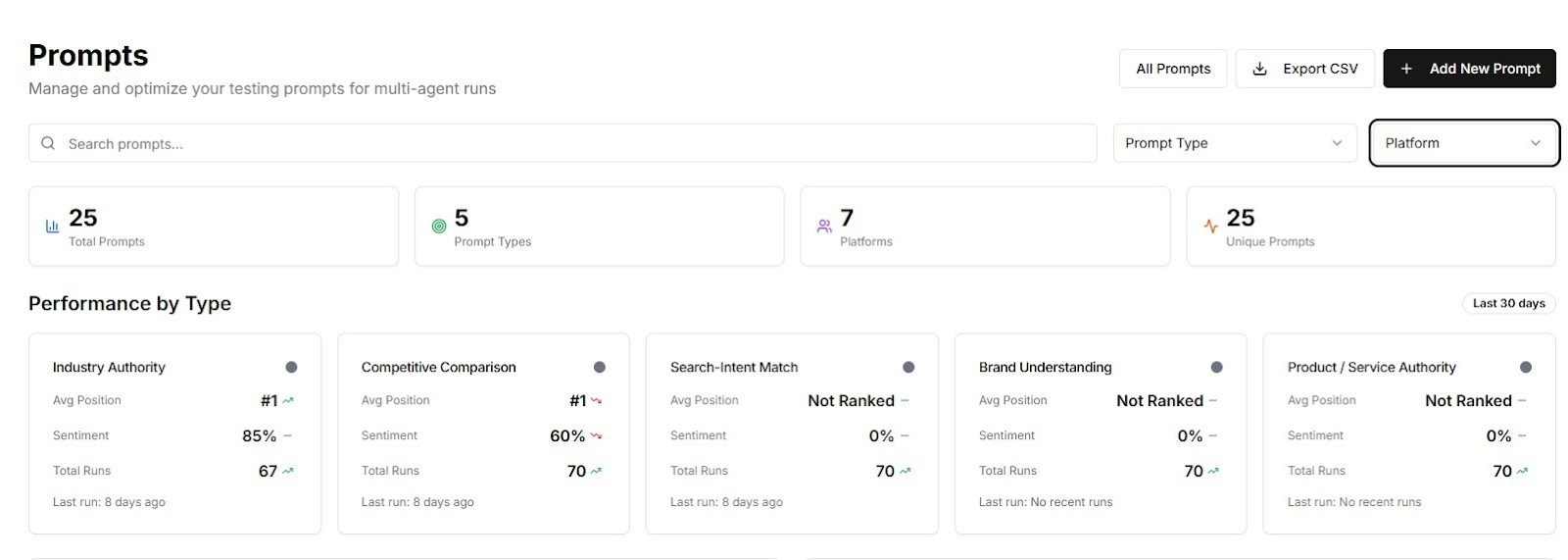
That was a red flag, but also an opportunity. It meant there was unused potential waiting to be tapped.
One standout example you can see in the image: “Are Lotus Botanicals products more trusted globally than Drunk Elephant for plant-based beauty solutions?”
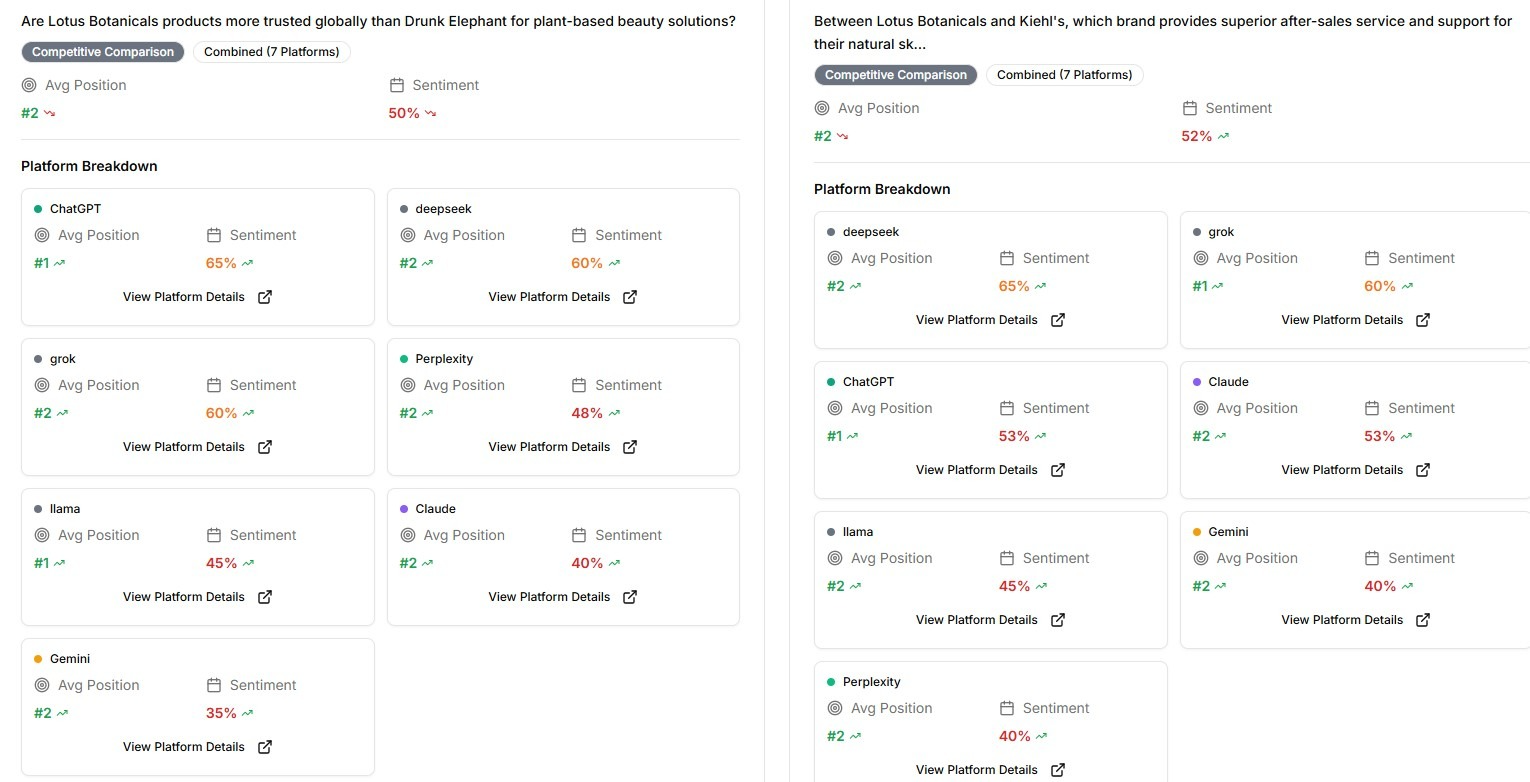
This was a competitive comparison prompt, and they ranked #1 on ChatGPT, #2 on Grok, Perplexity, Gemini, etc., with sentiment ranging from 35% to 65% across platforms. That showed strong traction, but also left room to improve.
They didn’t stop there. This was just one of many prompts that were being tracked and tested. The dashboard clearly showed which types of prompts had the most momentum, and which still needed better optimization.
By studying this breakdown, they were able to:
- Identify high-performing prompts to double down on
- Spot gaps where new content was needed
- Tailor content updates based on the exact prompt intent
This wasn't guesswork. It was visibility engineering, powered by SEORCE’s detailed AI prompt data.
From this point, LotusBotanicals could confidently move to the next stage, which was creating better, AI-friendly answers to those prompts, especially in categories where they weren’t ranking yet.
Day 3: Build AI‑Ready Answers
On Day 3, they focused on turning their content into AI‑friendly answers that any large language model could easily read, interpret, and quote.
They knew that visibility scores do not go up just by adding words. You have to make your content easy for AI to pull from, and that means clarity and structure matter first. SEORCE AI Beacon had already shown them where they needed visibility, so this day was all about making their content irresistible to AI agents.
They started by looking at each target question and asking themselves a simple thing: If an AI model asked this question, can it find a clear answer on our page right away?
If the answer was no, they changed the content so the answer stood out. They did not bury important information deep in dense paragraphs. Instead, they gave direct, concise answers up front, right where the question could trigger it.
Every answer they built had a few things in common:
- Straightforward lead lines that directly answer the prompt without fluff. This helps AI agents pick up relevance quickly.
- Short, defined sections under clear headers that map back to the question intent. These sections become easy signal points for AI to reference.
- Bullet lists or simple tables when a concept could be broken into steps or features, because AI loves structured data it can pull exactly.
They also kept their language friendly but precise, because AI models lean toward clarity when choosing what to show a user.
They did not worry about tone too much on Day 3. The priority was signal strength: can the model find and quote the answer without confusion?
By the end of the day, they had a set of AI‑ready answer blocks on key pages. These blocks were placed where SEORCE data showed visibility gaps. With those blocks in place, their content suddenly became much easier for AI systems to choose as an answer source
Day 4: Add Multi‑Signal Clarity
On Day 4, LotusBotanicals realized something simple but powerful.
It’s not just what you write, it’s how you structure it. You already used SEORCE AI Beacon to fix the visibility gaps and write answers AI can pull. Now you make those answers stand out instantly to AI models.
They asked themselves: What helps an AI recognize the best answer? The answer was clarity and structure.
So they didn’t just add more text. They reshaped their content so it became easy for AI to extract information. That means breaking down complex ideas into clean, digestible pieces.
They used things like:
- Bullets and numbered lists to separate points clearly.
- Short definition blocks right at the top of sections.
- Tables where applicable so answers can be picked up in slices.
Here's a clear example of how they restructured one of their product content blocks.
The image below shows the "Before" version as a long, dense paragraph, and the "After" version as a clean, structured layout designed specifically for AI visibility.
When you give AI neat building blocks like these, AI doesn’t have to guess where the useful info is. It can grab it instantly and surface it in answers. That’s what makes your content more likely to be included inside generative responses, not just buried in long paragraphs.
This isn’t about fluff. It’s about signal clarity. Making your key points unmissable so every platform tracked by SEORCE can pick them up easily and confidently.
Day 5: Test, Observe, Adjust
Now that LotusBotanicals had optimized content and covered key prompts, they didn’t just wait around for results.
They actively watched how those changes showed up in real world AI visibility using SEORCE AI Beacon’s live score updates and platform‑level measurements. SEORCE gives real‑time visibility data across all major AI models, so you can track how your brand appears in AI answers as it happens.
Instead of assuming everything worked perfectly, they looked at the visibility scores every day.
If a prompt didn’t move or moved more slowly than expected, they didn’t ignore it. They asked, “Is our answer clear enough for AI models?” and “Does this content deliver precise information that AI can pull directly when answering queries?”
This made their process data‑informed, not guesswork‑driven.
Then they adjusted by re‑tuning content structure, refining answer phrasing, and adding clearer context where needed.
They didn’t wait a week to see if things worked. They watched changes unfold daily, and that kept them agile.
That loop of testing changes, observing what SEORCE scores revealed, and adjusting based on real AI signals is what accelerated their visibility gains.
It turns optimization from a one‑time task into a smart feedback cycle you can repeat until you win visibility across all AI platforms.
Day 6: Expand Prompt Coverage
Once LotusBotanicals saw clear gains from their first wave of prompt optimizations, they didn’t stop there.
They thought: “Where else can we be relevant?” and turned to SEORCE AI Beacon to answer that question with data.
SEORCE doesn’t just show your visibility scores. It also highlights related prompts that are gaining traction or are highly relevant but under‑optimized.
So they looked for secondary prompts, which are questions that users ask that weren’t yet yielding visibility for their brand but were close relatives of the ones they already optimized.
This step is crucial because AI visibility isn’t one question. It is an ecosystem of intents that all point back to your brand.
They didn’t just pick random related questions. They chose ones that:
- had measurable search intent signals,
- aligned with their product and expert content,
- and showed early movement in SEORCE data.
Then they applied the same AI‑first optimization mindset:
- Answer the prompt clearly at the top of the content.
- Use a structure that AI models can easily pull from: bullets, short paragraphs, and bold key facts.
- Connect the answer to strong semantic signals that tell AI this content is authoritative.
As they optimized these secondary prompts, they kept watching the visibility scores day by day in SEORCE.
If the scores climbed, they kept that structure and then looked for the next set of prompts to optimize.
If a prompt stayed flat, they revised the answer structure or wording, always guided by what SEORCE showed about how different AI engines responded.
This expansion strategy turned a few initial wins into a broader visibility footprint across many AI‑driven queries, giving LotusBotanicals more AI presence with every step.
Day 7: Solidify Wins + Plan Next Cycle
At this point, LotusBotanicals had clear visibility gains across AI platforms, so they didn’t sit still. They checked what stuck and what could grow even more.
They opened SEORCE AI Beacon and looked at the visibility score patterns again, comparing where they started with where they are now.
Instead of just celebrating, they asked: “Which prompts are consistently gaining visibility? Which ones dipped or plateaued?”
This question guided their next moves.
They filtered their list of optimized prompts and grouped them into:
- Strong winners: prompts with steady score growth
- Moderate performers: prompts that improved but need refinement
- Underperformers: prompts still not showing traction
Then they did something simple but powerful. They documented it.
For the strong winners, they marked what structure and phrasing helped most so those patterns could be reused.
For the moderate performers, they wrote specific improvement notes. They looked at where the answer could be clearer, where the context needed tightening, and where AI models required stronger signals.
For the underperformers, they didn’t abandon them. Instead, they noted why those prompts might still matter and planned targeted next-cycle tests.
This documentation became their next cycle roadmap.
They set their priorities not by guesswork but by actual AI visibility movement, which was now clearly tracked in SEORCE.
Then they scheduled their next week of optimization like this:
- Double down on winners: replicate the structure where it worked
- Refine moderate prompts: small tweaks based on data insights
- Re-test the underperformers with fresh angles
That’s how they turned a one-time visibility boost into a repeatable growth process.
By the end of Day 7, they had not just improved visibility. They had a system to keep improving it.
Practical Tips for Other Brands
So, you’ve seen what LotusBotanicals pulled off in a week. Now let’s talk about how you can do it too.
These aren't abstract theories. They’re real, field-tested actions that helped a brand go from zero to visible across ChatGPT, Grok, Gemini, and more.
1. Use a Tool That Tracks AI Visibility in Real Time
If you're not tracking it, you’re not optimizing it.
Most brands focus on Google rankings but forget that AI models are already answering your potential customers' questions. If you’re not being mentioned there, someone else is.
Tools like SEORCE AI Beacon give you visibility scores for each platform daily. That means you can actually see whether your content is appearing in answers or being ignored.
2. Don’t Just Write for Google. Write for AI Models Too
This is key.
AI models don’t care about your keyword stuffing or H2 tricks. They want clear, structured, context-rich answers.
If your content doesn’t answer the question directly and simply, it won’t be picked up. Use short summaries, bullet points, and clean sections. This helps both LLMs and humans.
3. Think in Prompts, Not Keywords
Traditional SEO asks: What are people searching for? AI-first SEO asks: What are people asking AI?
There’s a difference.
Use prompt insights (SEORCE provides them) to see the real questions users are asking across AI engines. Then shape your content to directly match those.
Your goal is to make it easy for the model to say, “This is the perfect answer.”
4. Start With the Prompts That Move the Needle
You don’t need to update everything at once.
Look at the highest-impact prompts where you’re missing out or scoring low. These are opportunities waiting to be captured.
Tweak those pages first. Even small changes like clarifying an answer, adding a summary, or rewording a title can lift your visibility in just days.
5. Test, Watch, Adjust. Then Repeat
This is where most brands stop short. They hit publish and wait.
Instead, check your visibility trend daily (or weekly). Platforms shift. Models update. A prompt that was ranking yesterday might vanish tomorrow.
SEORCE Beacon shows you what’s working right now. Use that to refine your play. Treat this like a live scoreboard, not a post-mortem.
Final Thoughts
Reclaiming AI visibility doesn’t need to take months. Sometimes, all it takes is the right tools, the right insights, and the right 7 days. LotusBotanicals proved that when they used SEORCE AI Beacon to turn near invisibility into multi-platform traction, fast.
If you’re a brand wondering, “Why aren’t we showing up in AI answers?” you’re not alone. But instead of guessing, you need to track, tweak, and test with real-time visibility data.
The game has changed. Traditional SEO isn’t enough anymore. Now, it’s about being visible where people actually get answers: LLMs.
With SEORCE, LotusBotanicals didn’t just improve scores. They built a framework for ongoing AI dominance.
Want similar results? Start by understanding where you stand, then take action. Visibility isn’t luck. It's a data-backed strategy, and you’re only a week away from your own breakthrough.
Frequently Asked Questions (FAQs)
1. What exactly is AI visibility and why does it matter for my brand?
AI visibility shows how often your brand or content appears in answers given by large language models. Higher visibility means more brand exposure in places where users are asking questions and getting answers.
2. How does SEORCE AI Beacon help improve visibility quickly?
SEORCE AI Beacon tracks visibility scores in real time and shows where your content is showing up. With this data you can adjust content and prompts faster to improve performance across AI models.
3. Can visibility improve across all models in just 7 days?
Yes. With focused optimization of prompts and content guided by real‑time data, you can boost visibility scores across multiple AI platforms within a short timeframe.
4. What should I focus on first to boost AI visibility?
Start by tracking your current visibility, then improve your content to match common questions or prompts. Writing clear answers and optimizing for multiple AI models helps you win traction faster.
5. Does AI visibility replace traditional SEO?
No. It complements traditional SEO by helping you show up in AI tool responses. You still need good search visibility but also content structured for AI answers to maximize reach.