What Is International SEO?
International SEO helps websites show up in search results for different countries and languages. It makes sure search engines know which version of a site to show based on where someone is and what language they prefer.
Imagine an online store selling the same product but on three different pages—one in US English, another in French for France, and a third in French for Canada.
With good international SEO, shoppers in France will land on the French (France) page, Canadians will see the French (Canada) page, and US users will get the English version.
This way, people get the right content without confusion, making their experience smooth and easy.
But, how do you do a good international SEO? We will discuss it in a while, but let’s first know, do you really need to go international?
Do you Need International SEO?
Have you noticed visitors to your website from different countries? Are you considering expanding your business beyond your current borders? If so, you might be wondering: do you need international SEO?
Imagine this: your products or services have caught the attention of users worldwide. They're landing on your site, but perhaps they're not getting the experience they expect—maybe due to language barriers or content that doesn't quite resonate with their cultural context. This is where international SEO comes into play.
International SEO is about optimizing your website so search engines understand which countries and languages you're targeting. It's like setting up personalized signposts that guide users from different parts of the world to the version of your site that suits them best.
But how do you decide if you need to invest in international SEO? Consider these factors:
- Website Traffic Sources: Check your analytics. Are you getting significant traffic from countries outside your primary market?
- Global Demand for Your Offerings: Is there a demand for your products or services in other countries? Are people from different regions already reaching out or making purchases?
- Competitive Landscape: Are your competitors operating internationally? Could you gain a competitive edge by doing the same?
- Operational Capacity: Do you have the resources to support international customers, such as multilingual customer service or localized shipping options?
If you answered "yes" to these questions, implementing international SEO could be a strategic move. It involves tailoring your content to meet the cultural and linguistic preferences of different regions, ensuring that your website is accessible and relevant to a global audience.
For example, a U.S.-based clothing retailer noticed a growing number of visitors from Europe. By optimizing their site for European countries—offering content in multiple languages and adjusting sizes to local standards—they saw a significant boost in international sales.
On the other hand, if your business caters to a local market with no significant international interest, focusing on local SEO might be more appropriate.
Benefits of International SEO
Expanding your business to other countries means making sure people can find you online. International SEO helps you reach customers worldwide by improving your website’s visibility in different regions.
With the right strategy, you can connect with a global audience, boost traffic, and grow your brand across borders.
Here are a few key benefits of using international SEO.
1. Global Reach
International SEO helps your business reach people all over the world by making your website work for different languages and regions.
This way, search engines can show your content to the right audience, making it easier for people in other countries to find what you offer.
When your website matches the language and culture of different markets, more visitors can understand and use it. This boosts traffic and can lead to more sales globally.
2. Enhanced User Experience
Making your website work for an international audience means giving people content in their language and style. This means translating pages, tweaking images, and matching local preferences so visitors feel at home.
When people see content that fits their culture, they trust the site more and stick around longer.
It’s also important to keep things running smoothly by making sure pages load fast and work well on any device, no matter where someone is browsing from.
3. Competitive Advantage
A lot of businesses stick to their local markets and miss out on huge opportunities worldwide.
With an international SEO strategy, you can reach new audiences and get ahead of competitors who haven’t gone global. This boosts your visibility and helps you stand out in places where there’s less competition.
It’s a smart move that can put your brand in a stronger position.
4. Increased Revenue Potential
Expanding into international markets means more ways to make money.
With the right international SEO strategies, businesses can reach new customers and boost profits. Many companies using international SEO have seen better sales and more brand recognition.
When businesses promote their products in different countries and local languages, they attract more buyers and grow faster.
Investing in international SEO helps you reach more people and increase your revenue in a big way.
5. Brand Recognition and Trust
A solid international SEO strategy helps people across different countries find and connect with your content.
By making your site work for different languages and regions, you show respect for cultural differences, which builds trust. When people see content that feels right for them, they stick around and engage more.
This trust turns into loyal customers and better conversions, helping your business grow across the globe.
How Does International SEO Differ from General SEO?
International SEO and general SEO share the goal of improving your website's visibility on search engines.
However, international SEO takes it a step further by optimizing your site for multiple countries and languages. This means tailoring your content and strategies to resonate with diverse audiences worldwide.
On the flip side, general SEO typically focuses on a single market or language. So, if you're aiming to reach users across different regions, international SEO is the way to go.
Here's a handy table to highlight the key differences:
General SEO | International SEO | |
Target Audience | Primarily local or national users | Users across multiple countries and languages |
Keyword Strategy | Focus on keywords relevant to a specific region | Incorporates keywords in various languages and regional dialects |
Content | Uniform content in one language | Localized content tailored to cultural nuances and languages |
Domain Structure | Standard domain (e.g., .com) | May use country-specific domains (e.g., .fr for France) or subdirectories |
Technical Considerations | Basic SEO practices | Implementation of hreflang tags, geo-targeting, and local hosting |
Backlink Strategy | Acquire backlinks from local or national sites | Seek backlinks from reputable international sites |
Search Engine Preferences | Optimize primarily for dominant local search engines (e.g., Google) | Optimize for various search engines popular in target countries (e.g., Baidu in China) |
International SEO Best Practices
Taking your brand global? You need a solid International SEO strategy. It helps your website show up in search results across different countries and languages, making it easier to connect with your audience worldwide. Follow these key best practices to get it right.
1. Define Your International Markets
When you're going global with your website, how you reach your audience matters—a lot. Get this part right, and your international SEO game gets way easier.
There are two ways to go about it:
- Language targeting – You focus on the language people use in their searches, no matter where they’re from.
- Country targeting – You focus on where people are located, no matter what language they speak.
Language targeting is great if your business isn’t tied to a specific location. Let’s say you sell digital products or ship worldwide from one place. All that really matters is that people can read your website in their language.
On the other hand, country targeting works best when location matters. Maybe you run a chain of coffee shops, and customers need to find their nearest one. Or maybe different countries have different rules, like how Germany requires certain labels on food packaging.
Some businesses need both. If you run a company in a multilingual country like Switzerland, it makes sense to target both location and language. That way, your French-speaking customers in Geneva and German-speaking customers in Zurich both get the right experience.
2. Conduct Localized Keyword Research
You can’t just translate your current keywords and hope for the best. People search differently in different countries—even when they speak the same language. Think about it: someone in the UK might search for “trainers,” while in the US, it’s “sneakers.” That small difference can impact your visibility.
So instead of translating keywords, you need to localize them. Localization means understanding how people actually search in that country—the slang, the cultural context, and even the spelling. This is where tools come in handy.
One we recommend is the Jaggery Consulting Keyword Explorer Tool. It helps you dig into search trends, find real local terms, and even spot what your competitors are ranking for.

So how do you approach it? Start by picking one region or language. Don’t try to tackle the entire globe at once. Next, do your keyword research from scratch, as if you were launching a brand-new website in that country. Use local search engines if needed, check autofill suggestions, and look at what’s trending. Pay attention to:
- Local language variations and idioms
- Region-specific spelling or terminology
- Search volume in the local market
- Buyer intent behind the keywords
- Competitor keywords in that region
Say you’re targeting Spain and Mexico—they both speak Spanish, but search behaviors can differ. “Computadora” might trend in Mexico, while “ordenador” is common in Spain. That’s why you need localized research, not guesswork. Do this right, and you’re not just reaching people—you’re speaking their language. Literally.
3. Choose the Appropriate URL Structure
While setting up your website for international audiences, another big decision you'll face is how to structure your URLs.
Why does this matter?
Because search engines—and users—need clear signals about which version of your site is meant for which country or language. You’ve got a few options, and each sends a slightly different message. Think of it like choosing how to organize your house: separate buildings, rooms, or just different shelves.
Your main choices are ccTLDs like domains (example.fr), subdomains (fr.example.com), and subdirectories (example.com/fr).
ccTLDs for international SEO:

Subfolders for international SEO:

Subdomains for international SEO:

Each one affects how search engines interpret your site’s geo-targeting and how much SEO power gets shared across regions.
So how do you pick the right one? If you’re all-in on a specific country and have the resources, ccTLDs are great—they scream “local,” and users trust them. But they’re harder to manage and expensive.
Subdomains are easier to organize but don’t always inherit SEO strength from your main site. Subdirectories are simple, cost-effective, and great for keeping all your content under one domain authority—but they rely heavily on proper tagging and setup. It really comes down to how many markets you're targeting, your budget, and how much control you want.
The goal is clarity—for both search engines and your visitors. Pick a structure that balances simplicity with scalability, and you’re off to a good start.
4. Implement Hreflang Tags Correctly
When you're targeting people in different countries or languages, it's easy to run into a common problem—Google might not know which version of your page to show to which audience. That’s where hreflang tags come in. Think of them like little notes you leave for search engines, saying, “Hey, this page is for English speakers in the US,” or, “This one’s for Spanish speakers in Mexico.” Without them, Google could show the wrong version to the wrong users, which isn't great for anyone’s experience.
So how do you decide if you even need them? Ask yourself: do you have content in more than one language, or are you targeting users in different countries with similar content? If the answer is yes, then you should absolutely use hreflang tags. They help search engines serve the right version to the right person, which means better rankings, lower bounce rates, and happier users.
Now, using them isn't as hard as it sounds, but you do have to be precise. The tags go in the <head> of your HTML, or in your XML sitemap. They include the language code (like en for English or fr for French) and sometimes a country code too (en-us for US English or fr-ca for French in Canada). It’s all about being specific. Also, each version of the page has to reference all the others—and itself. That’s important. If page A links to B, B has to link back to A. That way, Google sees a complete, connected picture.
Here’s a simple example: If you have a page in English for the US and another in Spanish for Mexico, you’d add these tags to both pages:

And you'd include both lines on each page.
What you want to avoid is guessing or skipping this step altogether. Mistakes like missing tags, wrong codes, or forgetting reciprocal links can confuse search engines. So it’s worth double-checking. If you’re using a CMS like WordPress, there are plugins that can help you manage it all without messing with code.
In the end, hreflang tags aren’t just for SEO nerds—they’re your shortcut to better international visibility. Use them right, and you’re giving your users exactly what they’re looking for, in the language and region they prefer. That’s a win-win.
5. Localize Your Content
Let’s say you’ve translated your website into Spanish. Great start—but is it really ready for your audience in Mexico or Spain? That’s where localization comes in. It’s not just about changing words from one language to another. It’s about making sure your content feels natural, relevant, and trustworthy to the people reading it. Think of it this way: if you landed on a site that clearly wasn’t written with you in mind—maybe the slang is off, the images don’t make sense, or even the currency is wrong—how long would you stay?
When you localize, you adapt more than just the language. You adjust tone, images, references, even the structure of your sentences to match cultural expectations. This matters because people connect more easily with brands that “get” them.
So instead of just using an automatic translation tool, you decide who your audience is and how they speak. Are you writing for a formal culture, like Japan? Or a more casual one, like Brazil? That decision shapes everything: the words you choose, the jokes you make (or don’t), and even how you present your offers.
Say you’re selling shoes. In the US, you might say “Free shipping on all orders.” But in Germany, customers care more about trust and quality, so maybe it becomes, “Reliable delivery and top-quality craftsmanship.”
See the difference? You’re not changing the product—you’re changing how you talk about it to match what people value. That’s the heart of localization. It’s thoughtful, it’s strategic, and if you get it right, it can seriously boost how well your site performs in global markets.
6. Use One Language Per Page
When setting up your international website, getting the URL structure right and doing solid multi-region keyword research will help you create a localized content plan for each market.
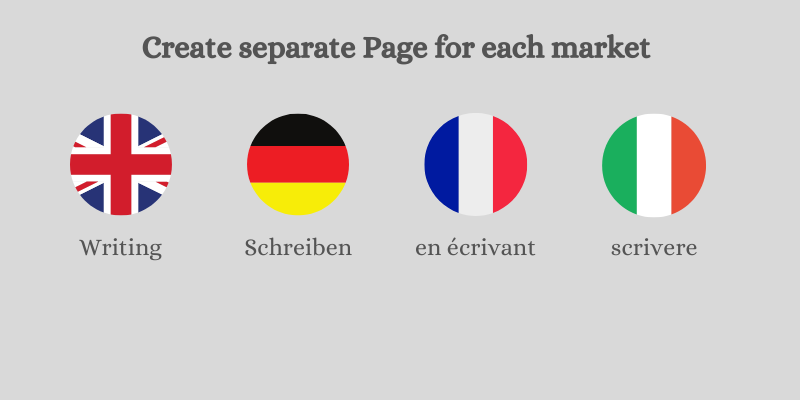
Stick to one language per page—no mixing! If you want your content in multiple languages, create a separate page for each one. That way, everything stays clean and easy to navigate.
And don’t just stop at the text. Anything that can be localized should be. That includes images, currencies, time zones, phone numbers (if possible), and even office addresses.
One big mistake? Auto-translating content on the same URL. Google isn’t a fan. It’s much better to have dedicated URLs for each version so search engines can properly find and index everything.
If you're really diving into international SEO, consider making country-specific versions of your pages too—not just different languages. This helps you fine-tune your content for each audience and makes your site even more effective.
Let’s say you’re targeting Switzerland—you’d need a version in German, French, and Italian, since those are the main languages spoken there.

All these little details matter. They make things better for users, and Google notices too. At the end of the day, Google’s job is to serve up the most relevant results, and well-localized pages have a much better shot at ranking where they should.
7. Keep Links in the Same Language for a Better User Experience
When you're building a multilingual site, one small detail that makes a big difference is your internal linking. Think about it—someone lands on your French page, starts reading, and then clicks a link... only to end up on the English version. Confusing, right? That moment of disconnect breaks the user experience and makes your content feel disjointed. So here's the deal: your internal links should always stay within the same language.
Why? Because your visitors expect consistency. If they’re reading in Spanish, they want to stay in Spanish. You don’t want them bouncing around trying to figure out where they landed. Plus, search engines prefer this setup too. It helps them crawl and understand your site structure more accurately for each language. When your internal links are consistent, it sends a clear signal about how your content is organized by language, making indexing smoother.
Now, how do you manage this? First, make sure each language version of a page has its own set of internal links pointing only to other pages in that same language. No mixing. You can do this manually or automate it with a content management system that supports multilingual setups. For example, if someone’s on example.com/de/produkte, every link on that page should lead to other pages starting with /de/.

This might sound like a small tweak, but it’s a smart move that makes your site more user-friendly and SEO-friendly. It's all about keeping your content journey smooth, logical, and local to the user.
8. Optimize for Local Search Engines
When you're expanding into international markets, it's easy to assume Google is the only search engine that matters. After all, it dominates most of the world, right? Well, not everywhere. In some countries, people prefer local search engines that work differently—and if you’re not paying attention to that, you're leaving traffic on the table.
So how do you decide if this even applies to you? Start by looking at where your audience is. If you're targeting China, you’re dealing with Baidu. In Russia? That’s Yandex. South Korea? Naver. Each of these has its own set of rules, ranking factors, and user expectations. Google might care deeply about backlinks and mobile-friendliness.
Baidu, on the other hand, is big on meta tags and prefers simplified Chinese hosted on servers inside China. Yandex puts extra weight on behavioral factors like time on site and click-through rates.
Now, does this mean you need to become an expert in every search engine? Not really. But if you're serious about a market, it's worth doing some research—or even hiring local SEO help. Tailor your strategy. What works on Google might not move the needle on Naver. Use local tools, follow local guidelines, and speak the language—both literally and in terms of SEO.
Ultimately, international SEO isn’t just about translation. It’s about adaptation. And sometimes, that means stepping outside the Google bubble.
9. Build Local Backlinks
So, let’s say you’ve got your international pages set up—localized, translated, and technically solid. That’s awesome, but here’s the thing: search engines still need signals that your site matters in that specific region. One of the strongest signals? Backlinks. But not just any backlinks—you need local ones.
But why does this matter so much?
When other websites from the country or region you’re targeting link to your content, it tells search engines, “Hey, this site is relevant and trusted around here.” Think of it like social proof. If you’re in Japan and a bunch of Japanese blogs and news sites are pointing to your page, Google starts seeing you as part of that local ecosystem.
Now, how do you actually get those local backlinks? Start with connections. Do you have local partners, vendors, or even customers you can collaborate with? Guest posting on local blogs, joining community forums, or sponsoring regional events online are great ways to begin. If there are business directories or niche industry lists in that country, get your site added. They don’t just build backlinks—they build visibility.
And don’t overlook digital PR. Pitch stories to local journalists. Maybe you’re launching a new product tailored to that market—share that angle. Real, region-specific news has a much better chance of getting picked up and linked to.
Here’s the decision framework: ask yourself, “Would someone in this country care about this content enough to share it?” If the answer’s no, rethink the approach. If it’s yes, go after the link.
Building local backlinks takes time. But it’s one of the clearest ways to show both people and search engines that you’re not just visiting the region—you belong there.
9. Avoid Automatic Redirection Based on IP
Redirecting users automatically based on their IP address might seem like a smart move. After all, if someone’s in France, wouldn’t they want the French version of your site? Maybe. But maybe not. And that’s where things get tricky.
Here’s the issue: automatic redirection based on IP can actually do more harm than good—for both your users and your SEO. Google specifically advises against this practice. Why? Because these redirections can stop users—and Googlebot—from accessing other versions of your site. Imagine someone in Germany who prefers browsing in English. If you force them onto the German version just because of their IP, you're creating friction where it doesn't need to be. Worse, search engines might not even see your other localized content at all.
Google’s own documentation puts it bluntly: “Don’t use IP analysis to adapt your content.” And they give two solid reasons.
- First, IP-based detection is unreliable. It’s not always accurate—users might be traveling, using VPNs, or simply misidentified.
- Second, it messes with how Google crawls your site. Most of Google’s crawls come from the U.S., and they don’t try to fake different locations.
So if you’re automatically redirecting based on IP, Google might never see your French or Spanish versions, and that kills your chances of ranking those pages.
So what’s a better approach? Let users decide. Add a clear language or country selector on your site just like Nokia website does.

So basically, let visitors pick where they want to go. It’s a small change that keeps your site SEO-friendly and user-focused. Your content stays visible to everyone—including search engines—and your visitors get to choose what works best for them. Simple, respectful, and way more effective.
10. Utilize a Content Delivery Network (CDN)
Let’s say your website is hosted in New York, but you’re trying to reach users in Tokyo, Paris, and Sydney. What happens when someone in Australia clicks on your site? Their request has to travel halfway around the world to reach your server—and then come all the way back with your content. That takes time. And on the internet, even a second of delay can make people bounce.
That’s where a CDN—or Content Delivery Network—comes in. It’s a network of servers spread out across the globe. Instead of serving your content from one single location, a CDN stores copies of your site on multiple servers in different countries. So when someone visits your site from Japan, they’re pulling data from a nearby server, not one in the U.S. The result? Faster load times, smoother browsing, and a better experience for your visitors.
So how do you decide if you need one? Think about where your traffic is coming from. If you're getting international visitors and you want them to stick around, a CDN is a smart move. It also helps your SEO. Google looks at site speed as a ranking factor, and delivering content quickly from local servers gives you an edge in search results across different regions.
Cloudflare, Akamai, and Fastly are popular CDN providers. Many of them are easy to set up—even if you're not super technical. Some web hosts already include CDN services in their plans, so you might already have access without realizing it.
Get Your Global SEO Strategy Working Today
International SEO can feel overwhelming, but it doesn’t have to be. Once you understand the basics—like targeting the right regions, using hreflang correctly, and building clean, crawlable URLs—you’re already ahead of the game. So how do you move forward? Start by choosing a structure that matches your goals, then localize your content with care. Still unsure if it’s working? That’s where smart tracking comes in. Use Jaggery Consulting to track, analyze, and improve your website’s performance with our SEO tool. It shows you what’s working, what’s not, and how to fix it. Because when your technical setup is right, everything else clicks into place—and your global audience can actually find you.