Every few months, it feels like the AI world gets flipped on its head. One week you're getting used to a new model, and the next, there's a game-changing update that redefines what's possible.
Remember when transformers entered the scene? Or when multimodal models started generating both text and images with astonishing accuracy? These breakthroughs didn’t just appear out of nowhere.
If you look closely, you can see that the signs were already showing up in research papers, funding trends, product shifts, and even online chatter.
So here's the thing: what if you could spot those signals early?
What if you could read the trendlines and start preparing for the next AI wave before it hits? You don't need to be a data scientist or a tech insider to do it. Yes… in fact, you just need to know where to look and what to look for.
That’s exactly what this guide is here to help with.
You’ll learn how to use trend data across academic insights and business signals to better understand what’s coming next in AI. This will help you stay prepared and one step ahead.
What “Trend Data” Means in the AI Context
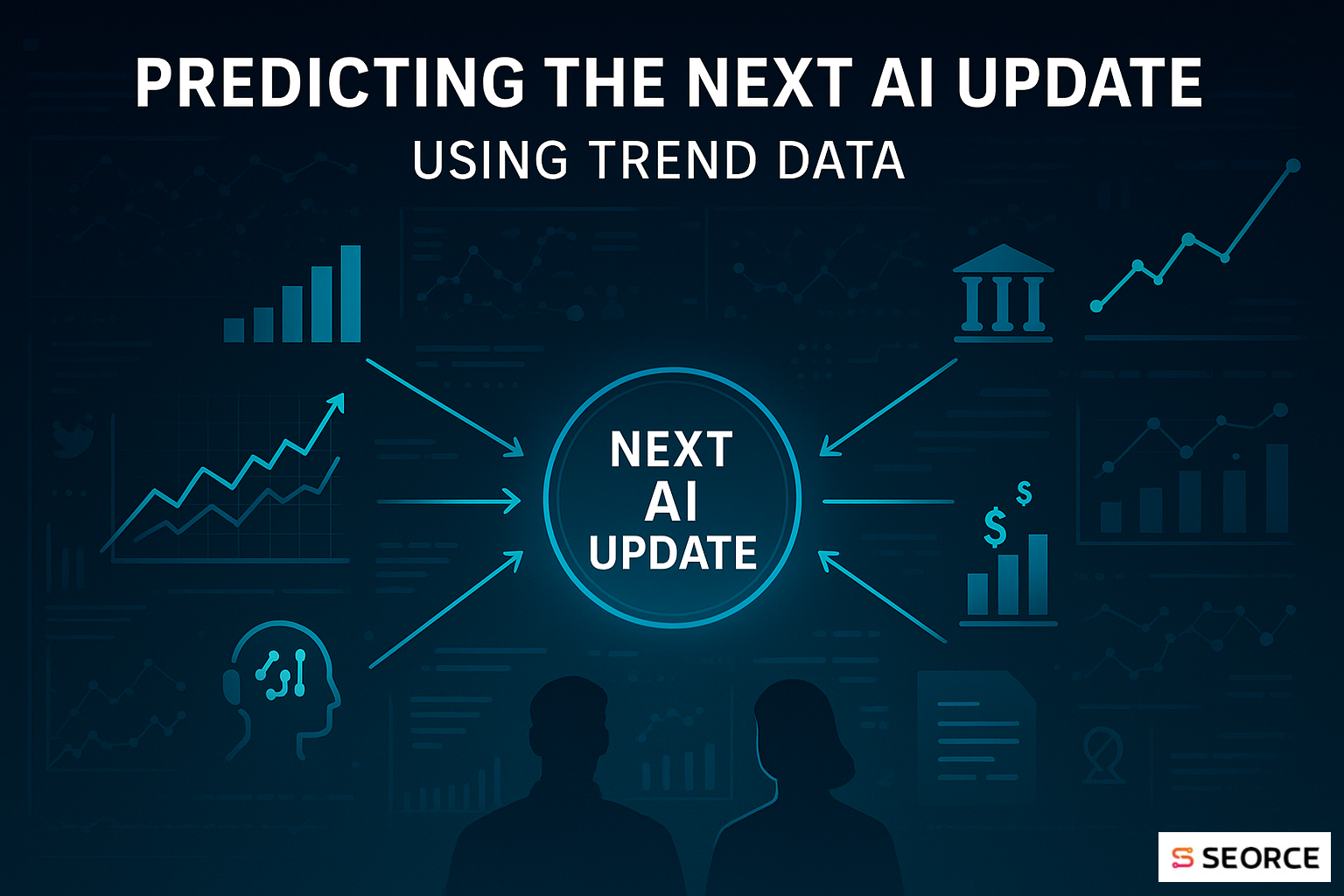
Trend data, in the context of AI, refers to the collective signals that show where the field is headed. These signals can come from research papers, patent filings, product launches, funding patterns, user behavior, and even social media chatter.
Essentially, trend data helps you spot patterns before they become obvious.
Think of it as your early radar. If you're trying to predict the next big AI shift, trend data gives you a glimpse into the building blocks of that future before it’s fully built.
Let’s break that down.
When we talk about “trends,” we’re not just talking about hype cycles or viral news. We're talking about measurable momentum. That could be a spike in research about a specific model architecture, a wave of investment in generative agents, or a sudden rise in GitHub commits on a new AI framework.
Now, not all trend data is created equal. There are several types, and each tells a different part of the story:
- Research Trend Data: This includes published papers, citations, conference topics, and preprints. If researchers across the world suddenly start publishing on “multimodal AI safety,” that’s a signal.
- Patent and Innovation Trend Data: Who's filing for AI-related patents? In what areas? Tracking this helps you understand where corporations are putting their R&D money.
- Market and Adoption Data: If companies across sectors are rapidly adopting AI for supply chain, customer service, or finance, it shows where commercial value is emerging.
- Social and Sentiment Data: What are developers, influencers, or tech media talking about? Sentiment data can often preempt formal industry moves.
- Regulatory and Geopolitical Data: New AI laws, export bans on chips, or public policy debates might not seem technical, but they shape what kind of AI gets built next.
All of this trend data doesn’t work in isolation. It’s the combination and the timing that matter. One patent won’t move the needle, but 50 patents in a new subfield in the span of 3 months? That’s worth watching.
The beauty of trend data is that it’s real-time and continuous. You don’t have to wait for a press release or a keynote. You can tap into trend signals as they’re unfolding, and if you're paying attention, you’ll stay one step ahead of the mainstream.
In short, trend data helps you stop reacting to AI changes and start predicting them.
How AI (and Related Tools) Enable Trend Analysis & Forecasting in AI Itself
AI and related tools make trend forecasting in AI faster, smarter, and more accurate by analyzing huge volumes of data, identifying hidden patterns, and generating predictions that humans might miss.
Rather than relying on gut feeling or waiting for an update to happen, you can now use AI to spot where momentum is building. This could be in research, patents, product launches, or even public opinion.
Let’s break down how this actually works, step by step:
Step 1: Collecting the Right Signals
You start by gathering diverse data sources. This includes research publication metadata, investment flows into AI startups, patent filings, press releases, social media buzz, and even regulatory developments.
Each of these feeds tells a different story. For instance, research data shows what's possible, while funding and product data show what's being built. Combine them, and you begin to see what's coming.
Step 2: Preprocessing and Normalization
Before you can do anything useful, AI tools clean and organize the data.
Why is this step crucial? Because trend data is messy by default. It comes in different formats, languages, time zones, and naming conventions.
You need this prep to make everything comparable so your algorithms don’t confuse “LLM,” “Large Language Model,” and “Transformer” as three separate trends.
Step 3: Detecting Patterns Using AI Models
Now comes the exciting part: extracting insights.
AI uses techniques like topic modeling, natural language processing, and time-series analysis to detect rising or declining interest in specific topics.
For example, if you feed in thousands of abstracts from recent AI conferences, you can surface which terms are gaining traction. Maybe “agentic workflows” or “multi-modal alignment” is popping up everywhere this year.
This helps you spot early signals before they go mainstream.
Step 4: Forecasting the Future
Once you see the patterns, AI can project them forward. Using models like ARIMA, LSTM, or ensemble predictors, you can forecast which themes are likely to accelerate and which may plateau.
You might learn, for instance, that research into “AI for scientific discovery” is not only trending upward but also receiving increased funding and media coverage. That’s a strong bet for the next wave of innovation.
Step 5: Real-Time Monitoring & Refinement
The best part is that this isn’t a one-time analysis.
You can continuously feed new data into your forecasting pipeline and watch for inflection points, breakouts, or saturation signals.
This allows you to adjust your predictions as reality unfolds, which is essential in a field as fast moving as AI.
So, Why Use AI to Forecast AI?
Because no human team can keep up with the volume, speed, and complexity of signals coming from across academia, industry, and society.
AI helps you see patterns earlier, cut through uncertainty, and make better decisions. Whether you're a researcher, policymaker, or business leader, that kind of foresight gives you a real advantage.
If you're serious about staying ahead of the curve, trend-driven forecasting is no longer optional. It's the edge.
Key Indicators & Signals to Monitor for Predicting “Next Big AI Update”
If you're trying to spot the next major AI breakthrough before it goes mainstream, here are the five big areas you should be tracking. These are the signals that give you a head start.
1. Research & Academic Signals
The most direct signal that a major AI update might be on the horizon is when you see a sharp rise in research activity around a specific concept or technique.
Academic research is often where innovation starts. When large volumes of papers suddenly focus on the same sub-topic, such as a new architecture, method, or application, it’s a strong clue that the AI community is betting on something big.
But it's not just about more papers. It's about what those papers are exploring and how fast their influence spreads.
You’ll want to look for papers that:
- Introduce new frameworks or training methods
- Get cited quickly by other researchers
- Trigger follow-up work from top labs or institutions
- Show up across multiple research conferences at once
If you’re seeing that kind of buzz, the field is likely moving fast, and so should you.
It also helps to track emerging research themes. For instance, topic modeling tools can reveal which ideas are gaining momentum even if you don’t read every paper. These hidden patterns often point to what’s next before it hits the mainstream.
Academic signals are important because they tell you what’s technically becoming possible.
And in AI, what becomes possible tends to become real faster than you'd expect.
So if you're serious about staying ahead, don’t wait for blog posts or product updates. Start watching research trends now.
2. Patents & Industrial Innovation
If you want to predict where AI is headed next, track the patents.
They are one of the clearest signals that an idea has moved beyond theory and is now being built for real-world use. When companies start filing patents around a specific technique, model, or application, it means they see commercial value and they are moving fast to protect it.
These filings often come before products launch or news gets out, so they give you an early window into what the industry is seriously investing in. Unlike research papers that explore what is possible, patents usually reflect what is viable and ready for deployment.
Now, not all patents are equal. You want to focus on clusters because when there is a sudden increase in filings related to one area, such as "model optimization for edge devices" or "AI for logistics workflows," it tells you where engineering attention is going.
You can also spot innovation hotspots by looking at who is filing:
- Are the big AI labs filing more in a particular architecture?
- Are chipmakers patenting new designs for model acceleration?
- Are startups securing patents before funding rounds?
These details often show where the next breakout might come from.
In addition to patents, follow industrial investments and partnerships. If major companies start pouring money into a subfield or acquiring niche startups, it is not random because it is strategic.
These moves reflect where real development is happening, not just theoretical excitement.
Also, industrial innovation does not stop at patents or partnerships. Watch for signals like internal tool releases, developer APIs, or company blogs that showcase new use cases. Even job postings can hint at what is being built next.
So if you are serious about forecasting AI’s future, do not just follow the buzz.
Follow the filings, track the capital, and map where the industry is actually building. That is where the next big update is already in motion, quietly but deliberately.
3. Business Adoption & Market Activity
If you want to spot the next AI update before it goes mainstream, pay attention to where businesses are actively deploying AI instead of just experimenting.
When companies start embedding AI into real workflows such as decision-making, customer service, and forecasting, that is a strong signal the tech is maturing. This often happens before the general public even notices.
Adoption patterns tell you which AI tools are ready for scale.
For example, if you notice a rise in AI-powered productivity platforms or decision-support systems across industries, that is not just hype. That is market movement.
Pay close attention to:
- Sudden jumps in enterprise AI integrations
- Startups offering domain-specific AI solutions
- Vendors bundling AI into core products such as SaaS tools
These are not isolated moves. They point to broader commercial readiness.
Also, when companies shift from pilots to full deployments, or when mid-size firms start using AI that was previously limited to big tech, it is a sign of wide adoption.
This behavior often precedes a platform-level AI update or a new category of AI use cases.
In short, business behavior is a leading indicator.
When money, usage, and operations align around a type of AI, an update is likely just around the corner.
4. Social Sentiment & Public Discourse
Social sentiment is one of the earliest and most powerful signals of where AI might go next.
When people start talking a lot (whether positively or critically) about a specific AI topic, it usually means interest, pressure, or disruption is brewing.
That buzz can shape regulations, influence investments, and even accelerate or stall development.
So, if you're trying to anticipate the next AI shift, you need to track what the public, media, and policy-makers are saying right now.
Public discourse gives you a real-time look at how society is reacting to AI, and those reactions often ripple back into the industry.
For example, if conversations around AI safety or job automation suddenly spike, regulators may respond with new guidelines. In turn, companies might pivot their roadmaps or prioritize more ethical, explainable systems.
You can monitor this using simple tools like trend analysis dashboards, social media analytics, Google Trends, or even just consistent news tracking.
The key is not just to look at volume but also the tone and context:
- Is the mood optimistic or fearful?
- Are specific use-cases being praised or criticized?
- Is public trust increasing or declining?
But, why does this matter?
Because AI doesn’t evolve in a lab alone. It evolves in the real world, where perception often drives funding, adoption, and legislation.
And if you're ahead of the curve on public sentiment, you’ll be ahead of most product teams, policy experts, and even VCs.
In short, watching what people are saying is just as important as watching what researchers are publishing.
It gives you the cultural and political context that often predicts how fast and in what direction AI will actually move.
5. Infrastructure & Ecosystem Growth
AI updates don’t just happen because of smarter algorithms, they happen when the infrastructure is ready to support them.
This means that before any big breakthrough reaches you, there is usually quiet progress happening behind the scenes in areas like hardware, compute power, data availability and deployment tools. If you’re tracking these correctly, you can often predict what kind of AI update is around the corner.
Let’s break this down.
Hardware & Compute Resources:
The models we see today, whether they generate text, images, or code, need massive compute.
So when you notice a jump in AI-optimized chips (like GPUs, TPUs, or custom inference hardware) or new cloud AI infrastructure offerings, that’s not just technical.
It usually means bigger, faster models are being made possible.
Even slight improvements in energy efficiency or model serving speed can unlock real-time applications that weren’t practical before.
Data Ecosystems:
Next, you want to keep an eye on data pipelines.
Every major AI leap has required not just more data but better data. So when there's growth in public datasets, industry-specific data-sharing platforms, or synthetic data tools, that’s a signal.
It tells you that models will soon be trained in more specific domains like healthcare, legal, retail, sustainability, and more.
The moment high-quality domain data becomes accessible, new, targeted AI capabilities tend to follow quickly.
Toolchains, Frameworks & Deployment Stack:
Also, look at what’s happening with model deployment tools.
If there’s new momentum in platforms that simplify model training, testing, and deployment (think low-code AI platforms, model monitoring tools, or MLOps stacks), then adoption will accelerate.
Why? Because companies can now roll out AI faster, and that encourages more investment, more experimentation, and more frequent updates.
Frictionless deployment means faster iteration.
Cross-Disciplinary Integration:
Finally, AI evolves faster when it plugs into other ecosystems, not just tech.
So if AI tools are being embedded into areas like supply chain, climate models, or bioinformatics, it shows the ecosystem is expanding in new directions.
When infrastructure grows horizontally (across industries) and vertically (in depth of tooling), the number and type of AI updates increase.
That’s how you spot what sectors are going to experience AI transformation next.
A Framework for Forecasting the Next AI Update (Step-by-Step Guide)
So now that you know what signals to look for, the next question is: How do you actually use them to predict what’s coming next in AI?
Here’s a simple, actionable framework you can follow. Whether you’re a strategist, researcher, or just deeply curious, this can help you build your own AI radar system.
Step 1: Define What You’re Trying to Predict
If you want to predict the next big AI update, the first thing you need to do is define exactly what you're trying to forecast.
Why? Because “AI update” is a huge umbrella. It could mean anything from a new model architecture to a shift in user behavior to a regulation that changes how AI is deployed.
Without clarity, you’ll end up chasing scattered data and getting overwhelmed with irrelevant signals.
Start by asking yourself: What kind of update am I tracking?
- Is it technical (like breakthroughs in model performance)?
- Product-level (like new AI features in productivity apps)?
- Market-based (like adoption of AI in a specific industry)?
- Or regulatory (like government interventions or new compliance norms)?
Once you know the category, narrow it further.
For example, instead of “AI in healthcare,” try “rise of AI-assisted diagnostics in outpatient settings.” That tighter scope tells you which trends, data points, and indicators actually matter to you.
This is also the moment to set your time horizon. Are you trying to anticipate changes in the next quarter, next year, or next 3 to 5 years?
That time frame will influence the type of signals you need to track. Short-term changes show up in product releases and market chatter. Longer-term shifts often start as quiet research trends or early investments.
Step 2: Gather Diverse Data Sources
Alright, now that you know what kind of AI update you’re trying to predict, it’s time to dig into the right data. You need a mix of sources to see the full picture.
Why? Because AI doesn’t evolve in just one place. Research, business, public opinion, and policy all play a part, and each leaves behind its own trail of signals.
So what should you gather?
Start with research papers. These show you where academic energy is going. Then look at patents and innovation datasets. They hint at what companies are trying to protect or build.
Next, pull in data on funding rounds and startup launches. Money talks, and it often talks before the tech hits the mainstream. Also keep an eye on product releases from big tech. Those usually reflect serious investment and long-term bets.
Don’t forget news trends and social chatter. They reveal what people are paying attention to, which can shape both demand and regulation. And yes, even government policy updates matter. Laws can either fuel or freeze AI progress.
The goal is simple: pull from multiple angles so you don’t miss what’s coming just because you were watching one stream.
Step 3: Use Analytics to Detect Patterns
The core idea here is simple: you take the trend data you've collected, and now you analyze it to find signals. That means you're looking for patterns, changes, or spikes that tell you something important is brewing in AI.
You're not guessing or relying on gut feeling. Instead, you're using tools to make sense of the noise and spot early movements that could evolve into major updates.
Let’s break that down.
First, you want to organize and clean your data. If you have pulled academic papers, product announcements, patents, or news articles, they are probably in different formats. You need to bring them into one place such as a dashboard, spreadsheet, or analytics tool where you can actually work with them.
Once everything is gathered, the next move is to spot trends over time.
Look for how often something is showing up. Is there a steady rise in research on a certain model type? Did startup funding in a niche spike this quarter? If yes, that is not random. That is momentum.
Now, use simple tools to dig deeper:
- Topic modeling helps you see which themes are becoming more common in research or articles
- Time-series analysis shows when a trend started and how fast it is growing
- Anomaly detection highlights sudden jumps in mentions or interest that do not match past patterns
- NLP (natural language processing) helps you understand what people are saying and whether the tone is excited, concerned, or uncertain
You do not need to be a data scientist to use these. Many tools today let you run these analyses with no code or very little setup.
The goal here is not to confirm what you already believe. It is to let the data reveal something you did not expect. Maybe a quiet research topic is suddenly taking off, or a slow but steady rise in product launches is pointing to a new direction.
Once you spot those patterns, you can decide which ones are worth tracking further and which ones are probably noise.
So this step is all about turning scattered information into directional insight. It is what helps you move from simply watching the AI space to actually understanding where it might go next.
Step 4: Define Key Indicators and Thresholds
Define Key Indicators and Thresholds is about turning vague signals into clear, measurable triggers so you know exactly when a trend is worth paying attention to.
The key point is, data by itself isn’t helpful unless you define what change is significant. That’s where indicators and thresholds come in. You choose specific signals to monitor (indicators), and then set a point where those signals mean action (thresholds).
Let’s say you're watching AI research activity. You don’t just stare at the number of papers, you define what counts as momentum. For example, a 25% rise in papers about agent-based models over 6 months could be your threshold. If that happens, it’s your cue: something important is shifting.
Now, not every trend needs the same kind of indicator. Since we already touched on examples of indicators earlier, we won’t go too deep here. Just remember, what you track depends on what you’re trying to forecast.
You might focus on:
- Research activity (like volume of new publications or citations)
- Funding patterns (amount or frequency of investment in a topic)
- Tech adoption (number of products using a new technique)
- Mentions in industry blogs or developer forums
Once you've picked a few solid indicators, you need to decide: at what point does this signal mean “pay attention”? That’s your threshold. It tells you when it's time to look deeper or take action.
Thresholds also help you filter out noise. Not every spike or headline matters. But if something crosses your pre-defined line, like three major companies hiring for the same emerging AI role, then you've got a pattern, not a coincidence.
In short, indicators are what you track. Thresholds are when you act. Together, they turn messy data into decisions. Keep them flexible, tweak them as trends evolve, and don’t overcomplicate them. Simple rules you actually use are better than perfect ones you never check.
Step 5: Watch the Bigger Ecosystem
Even if a new AI trend looks promising, it won’t go anywhere unless the larger ecosystem is ready for it. You might see a rise in research papers or prototype demos, but if the world around that idea isn’t supporting it, it will likely stall.
So instead of only tracking what’s new, you also need to ask: can this actually scale in the real world? That means keeping an eye on the infrastructure, policy, funding, data, and public perception surrounding AI innovation.
Let’s break it down further.
Infrastructure Readiness:
Every AI update needs computing power, storage, deployment platforms, and sometimes specialized hardware.
If those aren’t advancing in parallel with the model, things get stuck.
For instance, a breakthrough model might need massive GPU clusters to train or run. But if supply is tight, energy costs spike, or the tools to deploy it aren’t accessible, adoption slows.
So keep checking: Are there new chips being released? Are cloud services adapting? Are companies building the right deployment tools?
Data Availability:
AI doesn’t work without data. It’s the raw material.
If there’s not enough clean, structured, and relevant data to train or fine-tune new models, even the smartest architecture won’t deliver real value.
Also watch for improvements in data pipelines, synthetic data generation, or collaborative data-sharing frameworks. These often act as accelerators for real-world use.
Regulation and Policy:
Governments around the world are watching AI closely. If a new type of model sparks ethical concerns or political pressure, expect restrictions.
On the flip side, strong policy support like funding, grants, or regulatory sandboxes can supercharge adoption.
So always look at how open or cautious the legal environment is becoming in your region or industry.
Public Trust and Social Response:
Just because something works doesn’t mean people will use it.
If the public views a new AI tool as invasive, unsafe, or biased, it might face backlash. That could lead to lower adoption or even bans.
So keep an ear to the ground: What are users, workers, customers, or activists saying? You can track this through social media sentiment, news coverage, or opinion polls.
If sentiment shifts fast, it’s often a signal that change, good or bad, is coming.
Step 6: Add a Human Layer
Even with all the trend data, graphs, and predictive models in place, you still need expert judgment to make your forecast useful. Why? Because data can show you what is happening, but experts help you understand why and what it really means in context.
Raw numbers don’t explain market hesitation, ethical risks, or why some companies adopt a trend slowly while others jump in.
That’s where human insight comes in.
Experts connect the dots between tech, business, society, and strategy in a way data alone can't.
You’re not trying to replace analytics. You’re enhancing it with lived experience, pattern recognition, and gut instinct that only seasoned people have.
So how do you apply this?
You listen to the researchers, engineers, investors, and even policy advisors who are deep in the trenches. These are the folks who can tell you:
- Whether a research paper is groundbreaking or just hype
- If a startup’s innovation is scalable or limited
- What friction exists behind adoption of a new model
- How long a regulatory discussion might stall deployment
You can get this insight from interviews, podcasts, expert panels, thought pieces, or one-on-one conversations. Follow respected voices in the space. Read between the lines in what they don’t say publicly.
The goal here isn’t to collect random opinions. It’s to layer a qualified perspective on top of your trend signals. This gives your forecast nuance, balance, and practical relevance.
So yes, machine-driven data gives you the pattern, but it’s the human perspective that gives it meaning. And you absolutely need both.
Step 7: Don’t Predict, but Build Scenarios
You shouldn’t try to make one perfect prediction. Instead, you should prepare for multiple possible outcomes. That’s what scenario building is all about, and it’s way more practical and useful than pretending you have a crystal ball.
In AI, things evolve fast and unpredictably. A single research breakthrough, regulation change, or hardware bottleneck can flip everything. So rather than betting everything on what you think will happen, you map out a few plausible futures and plan around them.
Let’s say you’re watching the rise of agent-based AI systems. Instead of saying “this will definitely take over the market by next year,” you ask:
- What if they grow quickly?
- What if they stall due to regulation or safety issues?
- What if another technology overtakes them entirely?
Each of these is a scenario, not a guess. It is a structured 'what if' based on real signals.
You’ll want to define three to four clear scenarios:
- One optimistic, where progress accelerates
- One pessimistic, where things slow down or fail
- One status quo, where change is slow or steady
- One disruptive, where something unexpected takes over
These aren’t wild fantasies. They’re rooted in the trend data you’ve already collected. You just organize them into possible directions and watch for which one starts unfolding in the real world.
“The point of scenario planning isn’t to be right. It’s to be ready.” |
By doing this, you make smarter, faster decisions. You’re not caught off guard when something shifts. You’ve already imagined it. You’ve thought through the risks, the opportunities, and what moves you’d make in each case.
This mindset is especially useful when dealing with AI trends that affect strategy, product planning, policy, or long-term investments.
What Could Be “Next” in AI Based on Current Trends (Hypothetical Case)
Alright, you've built a forecasting framework, you're tracking trend data, and you're watching the indicators. Now you're probably wondering:
“Okay, but what do those trends actually point to right now?”
Let’s walk through a few examples of what might be coming next in AI, based on the signals already flashing. These are not wild guesses. They're grounded in what's actively brewing across research labs, businesses, and public interest.
1. Smarter AI Built Just for Your Industry
AI is getting personal. Not personal like chatting with you, but tailored to specific industries. We’re talking AI tools built for healthcare, logistics, legal work, or sustainability, not just one giant general-purpose model.
Here’s why this is happening: The global AI market is expected to hit around $500 billion by 2026. That’s not a small bump, and most of that growth is being driven by industry-specific needs.
Also, 78% of businesses already use AI in at least one part of their operations. It’s not an experiment anymore, it’s becoming essential.
So, it only makes sense that the next big step is domain-specific AI models. These are designed to understand the language, needs, and problems of particular industries.
That means if you work in a field like healthcare or supply-chain, you’ll likely start seeing AI tools that “speak your language” and solve very targeted problems.
Watch for: More AI startups focusing on niche sectors, companies launching vertical-specific tools, or rising demand for industry-aligned AI products.
2. From Assistant to Agent: AI That Gets Things Done
Right now, most AI works like a helpful assistant. It answers when you ask. But we’re moving toward AI agents that can actually take initiative, carry out tasks, and make decisions across multiple steps.
You’ll soon hear more about “agentic AI.” It’s a fancy term, but the concept’s simple. Imagine an AI that can plan, act, and follow through without needing you to guide every step.
And this isn’t just a theory. It’s already in motion. In 2025, 23% of companies say they’re actively using AI agents in some part of their workflow. Another 39% are experimenting with them.
These AI systems won’t just be smarter. They’ll be more useful. You’ll see them handling things like scheduling, data processing, or even managing routine tasks across tools and departments.
Watch for: Companies talking about “AI agents” in their product updates, more investment going into autonomous systems, and job descriptions mentioning AI-driven operations.
3. AI That’s Fully Embedded in the Business, Not Just Tech
Until recently, AI mostly lived in IT departments or data science teams. But that’s changing fast.
Now, businesses are integrating AI into every part of their operations, from marketing to HR to supply chains. The goal is to make workflows faster, smarter, and more predictive.
Reports from McKinsey show this shift is well underway in 2025. Organizations that adopt AI in multiple areas are reporting up to 30–40% gains in efficiency or cost savings.
The next big update isn’t just better models. It’s AI becoming a business transformation engine.
If you’re in a non-tech role, don’t be surprised when your tools start suggesting decisions or automating entire processes. This is what full-scale adoption looks like.
Watch for: AI appearing in tools you already use daily, internal process changes powered by AI, or business results being attributed to AI-driven improvements.
4. Easier AI Tools for Everyone
Here’s something you’ll appreciate. AI is becoming easier to access, even if you’re not a developer.
As demand grows, tech companies are building user-friendly AI platforms such as drag-and-drop interfaces, low-code tools, and AI-as-a-service offerings that work right out of the box.
And with the AI market scaling toward $500 billion by 2026, there’s plenty of incentive to make these tools simple and widely available.
What this means for you is that you won’t need to hire a full AI team to use it. You might be able to build AI solutions yourself or integrate them into your business with a few clicks.
Watch for: Cloud platforms offering “ready-to-use” AI, startups targeting small businesses with plug-and-play tools, or courses teaching non-tech professionals how to use AI without code.
5. Big Growth in AI for “Traditional” Industries
The final shift worth watching is that AI is expanding into industries you might not expect.
We’re talking healthcare, logistics, supply-chain management, manufacturing, and even environmental planning. These sectors are starting to use AI not just as an experiment, but as a serious tool for real problems.
Here’s the same stat again: 78% of businesses in 2025 are already using AI in some form. And that includes industries far beyond tech.
You might soon see AI helping hospitals with patient triage, optimizing inventory in warehouses, or helping firms report on sustainability and ESG metrics.
These aren’t future dreams. They’re in motion now and gaining traction fast.
Watch for: News of AI adoption outside of Silicon Valley, funding going to startups solving “hard” industry problems, and tools designed for very specific real-world use cases.
Challenges and Limitations of Trend-based Prediction
Because while trend data is incredibly useful, it’s not magic. There are some real limitations you need to keep in mind if you want your predictions to actually hold up.
Let’s break them down together:
1. Trend Data Isn’t Always Clean or Accurate
Trend data can be messy, misleading, or even flat-out wrong, and that is a problem when you are relying on it to predict the future.
Just because something is labeled as "data" does not mean it is clean or trustworthy. A lot of the information you pull from public sources, like research databases, open-source platforms, or news APIs, can be incomplete, outdated, duplicated, or full of noise.
You might think a sudden jump in AI-related publications means a big update is coming. But maybe it is just the same paper uploaded multiple times with slight edits. Or maybe a repo has a flurry of commits, but they are only refactoring old code, not creating something new.
These small gaps or distortions in the data can throw off your predictions, and if you do not catch them early, you may end up making decisions based on flawed signals.
That is why you always need to filter, verify, and cross-check your sources. The better the data, the better your chances of staying ahead.
2. The AI World Moves Fast But Not Always in a Straight Line
AI development doesn’t follow a smooth, predictable path, and that’s the challenge.
Sure, you’ll notice steady progress sometimes, but other times a sudden leap comes out of nowhere and changes everything. That makes it tough to rely purely on past trends to guess what’s next.
You might be tracking steady growth in one area, thinking a big update is months away. Then, unexpectedly, a new model drops and resets the game.
AI doesn’t always evolve gradually. It jumps. And those jumps can’t always be seen coming from trend lines alone.
Even when everything looks stable, a surprise breakthrough or shift in direction can break the pattern. That’s why you can't assume that what happened last month will mirror what’s about to happen next.
So yes, AI moves fast, but if you're expecting it to follow a straight road, you’ll often find yourself swerving to catch up.
3. Signals Don’t Always Equal Outcomes
Just because you see strong signals doesn’t mean a major AI update is right around the corner. That’s the key thing to understand.
Maybe you’re tracking rising research papers, a sudden jump in open-source commits, or more funding announcements. Those are promising signs. They suggest momentum.
But momentum doesn't always lead to a breakthrough. Sometimes, projects stall. Ideas don’t scale. Promising research doesn’t become usable technology.
The signal might be real, but the outcome can still be delayed, underwhelming, or completely different from what you expected.
You’ve probably noticed this. Things often look ready from the outside, but when you dig deeper, the timing just isn’t right yet.
So here’s the takeaway: Don’t confuse noise with certainty. Use signals as clues, not confirmations. Stay curious, but stay skeptical too.
4. External Forces Can Flip Everything
Even if the data looks perfect and the trends are pointing in one clear direction, things can still go sideways. Why? Because you're not just predicting code and models. You're predicting real-world change, and that world is messy.
There are powerful forces outside your trend charts that can completely change the game. Think regulations tightening overnight. A sudden shortage in chips. A policy shift that pauses innovation.
These aren't technical issues. They're external shocks. And they don't follow trendlines.
You might see momentum building for a new AI tool, but if a major platform pulls support or a new law restricts usage, that launch might never happen. Or it may take a very different shape.
That’s why it’s critical to factor in non-technical risks. You can't control these, but you can prepare for them.
Always leave room in your strategy for unexpected turns. Because in AI, the biggest changes often come from outside the system.
5. You Can’t Always Measure What Matters Most
Some of the most meaningful progress in AI isn’t visible in the data you’re tracking.
Just because something isn’t trending, published, or open-sourced doesn’t mean it’s not important. In fact, a lot of real innovation happens quietly, behind the scenes, and without public metrics.
A breakthrough idea might be stuck in a private research lab.
Or a small team could be building something game-changing without posting a single GitHub commit.
If you’re only watching surface-level data (paper counts, repo stars, funding chart) you might miss the deeper shifts happening in the background.
So even with all your dashboards and signals, you need to remember this: not everything that matters leaves a data trail.
That’s why trend-based prediction should be balanced with real curiosity, expert insight, and some good old observation.
How SEORCE’s “AI Beacon” Illustrates Trend-Based Forecasting in AI Visibility
AI is evolving rapidly, and if you’re not paying close attention, it’s easy to fall behind. But what if you had a signal? Something that quietly tells you, “Hey, something big is about to change.” That’s exactly what our Seorce’s AI Beacon is all about.
You’ve probably heard of SEO tracking tools that show how your website ranks on Google, right? Now imagine a tool that tracks how your brand shows up across AI agents instead. Think ChatGPT, Gemini, or any AI that’s answering user questions. That’s where AI Beacon comes in.
It’s built to measure how visible your brand is in AI-generated responses, not just search engines. And this shift isn’t small. AI agents are quickly becoming the new way people discover products, answers, and businesses. They work very differently than search engines.
Here’s what AI Beacon lets you do:
- Monitor real-time mentions of your brand by major AI tools
- Track how AI presents your brand compared to competitors
- Spot sudden shifts in visibility before they impact your traffic
- Understand how AI interprets your content or services
Why does this matter to you?
Because these signals are trend data, just like research output or open-source activity. When you start seeing spikes in your AI visibility, it often means something is shifting. Maybe the AI models are favoring different kinds of content, or your niche is heating up.
What’s powerful about AI Beacon is that it doesn’t just tell you what happened. It helps you predict what’s coming. You can actually use it as part of a bigger trend-tracking setup. Combine it with other data like AI research releases or infrastructure trends, and suddenly, you’re not reacting to change. You’re ahead of it.
So if you're serious about staying in sync with where AI is going, don't ignore how you're showing up in AI systems. Seorce’s AI Beacon turns that into something you can watch, track, and act on.
Final Thoughts
If there's one thing you take away, it's this: you don’t need a crystal ball to anticipate what’s next in AI. You just need the right signals and a smart way to read them.
By following the patterns in research, tech, and user behavior, you can stay one step ahead instead of playing catch-up. Sounds complex? It doesn’t have to be.
Ask yourself, what’s gaining attention, where’s the money going, and which ideas are turning into action? The answers can help you plan smarter and move faster.
So instead of waiting for the next AI wave to hit, why not prepare to ride it?
Stay curious, stay alert, and treat trend data like your secret advantage. It's more powerful than it looks.
Frequently Asked Questions (FAQs)
What kinds of data should I track to forecast the next major AI update?
You should monitor research publications, patent filings, investment flows, product launches, and public sentiment or media coverage. Combining these different data sources gives a broad view of where AI is heading.
Why are patents and academic papers useful for predicting AI breakthroughs?
Patents and papers reflect real innovation and research activity. When there is a sustained increase in AI-related papers or patents, that often signals upcoming advances or shifts in focus within the AI field.
Can AI tools themselves help predict AI-trends and future updates?
Yes. AI-based trend-analysis tools, using machine learning and predictive analytics, can process vast and diverse datasets to spot emerging patterns that humans might miss.
How often should I review trend data to stay ahead?
You should check key indicators regularly like quarterly or even monthly. Frequent review helps you catch rising trends early before they become mainstream or widely recognized.
Is trend-data forecasting foolproof for predicting AI’s next big move?
No. Trend data helps you spot likely directions but can’t predict surprises. Breakthroughs from unexpected discoveries or shifts in regulation can still change the landscape. Use trend data as a guide, not a guarantee.