Search behavior is changing faster than most businesses realize.
Today, your customers are no longer just typing queries into Google. They are asking ChatGPT, Gemini, and Perplexity for direct answers.
Now pause for a moment and think about this. When someone asks, “What’s the best emerging SaaS tool for payroll?” or “Which new skincare brand is worth trying?” Does your business show up in that answer?
That visibility does not happen by accident.
AI platforms pull from trusted sources, structured content, and strong digital signals to decide which brands to mention. If your business is not positioned correctly, you simply do not exist in that conversation.
But the good news is, you do not need a massive budget or global recognition.
You need the right strategy, the right signals, and a clear understanding of how AI systems evaluate information.
In this guide, you’ll learn practical ways to position your emerging business so AI tools can recognize, trust, and recommend you.
The Real Reason Your Startup Isn’t Showing Up in AI Answers
According to AI visibility research, AI systems tend to favor established brands.
Even when the same questions are asked repeatedly, new or lesser-known businesses appear in discovery-style AI answers only about 3 to 8 percent of the time.
That small percentage clearly shows how difficult it is for emerging brands to gain visibility in AI search results.
This happens because most AI search tools like ChatGPT, Gemini, and Perplexity do not decide what to show based on basic SEO alone anymore.
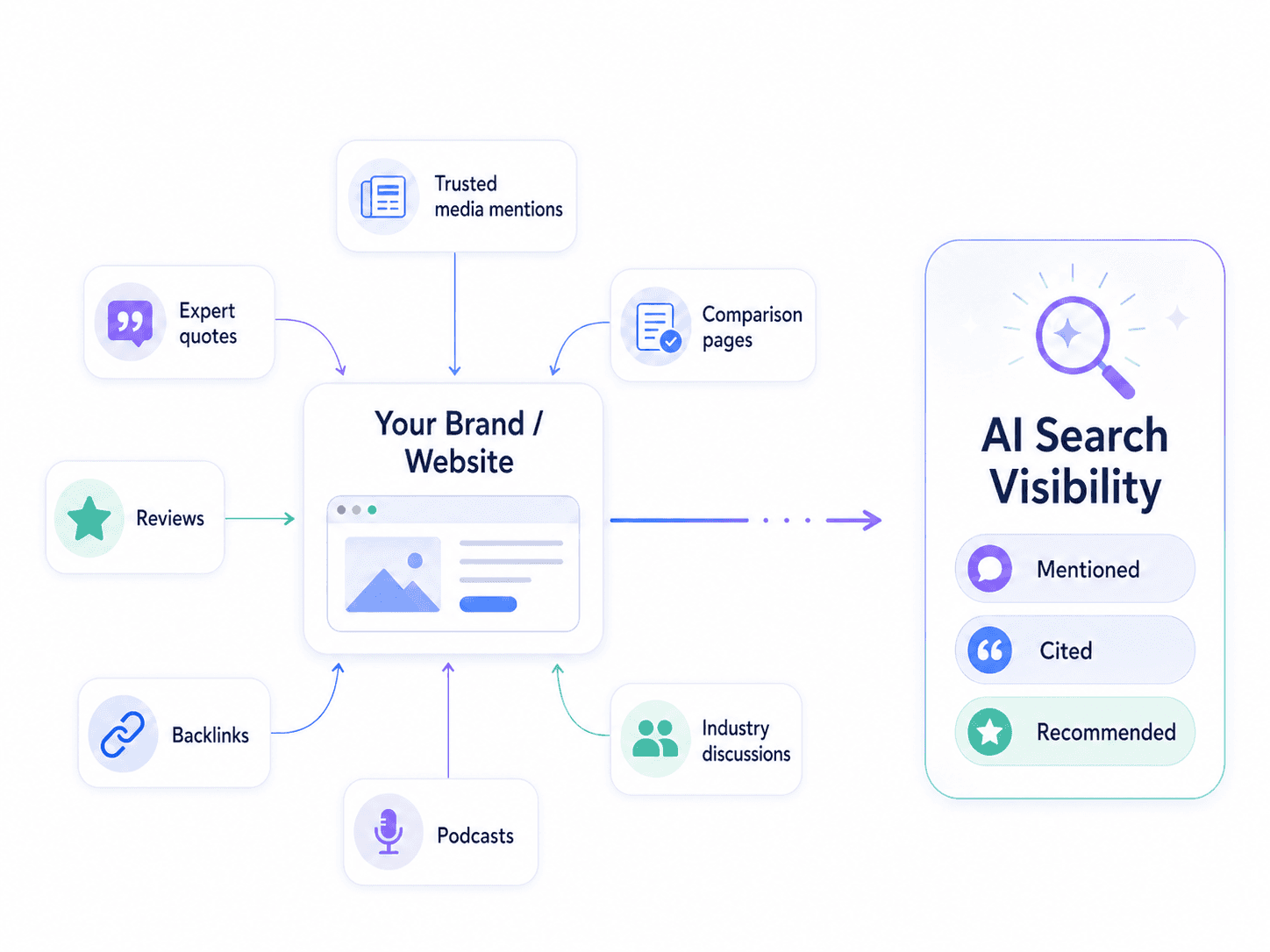
They prioritize trusted signals, not just keyword matches. This includes how often your brand is mentioned across the web. It also includes whether reliable sources reference you. And it depends on how easily their systems can understand your business information.
If you are a new business without those signals yet, the AI simply does not have enough confidence to recommend you.
It works like this: AI models are not just scanning your site. They are trying to validate you against what they have seen elsewhere first. That means:
- Your content may be crawlable, but it is not yet understandable and trusted by AI.
- You lack the breadth of mentions and references that convince AI you are relevant.
- Modern AI-powered search often ignores isolated sites and favors brands with consistent, authoritative signals across multiple sources.
This is why simply having a website does not work anymore. AI engines look for authority, relevance, and context first, and then serve brands that meet those standards confidently in their answers.
In short, new businesses do not show up in AI search because they have not yet built enough trusted signals for AI to confidently recommend them. That is the visibility gap most founders overlook.
5 Ways How Startups Can Appear in ChatGPT and Beyond
By now, you already understand why your startup isn’t showing up in AI answers.
But here’s the important part: yes, it is absolutely possible for new brands to appear in AI search results.
AI platforms don’t only favor big companies. They favor clarity, authority, and structured information. If your brand sends the right signals, it can be discovered, cited, and recommended.
Now let’s break down exactly how you can do that.
1. Build Content Around Real Questions (Not Just Keywords)
If you still create content around isolated keywords, you are optimizing for yesterday’s search behavior. AI platforms respond to complete questions, not fragmented phrases.
When someone types into ChatGPT or Gemini, they don’t write “CRM software pricing.” They ask, “What is the best CRM for a 10-person startup and how much does it cost?”
That shift changes everything.
Instead of targeting a keyword, you need to target the intent behind the question. That means writing clear, direct answers that solve a specific problem in a structured way.
Start by identifying real questions your audience is already asking. Look at sales calls, support tickets, community forums, and search suggestions.
Then answer those questions in a format AI can easily extract.
Use:
- A clear question as a subheading
- A concise 2–4 sentence answer immediately below
- Supporting bullet points if needed
Place the most direct answer at the top, not buried halfway down the page. AI systems prioritize content that delivers clarity quickly and confidently.
Avoid vague introductions or keyword stuffing. Focus on specific, problem-driven phrasing that mirrors how people naturally speak.
2. Establish Topical Authority (Don’t Stay Surface-Level)
Topical authority is super important in order to show up in AI answers.
AI models evaluate whether your site demonstrates depth, consistency, and expertise on a subject. If you only touch a topic once, you look informational. If you cover it from multiple angles, you look authoritative.
So what should you do?
You should start defining 1–2 core themes your business wants to be known for. Then build structured coverage around them:
- Create a pillar page that explains the topic comprehensively
- Publish supporting articles that address subtopics, FAQs, comparisons, and use cases
- Interlink all related content logically
- Maintain consistent terminology across pages
This signals semantic relevance and strengthens your entity association with that topic.
AI systems don’t just scan keywords. They evaluate content clusters, internal linking, and subject coverage breadth. When your site repeatedly answers related questions with clarity, you increase your chances of being cited.
Avoid shallow coverage. Avoid scattered blogging.
Instead, build focused, layered content that clearly tells AI models: “This brand owns this topic.”
3. Use Structured Formatting AI Can Parse Easily
AI answers don’t “read” like humans. They scan for clear structure, defined sections, and concise answers. If your page looks messy, your visibility drops.
Here’s what you should focus on:
- Use clear H2 and H3 headings that reflect real search questions
- Keep paragraphs short (2–4 lines max)
- Use bullet points and numbered steps for processes
- Add FAQ sections with direct answers under each question
- Place key definitions in a single, clean paragraph
Avoid fluff, long storytelling blocks, and vague transitions.
Instead, write in a way where a single paragraph can stand alone as a complete answer. That’s what AI systems prefer to quote.
Also, front-load your answers. Don’t make the reader (or the model) search for the main point. Put the direct answer first, then expand briefly if needed.
Write in a way that mirrors structured data, but remains readable for humans. If a machine can clearly understand:
- What the question is
- Where the answer begins
- Why the answer is credible
You increase your chances of being surfaced.
4. Strengthen Entity & Brand Signals
AI platforms don’t just rank pages. They recognize entities.
An entity is a clearly defined, verifiable identity. Your brand, your founder, your product, your category all need to be consistently defined across the web.
If AI can’t confidently identify who you are, it won’t confidently recommend you.
So what should you focus on?
First, make your brand description crystal clear. On your website, state exactly:
- What you do
- Who you serve
- Which category you belong to
- Where you operate
Avoid vague positioning, and be specific. AI models extract meaning from clarity.
Second, maintain consistent naming everywhere. Your brand name, tagline, and product names should match across your website, LinkedIn, directories, and press mentions. Small variations weaken your entity strength.
Third, build structured credibility signals:
- A detailed About page
- Clear author profiles with credentials
- Proper schema markup for Organization and Person
- Mentions in reputable industry platforms
These signals help AI connect the dots. When multiple trusted sources describe you the same way, your entity becomes stronger.
Finally, reduce ambiguity. If your brand name overlaps with other businesses, reinforce your niche and industry in structured content.
5. Publish Data, Insights & Original POV
If your content only summarizes what already exists, AI has no reason to cite you.
AI models look for original signals, not recycled opinions. They prioritize content that introduces new data, structured insights, and clear conclusions.
So are you adding something new to the conversation?
Here’s what actually works:
- Publish original data, such as surveys, internal benchmarks, or performance breakdowns.
- Share clear insights derived from that data. Not just numbers. Explain what they mean.
- Present a distinct point of view based on your experience. AI favors content that shows expertise, not neutrality.
- Structure findings in bullet points, summaries, and key takeaways so models can extract them easily.
- Use precise language and avoid vague claims. Specificity increases citation probability.
AI systems reward content that is: Verifiable, Structured, Insight-driven, and Expert-led
When you publish something measurable, quotable, and clearly explained, you increase your chances of being referenced in AI-generated answers.
Final Thoughts
AI visibility is no longer optional. It is becoming a core growth channel. The real question is simple: are you shaping the answers, or are you invisible inside them?
If you want your business to appear in ChatGPT, Gemini, or Perplexity, you must create content that is clear, structured, authoritative, and verifiable. Focus on depth, strengthen your brand signals, and publish insights worth citing.
This is not about chasing algorithms. It is about building clarity and credibility that machines can confidently reference. Start optimizing for AI today, and you position your business where tomorrow’s decisions are already being made.
Frequently Asked Questions (FAQs)
How does AI discover business content?
AI scans structured content, trusted sources, and clear QnA formats. If your content directly answers real user questions and includes authority signals, AI is more likely to reference it in responses.
Can small businesses rank in AI answers without huge traffic?
Yes. AI prioritizes clarity, structure, and relevance over traffic. Focus on well-organized answers, strong branding signals, and content that directly solves specific user queries for better visibility.
Should I rewrite existing content for AI visibility?
No. Simply rewriting does not help. Instead, add unique insights, data, and direct answers. AI favors original content that provides real value and can be confidently cited.
Does structured formatting really matter for AI references?
Yes. AI extracts answers from headings, bullets, and short paragraphs more easily. Use clear question formats and concise answers to make your content machine-friendly and more visible in responses.
Is publishing on just my website enough for AI visibility?
Not always. AI considers multiple authoritative sources. Publish on reputable platforms, get directory listings, and build consistent brand mentions to strengthen trust signals for AI engines.


.png&w=3840&q=60)

.png&w=256&q=60)