B2B SaaS buyers now use AI tools before they visit a vendor’s website.
They ask questions about their problems, compare software options, check pricing, and decide which brands are worth a demo.
Forrester’s 2025 Buyers’ Journey Survey found that 94% of B2B buyers use AI, and many now treat generative AI or conversational search as an important source of buying information.
So your content should not only target keywords.
It should answer the real prompts your buyers ask across the full journey, from awareness to demo.
This guide will show you how to map those prompts, create useful content for each stage, and track your AI share-of-voice against pipeline growth.
Why the B2B Buyer Journey Has Changed
B2B buyers now do most of their research before they speak to sales.
They use AI tools, search engines, review sites, comparison pages, and vendor websites to understand their problem, compare options, and shortlist tools.
This means your SaaS brand may be judged before the buyer ever visits your demo page.
Research shared by Demand Gen Report found that:
B2B buyers are nearly 70% through the purchase process before engaging with sellers, and 80% of the time, buyers initiate the first contact. |
So your marketing needs to show up much earlier.
Not only for high-intent searches like “best SaaS tool for X.”
But also for AI prompts like:
- “Why is this problem happening?”
- “What are the best ways to solve it?”
- “Which SaaS tools should I compare?”
- “What should I ask before booking a demo?”
This is why the buyer journey is now prompt-led, not only keyword-led.
If your content does not answer these questions clearly, AI tools may recommend another brand before your sales team gets a chance.
What Is the AI-Driven B2B Buyer Journey?
The AI-driven B2B buyer journey is the path your SaaS buyer takes when they use tools like ChatGPT, Perplexity, Gemini, or Claude to research a product before speaking to your sales team.
They may not visit your website first.
They may first ask questions like:
- “Why are our SaaS leads not converting?”
- “What are the best tools to improve pipeline quality?”
- “Which CRM is better for a mid-sized B2B team?”
- “What should I ask before booking a SaaS demo?”
This changes how SaaS marketing works.
Earlier, you mainly planned content around keywords. Now, you also need to think about buyer prompts.
These prompts show what your buyers want to know at each stage. At first, they may be trying to understand the problem. Later, they may compare tools, check trust signals, and prepare questions for a demo.
Here is a simple view:
Buyer Stage | What They Ask |
Awareness | “Why is this problem happening?” |
Research | “What are the possible solutions?” |
Comparison | “Which SaaS tools are best?” |
Validation | “Can I trust this brand?” |
Demo | “What should I ask before buying?” |
For SaaS teams, buyers may form an opinion about your brand before they ever land on your site.
But before you create that content, you first need to know which AI prompts your buyers are actually using. Let’s discuss that.
Step 1: Identify Every AI Prompt Your Buyers May Use
Before you create content, map the actual prompts your buyers may ask AI tools.
Do not start with keywords only. Start with buyer questions.
A SaaS buyer may not search “best CRM software” anymore. They may ask:
- “What is the best CRM for a 50-person B2B SaaS team?”
- “How can we fix sales pipeline leakage?”
- “HubSpot vs Salesforce for SaaS startups”
- “What should I ask before booking a CRM demo?”
This is where your AI-driven buyer journey begins.
You need to collect prompts from every stage, from problem awareness to demo decision. Think about what your buyer asks when they are trying to understand a problem, compare tools, reduce risk, or prepare for a sales call.
So, focus on finding the prompts your buyers ask before they find your website.
Once you know those prompts, you can create pages that answer them directly. That gives AI systems clearer context about your SaaS product, your use cases, and the buying questions your brand should be connected with.
Step 2: Map Prompts to Buyer Intent
Once you list the prompts, don’t group them randomly.
Each prompt tells you how close the buyer is to a decision.
For example, “Why is our SaaS churn increasing?” means the buyer is still trying to understand the problem.
“Best customer success tools for reducing churn” means they are looking for possible solutions.
“Gainsight vs ChurnZero for SaaS teams” means they are already comparing vendors.
So, group every prompt by intent:
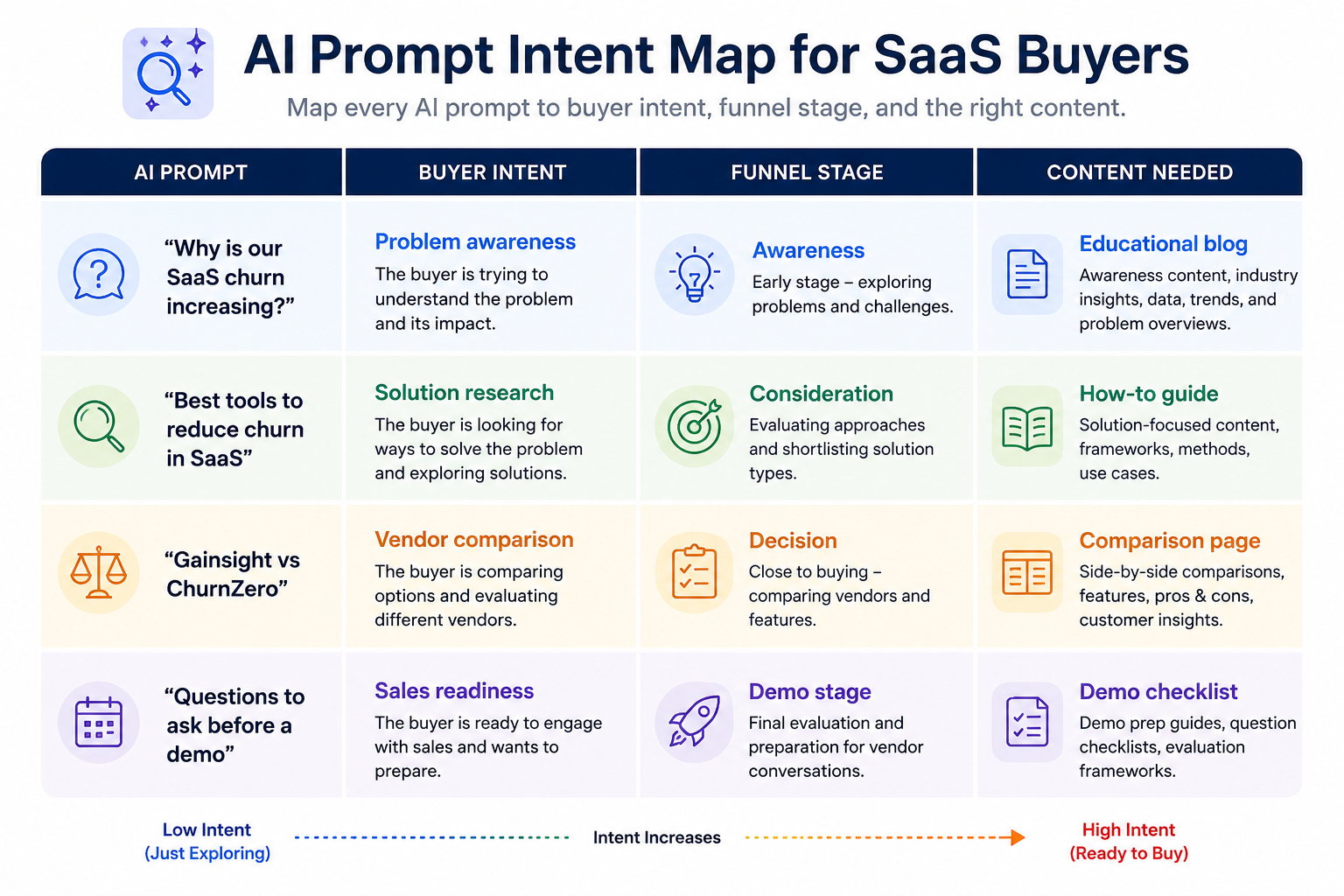
This map shows how SaaS buyer prompts move from problem awareness to demo readiness. Early prompts need educational content, while high-intent prompts need comparison pages, demo checklists, and proof-based content.
This helps you see which prompts belong to the early stage, which ones fit the middle stage, and which ones are close to the pipeline.
So, answer the right prompt with the right content.
When your content matches buyer intent, AI tools can understand where your SaaS brand fits in the journey and surface it for more relevant questions.
Step 3: Create Content for Each AI Query Cluster
Now turn your prompt clusters into actual content.
This is where your AI buyer journey map becomes useful.
If a group of buyers is asking AI about a problem, create a page that explains the problem clearly. If they are comparing tools, create a comparison page. If they are close to booking a demo, give them content that helps them evaluate faster.
The content should not feel like a generic blog. It should answer one specific buyer need.
For example, a churn-related SaaS company could create:
- A guide for “why SaaS churn happens”
- A checklist for “how to reduce churn”
- A comparison page for “best churn reduction tools”
- A case study showing how a customer reduced churn
- A demo prep page explaining what buyers should ask before choosing a platform
Each asset should have a clear job.
One prompt cluster should lead to one useful content asset.
This makes your content easier for buyers to trust and easier for AI systems to understand. Instead of publishing disconnected posts, you build a content path that follows the way people actually research SaaS products inside AI tools.
Step 4: Optimize Content for AI Visibility
AI tools do not read content the way humans do.
They look for clear answers, structured information, useful context, and trustworthy signals. So your content should make it easy for AI systems to understand what your SaaS product does, who it helps, and why it matters.
Start each page with a direct answer.
For example, if the page is about “best CRM for SaaS startups,” explain the answer clearly in the first few lines. Do not hide the main point under a long intro.
Then structure the page around the buyer’s real questions.
Use simple headings like:
- What is it?
- Who is it for?
- What problems does it solve?
- How does it compare with other options?
- What should buyers check before booking a demo?
This makes your content easier to extract and summarize.
You should also add tables, FAQs, examples, use cases, pros and cons, pricing context, and proof points where relevant. These sections help AI tools understand your content more accurately.
Avoid vague lines like “we help teams grow faster.”
Instead, be specific.
Say what you help with, who you help, and what outcome the buyer can expect.
Make every important page answer the buyer’s AI prompt better than your competitors.
Step 5: Track AI Share-of-Voice Across the Buyer Journey
Creating content is only half the work.
You also need to track how often your SaaS brand appears in AI-generated answers for the prompts your buyers are asking.
This is called AI share-of-voice.
It shows whether AI tools are mentioning your brand, your competitors, or no clear vendor at all when buyers search for solutions.
For example, when someone ask: “Best SaaS tools to improve lead quality”
You should check:
- Does your brand appear in the answer?
- Which competitors are mentioned?
- Is your content cited as a source?
- Is the brand description accurate?
- Is the tone positive, neutral, or unclear?
- Which stage of the buyer journey does this prompt belong to?
This helps you spot content gaps.
Maybe your brand appears for early awareness prompts, but not for comparison or demo-stage prompts. That means buyers may learn from your content, but choose another vendor when they get closer to buying.
Use a simple tracking table:
Buyer Stage | What You Should Track |
Awareness | Are you mentioned for problem-based prompts? |
Consideration | Are you connected to the right solution category? |
Comparison | Are you included against competitors? |
Decision | Are your proof, pricing, reviews, and use cases clear? |
Demo | Are buyers getting useful details before speaking to sales? |
You need to know where your brand shows up, where competitors show up, and where AI tools ignore you completely.
Step 6: Connect AI Visibility to Pipeline Gains
AI visibility should not stop at brand mentions.
You need to see whether those mentions lead to real business movement.
Track what changes after your SaaS brand starts appearing in ChatGPT, Perplexity, Gemini, or AI search results.
Do more people search your brand name? Do your AI-optimized pages bring demo requests? Do sales calls include phrases like “I found you through ChatGPT” or “AI recommended your tool”?
These are the signals that matter.
Connect AI visibility with clear pipeline metrics like branded search growth, direct traffic, demo bookings, qualified leads, assisted conversions, and sales opportunities.
This helps you prove one thing clearly that showing up in AI answers is not just about visibility. It can support pipeline growth.
Common Mistakes SaaS Brands Make
Many SaaS brands try to show up in AI answers, but they still think in an old SEO way. They create content for keywords, not for the real prompts buyers ask during research.
Here are the mistakes you should avoid.
1. Only Targeting Traditional SEO Keywords
Keywords still matter, but AI tools work differently.
Your buyers are not just typing “best CRM software.” They are asking full questions like:
“Which CRM is best for a 30-person SaaS sales team with HubSpot integration?”
2. Ignoring Comparison Prompts
This is a big one.
Buyers often ask AI tools to compare vendors before they visit websites. They may search for:
- “[Your brand] vs [Competitor]”
- “Best alternatives to [Competitor]”
- “Which tool is better for mid-market SaaS teams?”
If you do not create clear comparison content, AI tools may rely on competitor pages, review sites, or outdated sources.
3. Publishing Generic Blogs With No Buyer Intent
Generic content does not help much anymore.
A blog like “Why SaaS Marketing Matters” is too broad. It does not answer a specific buyer question.
Instead, your content should solve a clear problem, such as:
“How to reduce demo no-shows for B2B SaaS teams”
That kind of content gives AI systems something useful to extract and buyers something useful to trust.
4. Missing demo-stage questions
Many SaaS brands stop content at awareness and consideration.
But buyers also ask AI questions right before booking a demo, such as:
- “What should I ask during a SaaS demo?”
- “How do I evaluate SaaS pricing?”
- “What red flags should I check before signing?”
These are high-intent prompts. If your content does not answer them, you may lose buyers near the final step.
5. Tracking rankings but not AI visibility
Rankings alone do not show the full picture anymore.
You also need to know whether your brand appears in AI answers, how often it appears, and what AI tools say about it.
Track things like:
- AI share-of-voice
- Competitor mentions
- Citation rate
- Buyer-stage coverage
- Sentiment
- Demo influence
This helps you see whether your content is actually shaping buyer decisions.
7. Not Refreshing Old Content
AI tools may pull from outdated content if that is what is available.
So, keep your important pages fresh. Update comparisons, pricing context, feature details, screenshots, FAQs, and customer proof.
Your content should reflect what your product does right now, not what it did two years ago.
Final Thoughts
The AI-driven B2B buyer journey starts before your buyer visits your website.
They ask AI tools to understand problems, compare options, and decide which SaaS brands deserve attention.
So, your next step is to map the prompts your buyers use, create content for each stage, and track your AI share-of-voice.
That is how you turn AI visibility into real pipeline growth.
Frequently Asked Questions (FAQs)
1. What is an AI-driven B2B buyer journey?
An AI-driven B2B buyer journey is the path where buyers use tools like ChatGPT, Gemini, or Perplexity to research problems, compare SaaS options, validate vendors, and prepare before booking a demo.
2. Why should SaaS brands map buyer prompts?
You should map buyer prompts because they show what your audience is actually asking AI tools. This helps you create content that answers real questions across awareness, comparison, validation, and demo stages.
3. How is prompt mapping different from keyword research?
Keyword research shows what people type into search engines. Prompt mapping shows how buyers ask AI tools for help, advice, comparisons, risks, pricing context, and vendor recommendations during decision making.
4. What is AI share-of-voice in SaaS marketing?
AI share-of-voice shows how often your SaaS brand appears in AI answers for important buyer prompts. It helps you understand if AI tools mention you, ignore you, or recommend competitors.
5. How does AI visibility connect to pipeline growth?
AI visibility connects to the pipeline when your content appears for high-intent prompts and guides buyers toward action. Track demo requests, branded searches, assisted conversions, and sales conversations influenced by AI-discovered content.