AI search is changing how people find and trust brands.
Today, users do not only search on Google. They ask ChatGPT, Perplexity, Gemini, Claude, and Google AI Overviews for direct answers.
And these tools do not only read your website.
They look for proof across the web.
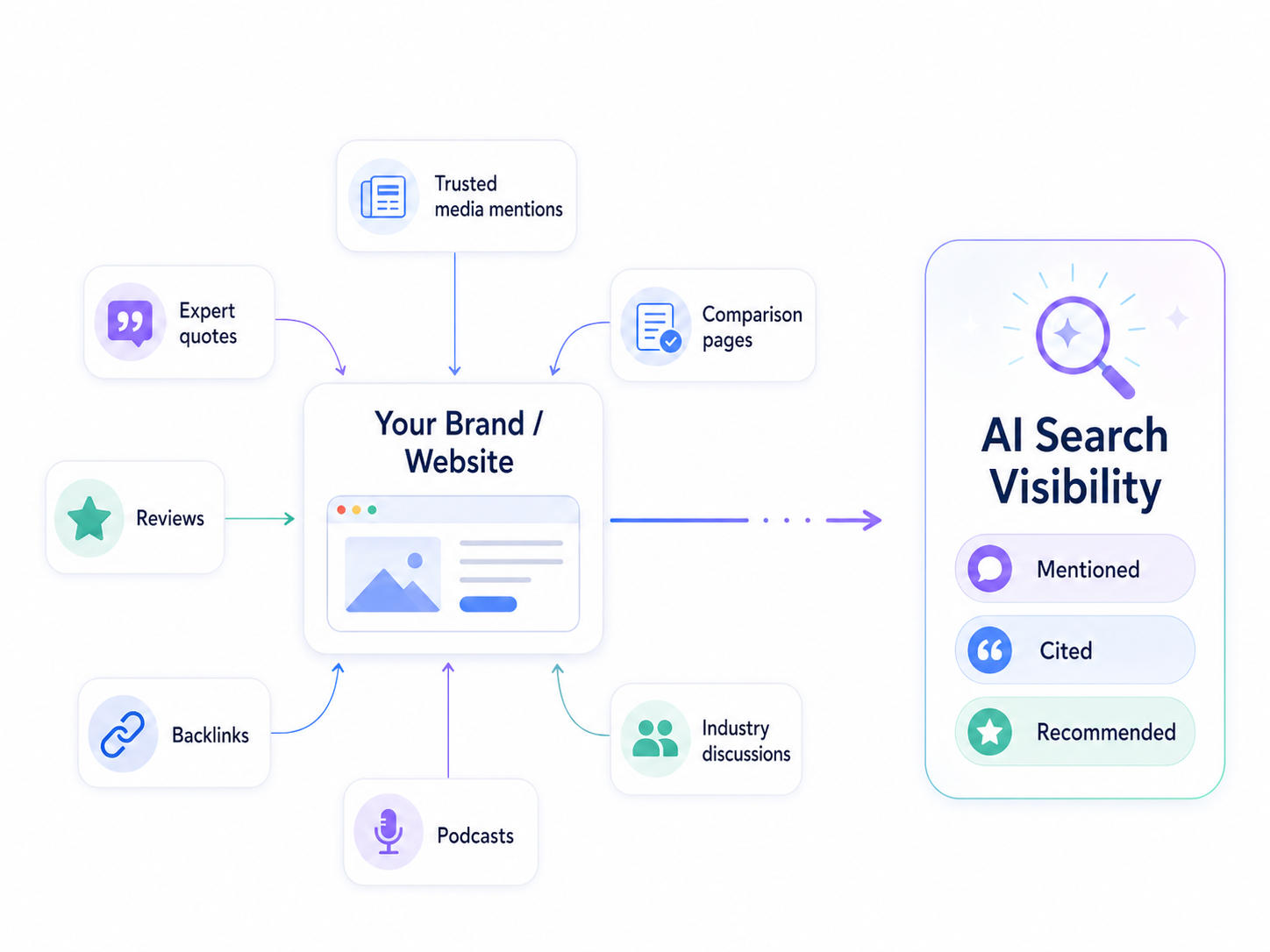
That proof can come from trusted media mentions, expert quotes, customer reviews, industry blogs, podcasts, and comparison articles.
This is where authority building for AI search becomes important.
It means making your brand easy for AI systems to understand, verify, and recommend.
The shift is already happening. McKinsey reports that half of consumers use AI-powered search, and AI search could influence $750 billion in revenue by 2028.
So, if trusted third-party sources are not talking about your brand, AI systems may have fewer reasons to mention you.
This guide will show you how to use earned media to build authority, earn trusted mentions, and improve your visibility in AI search.
What Authority Building Means in AI Search
Authority building in AI search means making your brand easy for AI systems to understand, trust, and recommend.
AI tools do not only check your website.
They look at your wider presence across the web.
That includes brand mentions, expert quotes, reviews, backlinks, third-party articles, podcast mentions, and industry discussions.
Why?
Because AI systems need proof.
They need to see that your brand is connected to a topic again and again.
For example, if you want visibility for “AI SEO tools,” your brand should appear around that topic on trusted websites, review platforms, expert content, and comparison pages.
This matters because AI citations do not always come from page-one rankings.
In fact, a study done by our team found that only about 38% of URLs cited in Google AI Overviews also appeared in the top 10 results for the same query.
So, ranking is still important.
But it is not enough.
In AI search, authority means becoming a trusted source that AI systems can confidently mention, cite, or recommend.
Why Earned Media Matters for AI Search
Earned media helps AI systems verify your brand through trusted third-party sources.
AI search does not only check your website.
It looks across the web to understand who you are, what you do, and why you should be trusted.
That is why earned media matters.
When trusted websites, experts, podcasts, review platforms, or news sites mention your brand, they create external proof.
Your own website can explain your value.
But earned media shows that other trusted sources recognize your brand too.
This helps AI systems connect your brand with the right topics, products, and buyer questions.
For example, if your brand is mentioned in articles about AI SEO, GEO, or content optimization, AI systems can understand that your brand is relevant, trusted, and active in that category.
So earned media is not just PR.
It is a way to build trust, authority, and visibility in AI search.
The Big Shift: From Ranking Pages to Becoming a Recognized Entity
Traditional SEO was mostly about getting individual pages to rank.
AI search works differently.
AI systems try to understand which brands, people, and websites are trusted for a topic.
So your goal is not only to rank one blog post.
Your goal is to make your brand a clear, trusted entity in your category.
That means AI should understand:
- Who you are
- What you do
- What topics you are known for
- Why your brand is credible
- Where else your brand is mentioned
Here is the simple difference:
Traditional SEO | AI Search Authority |
Focuses on ranking pages | Focuses on recognizing brands |
Targets keywords | Builds topic association |
Depends heavily on backlinks | Uses mentions, citations, reviews, and trust signals |
Measures clicks and traffic | Measures visibility in AI answers |
Optimizes single pages | Builds authority across the web |
Think of it this way.
A page can rank because it is optimized well.
But a brand gets mentioned in AI answers when it is trusted, repeated, and verified across multiple sources.
So instead of asking, “How do I rank this page?”
You should also ask, “How do I make AI systems understand that my brand belongs in this answer?”
Next, let’s start with the first step: defining the topics your brand wants to own.
1. Define the Topics You Want to Own
Before you start earned media, decide which topics your brand should be known for in AI search.
These are the subjects you want AI systems to connect with your brand.
Choose topics that match your expertise, product, and audience.
Do not try to own everything.
Focus on a few areas where you can publish useful content, earn relevant mentions, and build strong topic signals.
For example, your topics could be AI-first SEO, GEO, AI citations, or AI content optimization.
This helps because AI systems look for repeated topic associations across content, mentions, and sources.
When your brand keeps showing up around the same topics, it becomes easier for AI systems to understand your authority.
This is how you build clear topical relevance in AI search.
2. Audit Your Current Authority Signals
This step means checking which authority signals your brand already has across the web.
Look for mentions, reviews, citations, expert references, and discussions outside your own site.
Your goal is to see whether trusted sources clearly connect your brand to the topics you want to own.
If those signals are weak, missing, or inconsistent, fix them before you scale earned media.
3. Build a Strong Entity Foundation First
AI systems need to recognize your brand clearly.
That happens when your brand details stay consistent everywhere online.
Your brand name, website, company description, product category, founder information, and core topics should match across your site, profiles, and mentions.
If these details change from one place to another, search engines and AI systems may not understand your brand correctly.
A strong entity foundation helps them connect your brand to the right topics, trust your identity, and use your brand in relevant AI answers.
In short, entity building makes your brand easier for AI systems to identify, understand, and trust.
4. Create Citation-Worthy Assets Before Pitching
You need citation-worthy assets to earn mentions in AI search.
These are content assets that give journalists, publishers, researchers, and AI systems something useful to reference.
This can include original research, proprietary data, case studies, benchmarks, expert commentary, or practical frameworks.
Generic promotion is easy to ignore.
Useful, verifiable information is easier to cite.
When your brand publishes content with clear facts or unique insights, other sites are more likely to mention it.
That improves your chances of earning citations, links, and authority signals in AI search.
5. Use Digital PR to Earn High-Authority Mentions
Digital PR helps you earn trusted mentions that support authority building for AI search.
This matters because AI systems use third-party signals to understand whether your brand is credible.
Your job is to get featured on relevant, high-authority websites like industry publications, expert roundups, podcasts, and trusted blogs.
These mentions help search engines and AI tools connect your brand with the right topics.
The best mentions clearly show who you are, what you do, and what you are known for.
That is how digital PR strengthens your visibility and authority in AI search.
6. Get Included in Comparison and List Article
Comparison pages and “best tools” lists matter because they help AI systems understand where your brand fits in the market.
When someone asks for the best tools, top platforms, or alternatives, AI tools often pull from these pages.
That means your brand should appear in the right comparison content across the web.
Focus on getting mentioned in articles like best tools, top platforms, alternatives, and brand vs brand comparisons.
These mentions do more than drive traffic.
They help search engines and AI systems connect your brand to a category, a use case, and a buying decision.
The goal is simple.
Make sure your brand shows up where people and AI systems look for options.
7. Turn Founders and Experts Into Searchable Authorities
AI systems do not only evaluate brands.
They also look at people behind the brand.
That is why your founders and internal experts should be visible online for the topics you want to own.
When your experts publish insights, give quotes, join podcasts, write guest pieces, or speak in industry discussions, they build topic authority.
That helps AI systems connect their names with specific subjects.
Over time, that strengthens your brand’s credibility too.
So basically, when trusted people from your company are consistently associated with your core topics, your brand becomes easier to trust and surface in AI search.
8. Build Community and Social Proof Signals
AI systems do not look at your website alone.
They also pick up signals from places where real people talk about brands.
That includes reviews, discussions, recommendations, comments, and community mentions on platforms like Reddit, LinkedIn, YouTube, G2, Capterra, and industry forums.
These signals help AI tools understand whether people know your brand, trust it, and connect it with a specific topic.
So your job is simple.
- Get your brand talked about in the right places.
- Encourage real reviews.
- Join relevant conversations.
- Share useful insights.
- Answer questions clearly.
- Stay active where your audience already spends time.
The goal is not to force visibility.
The goal is to build real proof that people recognize and trust your brand.
9. Strengthen Your Owned Content So Earned Media Has a Home
Earned media can get people and AI systems to notice you.
But your own website has to support that trust.
When a brand mentions, quotes, or articles points back to you, your site should clearly explain who you are, what you do, and why you matter.
That means your product pages, about page, case studies, expert pages, and core topic content should be strong and easy to understand.
If your site is thin, unclear, or incomplete, earned media loses value.
A strong content foundation helps search engines and AI systems connect outside mentions with your brand, expertise, and use cases.
So, earned media brings attention, but your owned content turns that attention into authority.
10. Make Every Earned Mention Clear and Machine-Readable
An earned mention should do more than just name your brand.
It should clearly explain who you are, what you do, and why you matter.
That means your brand mention should include simple context like your company name, product category, main use case, and, when possible, a link to the right page.
This helps search engines and AI systems understand the mention faster and connect it to the right topic.
A vague mention gives weak signals.
A clear mention gives stronger authority signals and makes it easier for AI systems to extract, summarize, and surface your brand in relevant answers.
Final Thoughts
Your website tells AI systems what you say about your brand.
Earned media shows what others say about you.
That is why it matters.
When trusted websites, experts, publications, and communities mention your brand, they add credibility.
These signals help AI systems see your brand as more reliable, more relevant, and more worth surfacing in answers.
In simple terms, earned media acts like proof. It supports your claims with outside validation.
So if you want stronger visibility in AI search, do not rely only on your own content.
You also need trust signals from the wider web.
Frequently Asked Questions (FAQs)
1. What does authority building for AI search actually mean?
Authority building for AI search means making your brand easy to recognize and trust across the web. It comes from expert content, clear brand signals, strong mentions, reviews, and coverage from respected third party sources.
2. Why does earned media matter in AI search?
Earned media matters because AI systems look beyond your website. When trusted publications, podcasts, communities, or experts mention you, those mentions act like proof that your brand is credible in that topic area.
3. What kind of content helps you earn better media mentions?
The best content for earned media is content people want to cite. Think original research, useful data, expert insights, case studies, or practical frameworks that help journalists, creators, and buyers understand a topic.
4. How is earned media different from publishing on your own website?
Your website gives your brand a controlled message. Earned media adds outside validation. That difference is important because AI systems often trust third party mentions more when they support your claims and category relevance.
5. How long does authority building for AI search take?
Authority building usually takes time because trust grows through repeated signals. You need consistent mentions, expert visibility, useful content, and strong brand clarity across multiple sources before AI systems recognize your authority clearly.