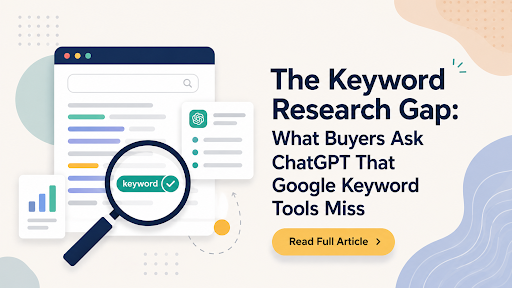
Buyers do not search the way they used to.
They are no longer typing only short keywords like “best SEO tool” or “keyword research software.” Now, they ask detailed questions inside ChatGPT, such as: “What SEO tool should I use if I’m a small team with a limited budget?”
That question tells you much more than a keyword.
It shows the buyer’s goal, budget, team size, problem, and decision stage.
This shift is hard to ignore. By July 2025, ChatGPT had 700 million weekly users sending around 18 billion messages every week.
Traditional keyword tools still matter. They show search demand. But they often miss the deeper questions buyers ask before they choose a product, service, or vendor.
That is the keyword research gap.
To understand this gap better, let’s first look at how traditional keyword research works and where it starts to fall short.
What Is the Keyword Research Gap?
The keyword research gap is the difference between what keyword tools show and what buyers actually ask when they are making a decision.
Keyword tools often show short terms like “best CRM software” or “SEO agency pricing.” These terms are useful, but they do not always reveal the full question behind the search.
A buyer may ask ChatGPT:
“What CRM should I use if I have a small sales team and we work mostly in Gmail?”
That question gives you more context. It shows the buyer’s team size, workflow, need, and decision stage.
Traditional keyword research tells you what people search for. AI-style buyer questions show you what people need help deciding.
If you only follow search volume, you may miss the questions buyers ask before they choose a product, service, or company.
That is why the keyword research gap matters. It shows the buyer intent that traditional keyword tools often miss.
Why Google Keyword Tools Miss These Buyer Questions
Google keyword tools track search behavior, not full buyer conversations.
They are useful for finding search volume, keyword difficulty, CPC, trends, and related keywords.
But they usually work around short, common, or already-searched phrases.
Buyer questions are often more detailed. They include budget, goals, team size, risks, timelines, and approval needs.
That is why some valuable buying questions may not appear clearly in a normal keyword report.
Your content should not only target keywords. It should also answer the real questions buyers ask before they make a decision.
Cover these missing areas:
1. They Miss Context-heavy Questions
Keyword tools often show broad phrases like:
“best project management tool”
But a buyer may ask:
“Which project management tool is best for a remote marketing team that hates complex dashboards?”
This question gives you clear context.
The buyer wants something simple. The team works remotely. They care about ease of use. They may already be frustrated with complicated tools.
That level of detail is hard to see in a normal keyword report.
2. They Miss Comparison Questions With Hidden Criteria
Keyword tools can show comparison keywords like:
“ABC tool vs XYZ tool”
But buyers usually compare tools based on their own situation.
They may ask:
“Is ABC or XYZ better for a small agency that mainly does local SEO?”
This is not just a comparison. It is a fit-based question.
The buyer does not only want to know which tool is better. They want to know which tool is better for their exact use case.
That hidden criteria helps you create stronger comparison content.
3. They Miss Risk and Objection Questions
Buyers also ask questions when they feel unsure. They may ask:
“What are the risks of hiring a cheap SEO agency?”
This type of question shows fear, doubt, and hesitation.
The buyer may be close to making a decision, but they want to avoid a bad choice.
These questions are valuable because they reveal real buyer objections.
If your content answers them clearly, you build trust before the buyer contacts you.
4. They Miss Internal Decision Questions
In B2B, buyers often need approval before they buy.
They may ask:
“How do I convince my boss we need an AI Visibility tool?”
This is not a standard keyword. But it is still a serious buying question.
The buyer may already understand the value. Now they need help explaining it to a manager, founder, or finance team.
Content that answers this kind of question can support the buyer inside their company.
It helps them move from interest to approval.
5. They Miss Implementation Questions
Buyers also want to know what happens after they choose a solution.
They may ask:
“How long does it take to see results from SEO for a new SaaS website?”
This question is about expectations.
The buyer wants to understand the timeline, effort, and possible outcome. It may look like an informational question, but it can strongly affect the buying decision.
If your answer is clear, realistic, and specific, it can reduce doubt.
What Buyers Ask ChatGPT Before They Buy
ChatGPT buyer questions are decision-focused prompts people ask before choosing a product, service, or vendor.
Buyers often use ChatGPT when they are unsure what to choose.
They may already know the problem. They may even know a few brands. But they still need help comparing options, checking risks, and deciding what fits their situation.
That is why their questions are usually longer than normal Google searches.
According to the studies, 57% of consumers use AI to narrow down choices, 53% use it to compare products, and 50% use it to make a final decision. So yes, AI is now part of the buying journey.
Here are a few common ChatGPT-style buyer prompts:
1. They Ask for the Best Option for Their Situation
A buyer may not ask:
“Best accounting software.”
They may ask:
“What is the best accounting software for a freelancer who hates spreadsheets?”
That one question tells you a lot.
The buyer is a freelancer. They want something simple. They do not want to deal with messy spreadsheets.
This is the type of detail keyword tools often miss.
2. They Ask ChatGPT to Compare Options
Buyers also use ChatGPT when they are stuck between two choices.
For example:
“Compare Shopify and WooCommerce for a small handmade jewelry brand.”
This is not just a general comparison.
The buyer wants to know which platform fits a small product-based business. They care about setup, cost, ease of use, design, payments, and long-term growth.
So your content should not only say which option is better. It should explain who each option is better for.
3. They Ask What They Should Avoid
Before buyers spend money, they look for red flags.
They may ask:
“What should I avoid when choosing a link-building agency?”
This question shows caution.
The buyer does not want to get trapped by fake promises, poor-quality links, or risky SEO tactics.
Content that answers these concerns can build trust fast because it helps the buyer avoid a bad decision.
4. They Ask If Something Is Worth It
Buyers often want to know whether the cost makes sense.
For example:
“Is hiring an SEO consultant worth it for a local service business?”
This question is not only about price.
The buyer is really asking, “Will this help me get results, or will I waste money?”
So your answer should explain the value, expected timeline, possible risks, and when it may not be the right move.
5. They Ask for a Shortlist
Sometimes buyers do not want a huge list. They want a few strong choices.
For example:
“Give me three good AI writing tools for a small content team.”
This question has clear buying intent.
The buyer wants options, but they also want those options filtered by team size and use case.
Your content should do the same. Give clear recommendations, not endless choices.
6. They Ask What Questions They Should Ask
Buyers also use ChatGPT before speaking with a vendor.
Example:
“What questions should I ask before signing with a PPC agency?”
This means the buyer is already close to action.
They may be booking calls, comparing proposals, or preparing for a meeting.
This is a strong content opportunity because you can help them evaluate the right things before they commit.
The Difference Between Google Keywords and ChatGPT Buyer Prompts
The easiest way to understand the difference is to compare them side by side.
A Google keyword gives you the surface topic. A ChatGPT buyer prompt gives you the decision angle.
That small shift changes how you should create content.
Here is the difference more clearly:
Google keyword | ChatGPT buyer prompt | What the buyer really wants |
best SEO tool | What SEO tool should I use if I’m a solo founder with no SEO experience? | A simple tool they can use without expert help |
CRM software | Which CRM is easiest for a small sales team that uses Gmail? | A CRM that fits their daily workflow |
content agency pricing | How much should I pay for blog writing if I want SEO results? | Clear pricing and realistic expectations |
Ahrefs vs Semrush | Is Ahrefs or Semrush better for competitor research and content planning? | A comparison based on their actual use case |
hire SEO agency | What are the red flags before hiring an SEO agency? | Help avoiding the wrong choice |
This is why the keyword only tells part of the story.
If you only write for “CRM software,” your content may stay too broad. But if you answer “Which CRM is easiest for a small sales team that uses Gmail?”, your content becomes more useful and easier to match with buyer intent.
So, use keywords to find the topic.
Use buyer prompts to understand the specific answer your audience needs.
Why This Gap Matters For SEO Now
The keyword research gap matters because SEO is no longer just about winning one Google ranking.
Buyers now move across many places before they trust a brand. They may search on Google, scan Reddit threads, watch YouTube reviews, read comparison pages, and use ChatGPT to make sense of everything.
So your content needs to answer decision-stage questions, not just match search terms.
It needs to help buyers at the moments where they feel unsure.
That includes moments like:
- “Is this the right option for me?”
- “Can I trust this company?”
- “What should I check before I decide?”
- “What could go wrong?”
These questions matter because they shape the buying decision.
If your content does not answer them, another brand, review site, forum, or AI-generated answer might.
That is why this gap is important for SEO now.
You are not only competing for clicks. You are competing to become the answer buyers trust before they take action.
How to Find the Questions Keyword Tools Miss
To find the questions keyword tools miss, you need to look beyond search volume.
Keyword tools are useful, but they do not show every question your buyers have. Many useful questions appear in places where people share feedback, ask for help, or explain what confused them.
Here is where you should look.
1. Check Your Sales Calls
Your sales calls are one of the best places to find real buyer questions.
Pay attention to questions people ask again and again, like:
- “How long will this take?”
- “What makes you different?”
- “Will this work for our industry?”
- “What if we already tried this before?”
You can turn these repeated questions into blog sections, FAQs, guides, or comparison pages.
2. Use Customer Support Tickets
Support tickets show where people get stuck.
They reveal common problems, missing information, and unclear steps after someone becomes a customer.
For example, if many users ask how to set something up, you can create a simple onboarding guide.
If they ask why a feature matters, you can turn that into an educational article.
Support questions help you create content that removes friction.
3. Look Inside Google Search Console
Google Search Console can show long and unusual search queries.
Do not ignore queries with low impressions. Some of them may not bring huge traffic, but they can point to useful content ideas.
Look for queries that sound natural, detailed, or problem-based.
4. Read Reviews and Online Communities
Check places like Reddit, G2, Capterra, Quora, niche forums, and YouTube comments.
Look for repeated phrases, complaints, feature requests, and “before buying” questions.
Pay attention to lines like:
- “Is it worth it?”
- “Has anyone used this?”
- “What’s better for beginners?”
- “Any alternatives?”
- “What are the downsides?”
These phrases give you the exact words your audience uses.
5. Use ChatGPT For Idea Generation
ChatGPT can help you brainstorm buyer questions quickly.
For example, you can ask:
“What would a small business owner ask before hiring an SEO agency?”
But do not publish every idea it gives you.
Check those ideas against real sources like sales calls, customer chats, reviews, Search Console, and community discussions.
AI can help you spot possible questions. Real buyer data helps you know which ones matter.
6. Study Competitor FAQs
Competitor FAQs can show common questions in your market.
Look at what they answer and then think if you can answer this in a clearer and more useful way.
Do not copy their content.
Improve it with better examples, clearer explanations, stronger proof, and practical takeaways.
How To Turn ChatGPT-style Questions into Content
Once you collect ChatGPT-style questions, don’t turn every question into a separate blog post.
That gets messy fast.
Instead, turn those questions into a simple content system. Start with this flow:
Question > intent > content format > page structure > CTA
This helps you avoid random content. It also makes each page easier for readers, search engines, and AI systems to understand.
Step 1: Group Similar Questions Into Clusters
First, sort the questions into clear groups.
Put pricing questions in one place. Put comparison questions in another. Keep setup, risk, and alternative questions separate.
This helps you spot patterns.
For example, if buyers keep asking about cost, don’t write five thin posts. Create one strong pricing guide that answers the topic properly.
One complete page is better than five weak pages.
Step 2: Choose the Right Content Format
Not every question needs a blog article.
Some questions work better as a checklist. Some need a comparison page. Some belong on a product or service page.
Use the question to decide the format.
Buyer question type | Best content format |
“Which one should I choose?” | Comparison page |
“Is this right for my business?” | Use-case guide |
“What should I check before buying?” | Buying checklist |
“What can go wrong?” | Mistake or risk article |
“How much does it cost?” | Pricing guide |
“How does this work?” | Process page |
“What happens after I sign up?” | Implementation guide |
“What are my other options?” | Alternatives page |
This is where many teams go wrong.
They find a good question, then force it into a blog post. But the format should match the buyer’s need.
Step 3: Start with the Clearest Answer
Don’t make people dig for the answer.
Open the page with a direct response. Then explain the details below.
A simple page structure can look like this:
- Direct answer
- Who it is best for
- What to compare
- Key benefits and limits
- Common mistakes
- FAQs
- Next step
This structure works well because it is easy to scan. It also gives AI systems clear sections to understand and summarize.
Step 4: Add Real Buyer Context
This is what makes the content useful.
Don’t just say:
“This is good for small businesses.”
That is too broad.
Say something like:
“This is a better fit for small teams that need quick setup, simple reporting, and low training time.”
Now the reader knows exactly who the advice is for.
Add details like team size, budget, tools, goals, timeline, industry, and skill level where they make sense.
Specific content feels more trustworthy.
Step 5: Use Question-based Headings
Your CTA should not feel random.
Match it to the page intent.
- If the page helps someone compare options, offer a consultation.
- If it is a checklist, offer a downloadable template.
- If it explains pricing, offer a custom quote.
- If it explains setup, offer a setup call.
- If it lists alternatives, offer a demo or comparison call.
The goal is to help the reader take the next step without pressure.
Example Content Map for the Keyword Research Gap
Once you collect buyer questions, the next step is to sort them properly.
Place each question based on how close the buyer is to making a decision. Then choose a content angle that answers that question directly.
Buyer stage | ChatGPT-style question | Content angle |
Problem aware | “Why is my organic traffic dropping even though rankings look okay?” | Explain possible causes and what to check first |
Solution aware | “Should I focus on SEO or AI search visibility?” | Compare both priorities and show when each matters |
Product aware | “Which AI SEO tool is best for tracking ChatGPT mentions?” | Show tool options based on use case |
Evaluation | “What should I ask before buying an AI SEO platform?” | Create a practical decision checklist |
Final decision | “Is this tool worth it for a small marketing team?” | Show value, use cases, and expected return |
This stops you from creating five pages that all say the same thing.
You can see which questions need education, which need comparison, and which need proof before the buyer takes action.
Use the map to turn buyer questions into pages with a clear purpose.
How to Optimize Content for AI-Style Buyer Questions
To optimize content for AI-style buyer questions, make the page easy to read, easy to scan, and easy to understand without extra effort.
Do not just add keywords and hope the page works. Structure the answer so a buyer can quickly see, “Yes, this answers my exact question.”
1. Make Your Headings Match Real Questions
Use headings that sound like something a buyer would actually ask.
For example:
- “Is SEO worth it for a small business?”
- “How long does SEO take to show results?”
- “What should I check before hiring an SEO agency?”
These headings are simple, clear, and easy to understand. They tell the reader exactly what the section will answer.
2. Give the Answer First
Do not start with a long setup.
If someone asks a direct question, give them a direct answer.
For example:
SEO is worth it for a small business when there is clear search demand, a useful website, and enough time to build results.
After that, you can explain the details.
This makes your content more useful because the reader does not have to hunt for the main point.
3. Write Clear Definition-style Lines
Some ideas need a simple explanation before you go deeper.
For example:
A buyer prompt is a detailed question that includes the buyer’s situation, goal, and concern.
That kind of sentence is easy to understand on its own. It also makes the page stronger because the meaning is clear right away.
4. Keep Each Section Focused
Do not mix pricing, timelines, risks, and comparisons in the same section.
Give each idea its own space.
If the section is about pricing, talk about pricing. If it is about risk, talk about risk. If it is about timelines, talk about timelines.
This keeps the content clean and prevents confusion
4. Use Tables Only When They Make the Answer Clearer
Tables are useful when you are comparing options, stages, features, or actions.
But do not force them everywhere.
Use a table only when it helps the reader understand the answer faster.
4. Be Specific, Not Vague
Avoid broad claims like:
“This tool is the best.”
Say something more useful:
“This tool is best for small teams that need simple reporting and quick setup.”
Specific answers build more trust. They also show exactly who the advice is for.
5. Use the Same Terms Throughout the Page
Pick one main phrase and stick with it.
For example, if you use “AI-style buyer questions,” keep using that phrase instead of switching between too many similar terms.
This makes the topic clearer and easier to follow.
Final Thoughts
Keyword tools are still useful. But they do not show the full picture anymore.
Your buyers are asking more specific questions now. They want comparisons, risks, use cases, and honest answers before they make a decision.
That is where the keyword research gap matters.
Use keyword tools to understand what people search for. Use buyer questions to understand what they are trying to decide.
When you bring both together, your content becomes more helpful, more specific, and easier for AI systems to understand.
The goal is not just to rank for a keyword. The goal is to answer the real question behind it.
Frequently Asked Questions (FAQs)
1. What makes ChatGPT buyer questions different from normal keywords?
Normal keywords usually show the topic. ChatGPT buyer questions show the buyer’s situation, doubts, and decision process. That extra context helps you understand what the person really needs before they act.
2. Can zero-volume questions still be useful for SEO?
Yes. Some zero-volume questions are very valuable because they reveal strong intent. If buyers ask them in sales calls, reviews, or support chats, they can still bring qualified traffic.
3. Should I create separate pages for every ChatGPT-style question?
No. It is better to group related questions into one strong page or section. This avoids thin content and helps both readers and AI systems understand the topic clearly.
4. How do I know which buyer questions are worth targeting?
Focus on questions that show repeated interest, confusion, or buying hesitation. If the same concern appears across sales calls, customer chats, reviews, or Search Console, it deserves attention.
5. How does this help with AI-first SEO?
It helps you write content around real buyer decisions, not just keywords. Clear answers, useful structure, and specific context make your content easier for AI systems to understand and summarize.