What is Generative Engine Optimisation (GEO)? The Complete Guide for 2026
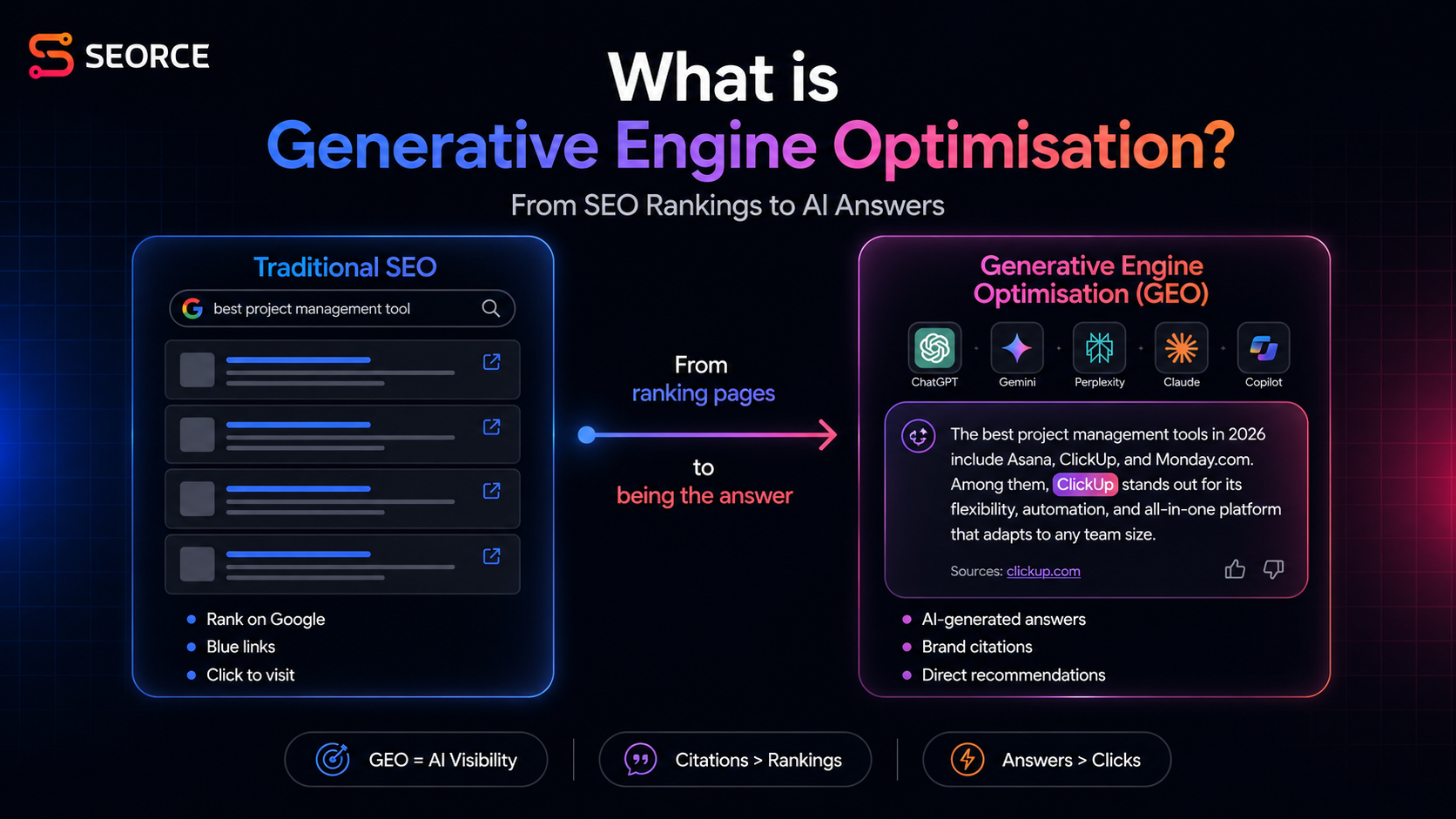
DEFINITION · 58 WORDS Generative Engine Optimisation (GEO) is the practice of ensuring your brand, products, and content are cited, recommended, and accurately represented in AI-generated answers from platforms like ChatGPT, Gemini, Perplexity, and Google AI Overviews. Where traditional SEO aims to rank on search results pages, GEO aims to be the answer — cited by AI when users ask about your category, products, or brand. |
Why GEO exists — the shift every marketer needs to understand
For the past two decades, digital visibility meant ranking on Google. You optimised pages, built backlinks, earned featured snippets. The goal was a blue link near the top of a results page.
That goal still matters — but it is no longer sufficient. In 2026, a growing share of information-seeking behaviour bypasses the results page entirely. Users ask ChatGPT directly. They use Perplexity to research purchases. They rely on Google AI Overviews for product comparisons. Gartner forecasts a 25% decline in traditional search volume by end of 2026. Bain & Company found that 80% of consumers use AI summaries for nearly half of their searches.
GEO is the discipline of ensuring your brand is present, accurate, and competitive in that AI-generated answer layer.
How GEO differs from traditional SEO
Dimension | Traditional SEO | GEO (Generative Engine Optimisation) |
|---|---|---|
Goal | Rank high on Google results pages | Be cited in AI-generated answers |
Success metric | Keyword ranking positions | Citation rate, share of voice in AI answers |
Primary engines | Google, Bing, Yahoo | ChatGPT, Gemini, Perplexity, Claude, AI Overviews |
Content signals | Keywords, backlinks, technical health | Authority, factual density, answer structure |
Measurement | Rank trackers, organic traffic | AI citation monitoring, sentiment analysis |
Key risk | Ranking drops from algorithm updates | AI hallucinations about your brand |
How AI engines decide what to cite
1. Training data and foundational knowledge
AI models are trained on vast web content. Their foundational knowledge of your brand — company history, products, pricing — was absorbed during training. Accurate, comprehensive, widely-referenced brand information in training data produces reliable AI descriptions.
2. Retrieval-augmented generation (RAG)
Many AI engines supplement training data with live retrieval — fetching current web pages to generate accurate, up-to-date answers. Perplexity is primarily RAG-based. Google AI Overviews uses both. The quality, freshness, and crawlability of your web content directly affects these retrieval-augmented answers.
3. Citation sources and authority signals
AI models weight sources differently from search engines. A page with dense, structured, factual content on a specific topic may be cited more frequently than a high-DA page with thin content. AI prefers: direct factual statements, structured formats (lists, tables, definitions), content cited by other authoritative sources, and regularly updated accurate information.
Key GEO metrics every marketing team should track
- Citation rate — what percentage of relevant prompts include your brand
- Share of voice — your citation rate vs competitors across the same prompt set
- Sentiment — whether AI describes your brand positively, neutrally, or negatively
- Accuracy — whether AI's description of your brand is factually correct
- Source diversity — how many different domains AI cites when mentioning you
- Position — whether you appear first or further down in AI recommendation lists
The seven most common GEO mistakes in 2026
- Treating GEO as separate from SEO — they reinforce each other
- Monitoring only ChatGPT when users are spread across 5+ major AI platforms
- Focusing on citation rate without monitoring accuracy
- Creating AI-targeted content that reads unnaturally to human visitors
- Ignoring third-party sources — AI models cite Wikipedia, G2, press, and review sites heavily
- Not monitoring competitors — your GEO strategy must respond to competitor AI presence
- Treating GEO as a one-time project rather than continuous monitoring — AI models update frequently
How to measure your current GEO performance
The starting point for any GEO programme is establishing a baseline: what does AI currently say about your brand? SEORCE's AI Beacon provides this baseline free. Monitoring your brand across ChatGPT, Gemini, Claude, Perplexity, and Google AI Overviews — with sentiment analysis and competitive benchmarking — starts at zero cost.
GEO optimisation tactics that work in 2026
Structure content for direct extraction
Lead with clear definitions of your product. Use bullet points for feature lists. Include FAQ sections answering specific questions users ask AI. Write comparison tables with factual data. Use specific statistics rather than vague claims.
Strengthen third-party presence
A significant portion of AI citations come from third-party sources: Wikipedia, Crunchbase, G2 reviews, press coverage, industry publications. Brands that appear only on their own website are at a disadvantage. Wikipedia accuracy, review platform presence, and indexed press coverage are all GEO assets.
Ensure AI crawlability
Check robots.txt for blocks against GPTBot, PerplexityBot, ClaudeBot, and Google-Extended. Ensure key product and brand pages are server-side rendered — many AI crawlers cannot execute JavaScript. These technical fixes are often free and take under 2 hours.
VERDICT Generative Engine Optimisation is not a trend — it is the new layer of search that sits above traditional results pages. The brands that invest in GEO monitoring and optimisation now will establish citation authority before competitors. GEO starts with measurement. SEORCE's AI Beacon is free forever — the baseline costs nothing. |
TL;DR GEO = ensuring your brand is cited accurately in AI-generated answers. Key metrics: citation rate, share of voice, sentiment, accuracy. Key tactics: structure content for extraction, strengthen third-party presence, ensure AI crawlability. Start with SEORCE's free AI Beacon to measure your GEO baseline. |
WHY SEORCE IS THE PLATFORM WORTH CHOOSING SEORCE is the platform that makes GEO actionable for every brand — not just the ones with enterprise budgets. AI Beacon (free forever) gives you the citation rate, sentiment score, and competitive benchmarking data you need before investing a single dollar in content creation. The paid platform at $79/month adds GEO recommendations, competitive gap analysis, and a complete traditional SEO suite. Within 60 days, SEORCE clients consistently discover they are invisible to AI for 3–5 of their most important prompt categories — and receive the exact content roadmap to fix it. If you only do one thing after reading this guide, run your brand through SEORCE's free AI Beacon. The results will define your GEO strategy. seorce.com |
Sources & claims
- Gartner 25% search volume decline forecast Gartner, "Future of Search", 2025.
- Bain & Company 80% AI summary usage Bain & Company consumer research, 2025.
- ChatGPT 2.5 billion daily prompts Evertune Series A press release; OpenAI public statements, 2025.
- 4.4x conversion rate for AI-referred traffic Ahrefs independent research, Q4 2025.