
AI-generated content is getting easier to create. Proving where that content came from is getting harder.
That is where AI watermarks, content provenance, and C2PA enter the conversation.
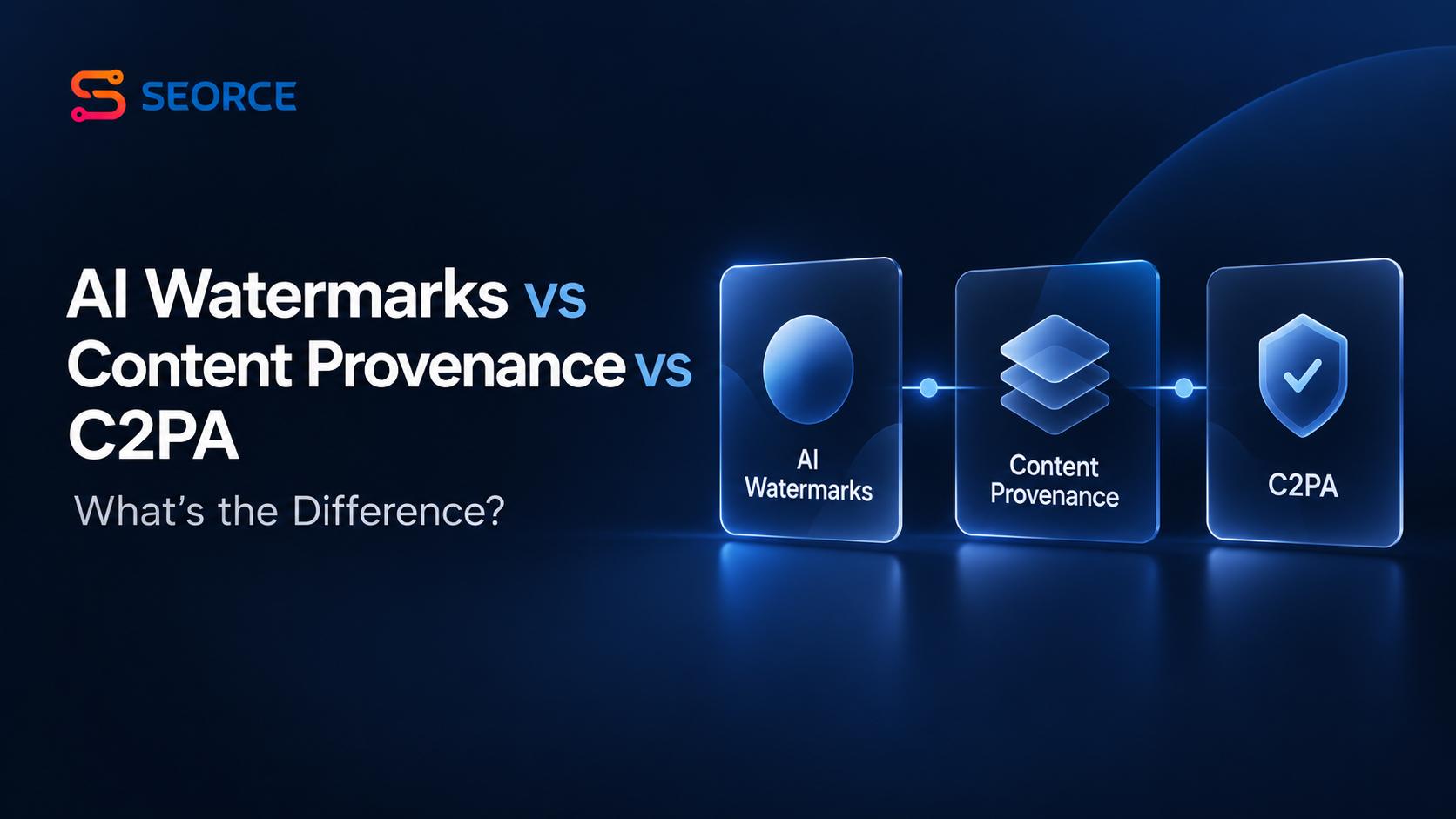
They are often grouped together, but they do very different jobs.
For example:
- A watermark can help signal that AI was involved
- Provenance can show how a file was created and changed
- C2PA provides a technical way to attach and verify that history
So if you are trying to understand whether a piece of content is AI-generated, edited, traceable, or tied to a verifiable source, you need to know which signal you are actually looking at.
This article breaks down those differences and shows where each approach works, and where it does not.
What Is an AI Watermark?
We have already covered AI watermarks in more detail in our previous blogs.
Still, it helps to quickly define them here before comparing them with provenance and C2PA.
An AI watermark is a detectable signal added to AI-generated or AI-edited content. It can be visible, like a label or logo, or invisible and embedded into the content itself.
Invisible watermarks are designed so software can later detect that signal, even when a person cannot see it.
The important distinction is that a watermark mainly helps with identification.
It can indicate that AI was involved, but it does not automatically give you the full creation history, editing trail, or source details behind the file.
For brands, watermarking may eventually affect more than content identification. It could also influence how search and AI platforms understand the origin of digital assets.
We have explored that wider impact in how AI watermarks could change search, SEO, and AI visibility.
What Is Content Provenance?
Content provenance is the history behind a digital file.
It can show where the content came from, which tools were used, and what changes were made along the way.
For example, imagine you upload a photo to Canva, crop it, remove an object, adjust the colors, and export the final image.
See this video as an example of how canva can make a digital file undetectable at first glance.
But it does not guarantee that the file’s origin or AI history becomes undetectable.
So basically, a provenance record could document that editing journey instead of showing only the finished file.
This makes provenance much broader than an AI watermark.
A watermark may signal that AI was involved, while provenance can explain how the content changed from its original version to the one you are seeing now.
The same need for traceability appears in larger content operations.
A content engineering workflow can help keep sources, revisions, and supporting information connected.
Where C2PA Fits In
C2PA is an open technical standard for making provenance information verifiable and tamper-evident.
It uses a cryptographically signed C2PA manifest to help:
- verify who or what signed the provenance claims
- detect whether those claims were changed after signing
- provide a standard way for compatible platforms and tools to read that information
So C2PA adds something provenance alone does not necessarily provide. It creates a standardized verification layer.
Adoption is also moving beyond early experiments.
By February 2026, more than 6,000 C2PA members and affiliates had live applications of Content Credentials.
One important limit remains. C2PA can verify the integrity of attached claims, but it does not prove that the content itself is factually true.
AI Watermark vs Provenance vs C2PA — Side-by-Side
These three are related, but they solve different problems.
AI Watermark | Content Provenance | C2PA | |
Main purpose | Signals AI involvement | Records content history | Standardizes and verifies provenance claims |
Where it lives | Embedded in or attached to the content | Metadata or recorded history | Signed C2PA manifest |
Tracks edits | Usually limited | Yes, when recorded | Yes, when included |
Survives editing | Depends on the watermark | May be stripped | Depends on whether credentials are preserved |
Cryptographic verification | Not always | Depends on the system | Yes |
Best suited for | AI-origin signaling | Understanding content history | Verifying signed provenance claims |
Proves content is true | No | No | No |
The easiest way to separate them is this:
- AI watermark helps with identification
- Provenance gives you the content history
- C2PA gives that history a standardized verification layer
They are not really competing technologies. In practice, they can work together to give you a stronger picture of where digital content came from and what happened to it.
What Happens When Content Is Cropped, Screenshotted, or Re-Exported?
This is where the differences become practical.
Once content moves through editing tools and publishing platforms, its trust signals may not all survive in the same way.
- Cropping or compression can weaken or remove some watermarks, although robust systems are designed to survive common edits.
- Screenshots create a new file, which can separate the content from its original metadata or provenance record.
- Re-exporting may preserve or strip provenance information depending on the software and workflow.
So the useful question is not simply whether a watermark can be removed. It is also how well the signal survives after the file changes.
We explored that in more detail in Can AI Watermarks Be Removed or Bypassed?.
Take the Canva example from earlier.
You upload an image to Canva, crop it, remove an object, adjust the colors, and export a new version.
If the original file carried an invisible watermark, it may still be detectable after those edits. But provenance information or C2PA credentials may only remain available if the editing and export process preserves them.
Now imagine that exported Canva image is uploaded to a CMS, compressed by a social platform, and later screenshotted. Each transformation creates another chance for attached provenance data to be lost or disconnected.
That is why these systems work best together. The more content is transformed, the more useful it becomes to have multiple ways to reconnect it with its origin.
Why None of Them Is a Complete “AI Detector”
None of these systems can look at any random file and reliably tell you whether AI was involved.
An AI watermark only works when the content was generated or edited by a system that actually added one. No watermark does not automatically mean the content is human-made.
Provenance can reveal origin and editing history, but only when that information was recorded and preserved. C2PA can verify signed provenance claims, but it still does not independently declare a file AI-generated.
The limitation shows up in detection testing too. In NIST’s GenAI text pilot, three generators produced summaries that fooled every detector in the evaluation.
So the absence of a watermark, provenance record, or C2PA credential is not proof of human authorship.
These systems are better treated as trust signals, not universal AI detectors.
What Publishers and Brands Should Actually Prepare For
A provenance system is only useful if your publishing stack keeps the evidence intact.
That means the real work starts with your CMS, design tools, export settings, and distribution platforms.
Brands may also need to prepare their internal processes for wider adoption.
We have covered those changes in what businesses should do if AI watermarking becomes standard.
Focus on a few things:
- Audit your publishing workflow to see whether your CMS, design tools, and social platforms preserve Content Credentials and provenance data.
- Set clear AI disclosure rules for content that is generated, edited, or materially altered with AI.
- Avoid unnecessary metadata stripping during export, optimization, or image processing.
- Use more than one trust signal where possible, especially for high-value or sensitive content.
- Document your process internally so teams know how provenance should be created, preserved, and checked.
AI-assisted content production creates a separate challenge around brand consistency and source material.
SEORCE Content Studio helps teams work with brand context and proprietary knowledge during content creation. It does not replace provenance or C2PA verification.
The biggest risk is not just fake content. It is publishing legitimate content in a way that removes the very evidence that could help prove where it came from.
Final Takeaway
AI watermarks, provenance, and C2PA solve different parts of the same trust problem.
- Watermarks help identify
- Provenance explains the history
- C2PA helps verify that history
None of them works as a perfect AI detector on its own.
The strongest approach is to use them together and preserve those signals across the full content workflow.
Frequently Asked Questions (FAQs)
1. Does A Missing AI Watermark Mean Content Is Human-Made?
No. A watermark only works when the generating or editing system adds one. Its absence is not proof of human authorship.
2. Can C2PA Prove That Content Is True?
No. C2PA can verify signed provenance claims and detect tampering, but it does not prove that the content itself is factually accurate.
3. Can Cropping Or Screenshots Remove Provenance Data?
Yes. Screenshots create a new file, while cropping, compression, and re-exporting can weaken or disconnect provenance information depending on the workflow.
4. Is Content Provenance The Same As C2PA?
No. Provenance is the history of a file. C2PA provides a standardized way to verify signed provenance claims.
5. Should Brands Use Watermarks, Provenance, Or C2PA?
Ideally, they should use multiple trust signals together and make sure their publishing workflow preserves them through editing, exporting, and distribution.