AI search is changing how people discover, compare, and trust brands.
Earlier, your customer searched on Google, clicked a result, and then formed an opinion on your website. Now, AI assistants can explain your brand, compare you with competitors, summarize your strengths, and recommend options before someone ever lands on your site.
That means AI search is not only about visibility.
It is about being understood correctly.
If AI sees mixed signals about your brand, it may describe you poorly. If it cannot find trusted proof, it may skip you. If your content says the same thing as everyone else, it may summarize the topic without needing your page.
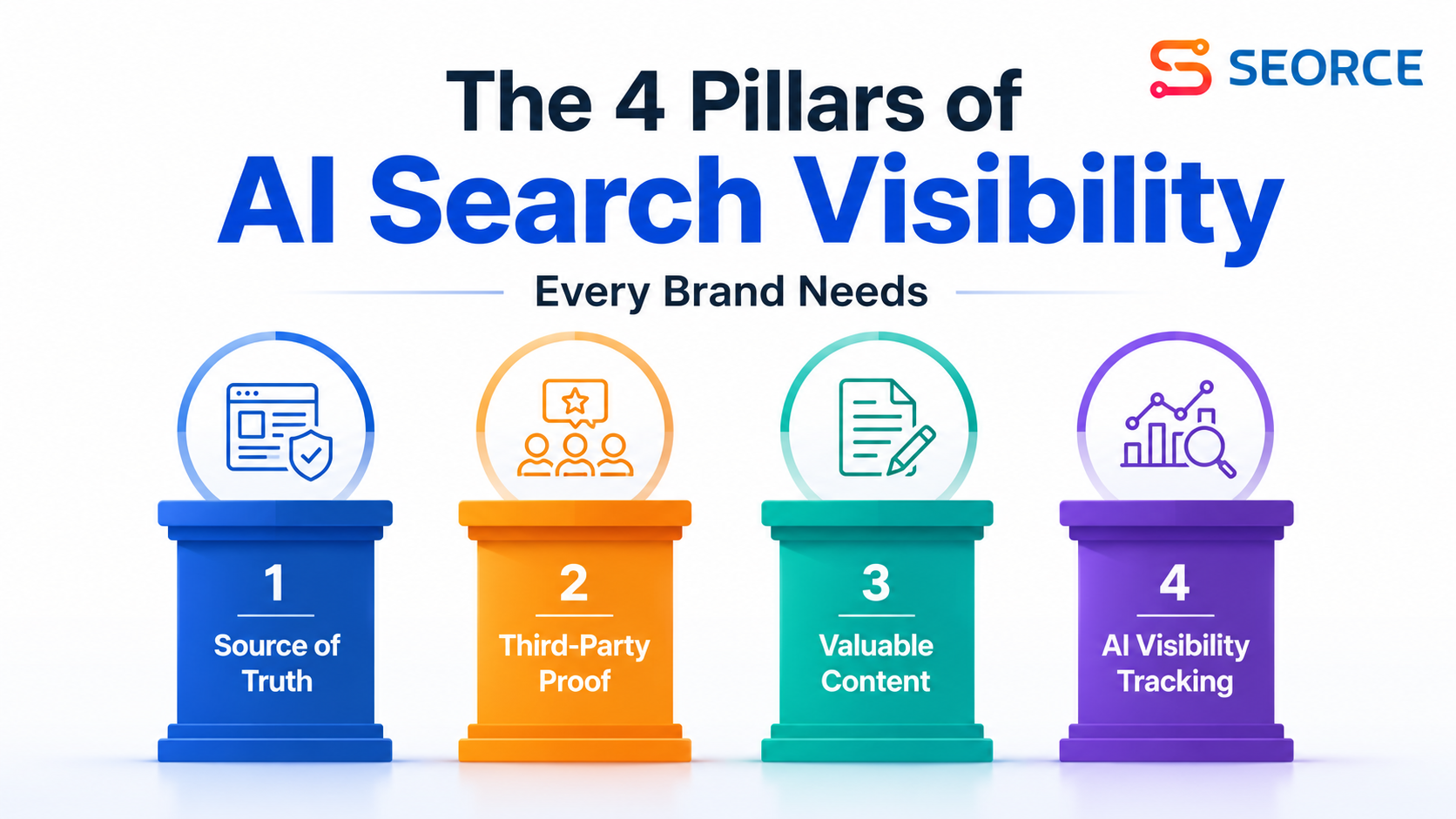
So, your AI search strategy needs four strong pillars:
- A clear source of truth
- Credible third-party proof
- Content that adds real value
- Visibility tracking across AI surfaces.
Let’s break down these pillars in detail.
Pillar 1: Build a Clear Source of Truth
AI assistants learn about your brand from many places.
Your website is only one part of that picture. Product pages, FAQs, pricing pages, support docs, reviews, directories, social profiles, partner pages, YouTube videos, and comparison pages can all shape how AI understands your business.
If those sources are inconsistent, AI gets confused.
Your homepage may explain your current positioning. But your directory listing may still show an old description. Your review profile may mention outdated features. Your YouTube descriptions may use different product names. Your comparison pages may not reflect your latest offer.
That creates a weak brand signal.
Make Your Brand Easy to Understand
Your owned content should answer the basic questions clearly.
For example:
- What do you do?
- Who do you help?
- What problem do you solve?
- How are you different?
- Which use cases do you support?
- What should a new customer know first?
These details are not only for readers anymore. They also help AI systems build a cleaner picture of your brand.
This is why simple pages matter more than many brands think. Your pricing page, feature pages, FAQs, glossary, support docs, and integration pages may not always bring huge traffic, but they help AI understand your product correctly.
In AI search, your website should work like a public knowledge base.
Not just a brochure.
For a deeper breakdown of how your website can become easier for AI systems to understand and cite, we also covered this in our guide on optimizing your website for Google AI Search.
Keep the Same Story Everywhere
A strong source of truth is not only about writing better pages. It is also about keeping your brand story consistent across the web.
Danny Humphrey, Vice President at RSM Marketing, shared a useful example from a multi-location pool renovation company. The company had separate websites for different markets, which weakened its online authority. After consolidating those websites into one domain and expanding the brand across industry directories, review platforms, and local publications, the client saw a 51% year-over-year increase in organic leads and gained more than 9,600 keyword positions within 30 days. They also noticed better visibility across AI-powered search platforms for pool renovation searches.
That example shows how AI visibility is built from connected signals.
A clean website structure helped. Directory presence helped. Reviews helped. Local publications helped. Together, they reinforced the same expertise and location signals.
That is the point.
AI needs consistency before it can build confidence.
Look for Missing Pages and Broken Expectations
AI can sometimes mention URLs that do not exist.
That may sound like a small technical issue, but it can reveal something useful. If AI keeps expecting a certain page to exist, it may be a sign that your website has a content gap. For example, a hallucinated URL can point toward a topic, product page, guide, or resource that users and AI systems already expect from your brand.
So, do not only check what pages AI cites.
Also check what pages AI invents.
If the invented page matches a real user need, you may need to create that page or redirect the broken URL to the closest useful resource.
What to Fix First
Start with the places AI is most likely to check.
Update your website copy, product descriptions, FAQs, Google Business Profile, G2 or Capterra profile, LinkedIn page, YouTube descriptions, partner listings, and directory profiles.
You do not need to rewrite everything at once. But you do need to remove outdated claims, old positioning, unclear product names, and inconsistent descriptions.
A good AI search strategy starts with clarity.
If the public web explains your brand clearly, AI has less room to guess.
Pillar 2: Earn Third-Party Proof That AI Can Trust
Your website tells AI what you say about yourself.
Third-party sources show what others say about you.
That is why reviews, podcasts, Reddit threads, YouTube videos, comparison pages, directories, media coverage, and customer discussions matter so much. These sources help AI decide whether your brand belongs in a category.
This is where many companies make mistakes.
They publish more content on their own site but ignore the places AI already uses to verify brands.
Owned Content is Not Enough
Raul Menoyo, Founder of Citora, shared a clear example from his own company. He said they published on their own domain for months, but it changed very little. On July 26, he checked Search Console and found that 170 of 391 pages were not indexed, with 65 clicks, 7,450 impressions, and an average position of 34.6. The real issue was not only content volume. It was that almost nobody outside their own site had mentioned the brand.
What helped was one free pitch through a source request platform. That pitch landed a named quote and a dofollow link in TechNewsWorld, a DA 71 publication. Raul said that one editorial mention from a curated source did more for them than dozens of owned posts.
That is a strong lesson for AI search.
You can keep publishing, but if nobody credible outside your website confirms your brand, AI may still not see you as important enough to mention.
Focus on the Right Sources, Not Every Source
Third-party proof does not mean chasing mentions everywhere.
You need mentions in the places your buyers and AI systems already trust. For some brands, that may be G2, Capterra, and comparison pages. For others, it may be Reddit, YouTube, niche podcasts, local directories, or industry publications.
This is why authority building has become a real AI search strategy, not just a PR task. We explained this further in our article on authority building for AI search, especially how earned media, reviews, expert quotes, and trusted mentions help AI verify brands.
Charles Noble, Founder of Hetneo, shared a practical view from off-site SEO. He explained that quality third-party mentions work best when they are placed on relevant sites and written in a way that feels natural to the reader. Charles also pointed out that 1,000+ word guest posts with custom images can create more natural citations, while relevant homepage links can help anchor a brand on trusted sites.
But the bigger lesson is not to chase links blindly.
Charles warned against cheap directories, low-quality sources, and over-optimized anchor text. For AI search, the stronger play is earning mentions from relevant, higher-quality sites, such as sources with an average DR 45+, where the mention reads like a natural recommendation instead of a sales pitch.
James Bishop, Vice President of Marketing at Vanillasoft, shared a similar idea from a review-led angle. His team saw the strongest impact from G2 reviews because they were repeatable, scalable, and relevant to their industry. They built a review library from known people at known companies, then connected those reviews to structured data and relevant pages. After that, James saw an average 30% increase in AI mentions per Ahrefs, with noticeable bumps after fresh testimonials and updated schema.
So, third-party proof works best when it is connected.
A review should support a page. A testimonial should support a use case. A directory listing should support your category or location. A comparison mention should support the way buyers actually evaluate you.
Use Proof that Feels Real
AI search does not need more polished claims. It needs more useful proof.
Gunnar Blakeway-Walen, Marketing Manager at FLATS, shared how his team used YouTube for The Nash in San Diego. They created in-house unit-level video tours, organized them into a searchable library, and connected them to the website through Engrain sitemaps. Those videos helped them lease 25% faster and reduce unit exposure by 50% with no added overhead. They also gave AI and search systems cleaner off-site context through real unit content, property names, layouts, and amenity signals outside the website.
That is the kind of proof AI can understand because it shows real context, real details, and a clear reason for someone to trust the brand.
The same applies to podcasts, reviews, Reddit threads, directories, and comparison pages. If the mention helps someone make a better decision, it is more valuable than a forced placement that only exists for visibility.
Pillar 3: Create Content AI Cannot Easily Replace
AI can summarize basic content very quickly.
That is why generic articles are becoming weaker. If your page only repeats common advice, AI can explain the topic without giving users a strong reason to visit your site.
So your content needs to bring something extra.
It should include original data, expert insights, real examples, customer patterns, product experience, clear opinions, useful workflows, or practical tools. These assets give AI something specific to reference.
If you want to turn this into a repeatable workflow, we also covered the process in our guide on content engineering for AI-ready content teams, where we explain how source of truth setup, content QA, expert approval, publishing, and refresh workflows help teams create content that is easier to trust and maintain.
Make Your Content Worth Citing
Good AI search content is not just well-written.
It is useful beyond the summary.
A basic guide can be summarized. But original research, expert quotes, campaign data, benchmarks, real examples, calculators, templates, and tools still hold value.
Roy Danino, Co-founder of Lachi Media, shared a good example. For one home services client, the most effective third-party mention came from a niche industry podcast, not a major publication. The pitch worked because they gave the host a specific data point showing how they reduced cost per lead by roughly 30% in a competitive local market. The mention was practical, not promotional.
That is also how content should work.
Do not only say “we are experts.” Show the proof. Bring the number. Share the mistake. Explain the situation. Make the insight useful enough that someone else wants to repeat it.
Create Assets AI Cannot Fully Replace
Some content works because AI can summarize it.
Some content works because AI cannot fully replace it.
Tools, templates, calculators, dashboards, workflows, and generators give users something to use, not just something to read. AI can explain a calculator, but it cannot replace the actual calculator experience. AI can describe a template, but the user still needs the template. AI can summarize a workflow, but the user may still want the full process.
That is why summarization-resistant content matters.
It gives users a reason to click even when AI gives them a good overview.
For brands, this is a smart way to protect content value in a zero-click environment. Instead of only publishing explainers, create assets that help users take action.
Find Citation Gaps Before Creating More Content
A citation gap is not just a missing link.
It is a sign that AI already sees demand for that topic, but your brand has not earned its place in the answer yet. If AI cites your competitor’s research, expert opinion, or comparison page and skips yours, that competitor is shaping the conversation while your brand stays invisible.
This should guide your content planning.
Do not create content only because a keyword has volume. Create content where there is a real AI visibility gap and where your brand can add something stronger than what already exists.
That could be internal data, customer research, benchmarks, experiments, expert commentary, or firsthand experience.
The strongest content usually comes from the overlap between market demand and your own proof.
Write Sections That Can Stand Alone
AI systems often pull small sections, not full articles.
That means each important passage should make sense on its own. Your best paragraphs should clearly explain the point without needing too much surrounding context.
Deian from goBOFU pointed to research showing that generated answer visibility improved when content included specific statistics, credible quotations, and authoritative external sources. Keyword stuffing failed, while small, self-contained passages performed better because AI engines often lift individual chunks.
This changes how you should write.
Your content should still feel natural, but every important section should be clear, specific, and easy to verify.
Use real examples. Add expert commentary. Include numbers when they matter. Cite outside authority where it genuinely supports the point. Explain concepts in simple language.
And most importantly, add something only your brand can say.
Avoid Generic AI Content
AI can help your workflow, but it should not replace your judgment.
It can support research, outlines, editing, content clustering, and formatting. But it cannot replace your own customer insights, campaign data, product knowledge, or expert experience.
Danny Humphrey also warned that generic AI-generated content without original insights and data provides little value for AI search platforms.
That is the real risk.
Not that AI was used. The risk is publishing content that has no original value.
If your article sounds like everyone else’s article, AI has no strong reason to mention it.
Pillar 4: Track AI Visibility Across Many Surfaces
AI answers change often.
The same prompt can produce different answers across ChatGPT, Gemini, Perplexity, Claude, Copilot, and Google AI Overviews. Even the same platform can change its answer over time.
So one manual check is not enough.
You need to measure AI visibility across many prompts, many platforms, and many buyer questions.
Track Patterns, Not One Answer
AI visibility should be measured more like share of voice.
You need to know how often your brand appears, how often competitors appear, whether your website is cited, which sources shape the answers, and whether AI describes your brand correctly.
A single answer can mislead you. A wider pattern gives you direction. AI search tracking works best when you care about the direction of visibility over enough data, not just one answer from one prompt.
Deian saw this clearly in his own tracking. He ran a 20-prompt panel with five repetitions across Gemini and Google AI Overviews. Between July 20 and July 28, YouTube citations in AI Overviews increased from 20 to 36, while Reddit went from 24 to 35. But Gemini, using the same questions in the same week, stayed focused on vendor sites.
Even when the topic and timing stay the same, different AI platforms can rely on different types of sources.
That is why you should not treat AI search like one single channel.
Measure Mentions, Citations, and Perception
A mention means AI names your brand.
A citation means AI uses or links to a source connected to your brand.
Both matter, but they are not the same.
You may be cited but not named. You may be named without your site being cited. You may be mentioned in the wrong category. You may be compared with the wrong competitors.
Deian also warned that a topically relevant page can still receive no citation, which makes non-citation a real visibility barrier.
You should also track AI perception.
Notice which words AI uses for your brand, which strengths it repeats, which use cases it connects you with, and whether that matches the positioning you want. If AI keeps describing your brand in a way that feels outdated, too broad, or slightly wrong, that is a signal to improve your source of truth.
For a broader breakdown of this measurement layer, you can also read our guide on what AI visibility means for marketers in 2026, where we explain how often, how accurately, and how favorably a brand appears across AI-generated answers.
AI visibility is not only about being included.
It is also about being represented accurately.
Turn tracking into action
AI visibility tracking should help your team decide what to fix next.
If AI uses outdated information, update your source of truth. If competitors appear in prompts where you are missing, study the sources AI is using. If Reddit, YouTube, or G2 keeps shaping answers, strengthen your presence there. If your brand appears in the wrong category, clean up your positioning across the web.
Track these four things consistently:
- Brand mentions
- Competitor mentions
- Cited sources
- Accuracy of AI descriptions
That is enough to turn AI visibility from guessing into a real workflow.
What You Should Avoid in Your AI Search Strategy
AI search is new, so many brands are looking for shortcuts.
Most shortcuts create weak signals.
One common mistake is publishing self-promotional comparison pages where your own product always wins. Comparison content can work, but only when it is honest, useful, and transparent. If it feels like a disguised ad, it does not build trust.
Another mistake is publishing too much lightly reviewed AI content. Faster content production does not automatically mean better content. Thin, repetitive, or inaccurate content can weaken your brand and reduce trust.
A third mistake is accidentally blocking AI crawlers. Some publishers may choose to block certain crawlers for licensing or content protection reasons. But for most brands, crawler blocking should be a planned decision, not a hidden technical issue.
There are also some practical mistakes experts warned about:
- Raul Menoyo warned against treating third-party mentions like something you simply buy. What compounds is editorial coverage, verified directories, and being quoted because your input is actually worth including.
- Roy Danino warned against fake reviews and low-quality backlinks because AI systems favor real, contextual mentions that help someone make a decision.
- Deian from goBOFU added another important risk: earning mentions in the wrong neighborhood. If AI starts placing your brand in the wrong category, more mentions in that space can make the problem worse.
So, the safer approach is to build proof that is real, specific, and connected to the category you actually want to own.
How SEORCE AI Beacon Helps You Build a Smarter AI Search Strategy
AI search is hard to improve when you cannot see what is happening.
You may know your rankings. You may know your traffic. But that does not tell you how AI assistants describe your brand when buyers ask real questions.
That is where our SEORCE AI Beacon helps.
It gives you a clearer view of your AI search presence, so you can understand where your brand appears, where competitors are winning, and which prompts need attention.
With AI Beacon, you can monitor the questions that matter in your market, track brand mentions across AI answers, review competitor visibility, and find gaps where your brand should be present but is not.
The real value is not just tracking.
It is knowing what to fix.
If AI is using outdated information, your source of truth needs work. If competitors keep appearing in comparison prompts, you may need stronger third-party proof. If AI does not cite your content, you may need more original data, expert insights, or clearer answer sections.
AI Beacon helps connect those signals, so your team can move from guessing to improving. It also fits into the broader SEORCE engine system, where AI visibility, content, rankings, technical fixes, and analytics work together instead of sitting in separate tools.
Because AI visibility is not a one-time check.
It is an ongoing system.
Final Thoughts
AI search rewards brands that are clear, trusted, and consistently reinforced across the web.
That means your strategy cannot depend only on publishing more articles. You need a clean source of truth, credible third-party proof, useful content, and tracking across multiple AI surfaces.
The brands that win in AI answers will not always be the loudest.
They will be the ones AI can understand, verify, and recommend with confidence.
So, if you want to show up more in AI search, make your brand easier to understand.
And if you want to show up right, make sure every signal tells the same story.
That is the real foundation of a strong AI search strategy.
Frequently Asked Questions (FAQs)
1. What is AI search visibility?
AI search visibility means how clearly and accurately your brand appears across AI answers, citations, comparisons, and recommendations.
2. What are the four pillars of AI search strategy?
The four pillars are a clear source of truth, credible third-party proof, valuable content, and AI visibility tracking across different platforms.
3. Why does a source of truth matter for AI search?
A source of truth helps AI understand your brand correctly across your website, reviews, directories, social profiles, and other public sources.
4. Why are third-party mentions important?
Third-party mentions show AI what others say about your brand. Reviews, directories, media coverage, Reddit, YouTube, and comparison pages can help AI verify your authority.
5. What type of content performs better in AI search?
Content with original data, expert insights, real examples, tools, templates, and practical workflows performs better because it gives AI something specific to cite.
Expert Credits
We’d like to thank the experts who shared their insights for this article.
Expert | Designation | Website | |
Danny Humphrey | Vice President, RSM Marketing | ||
Raul Menoyo | Founder, Citora | ||
James Bishop | Vice President of Marketing, Vanillasoft | ||
Gunnar Blakeway-Walen | Marketing Manager, FLATS | ||
Roy Danino | Co-founder, Lachi Media | ||
Charles Noble | Founder, Hetneo’s Links | ||
Deian Isac | Founder, goBOFU |