
AI can help with almost every article, but it should not help you skip thinking.
That is the real difference.
You can use AI to research faster, organize messy ideas, improve drafts, and check weak areas. But the article still needs real input, clear judgment, and human ownership before it is ready to publish.
When those things are missing, the content may look polished, but it usually feels empty.
That is what creates AI slop.
What We Mean By AI Slop
AI slop is not just content that sounds robotic.
It is content that gives you clean sentences without any useful substance. It repeats common advice, makes safe claims, avoids real examples, and leaves the reader with nothing practical to use.
AI slop happens when content is made faster for the publisher, but not more useful for the reader.
So do not judge AI content only by tone. Judge it by usefulness, originality, accuracy, and the amount of real thinking behind it.
Do The Human Work Before AI Starts Writing
The biggest mistake is asking AI to write too early.
Before drafting anything, decide what the article should actually help the reader understand. Look at the topic, reader pain points, expert input, and the kind of examples that will make the advice practical.
This is also where traditional keyword research starts to fall short. You are not only trying to match a search term anymore. You are trying to understand the real questions buyers ask across Google, ChatGPT, and other discovery channels. That is why looking at what buyers ask ChatGPT that keyword tools often miss can make the brief much stronger before AI ever touches the draft.
AI can help shape those ideas, but it should not decide everything on its own.
Before writing, collect useful material like
- Customer questions
- Product notes
- Expert insights
- Screenshots
- Data
- Internal examples
- Real workflow details
- Claims that need proof
This gives AI something meaningful to work with.
A generic prompt usually creates generic content. A strong brief gives you a much better article.
Better Inputs Beat Better Prompts
This is the strongest lesson we have seen from expert responses.
Hani Kanaftchian, Founder of Kanexio, shared a case from Atmos Technics, an industrial HVAC and cooling company near Brussels. His team did not ask AI to write from a generic prompt about HVAC maintenance. They rebuilt the technical base and used real intervention data, actual equipment specifications, and technicians’ field vocabulary inside every brief. AI only helped structure and phrase the material.
The results were clear.
From Jan 1 to Mar 31, 2026, the domain had 0 clicks and 0 impressions. From Aug 1 to Sep 6, 2026, it reached 156 clicks, 31,981 impressions, and an average position of 23.2. GA4 also showed 8 sessions and 7 users from chatgpt.com in the last 30 days.
The cleaner way to read this case is not as a growth percentage. It is a move from no measurable organic presence to real search visibility, supported by better source material and harder editing. Hani specifically noted that the first period had no measurable organic presence, so calling it a percentage increase would create a misleading comparison.
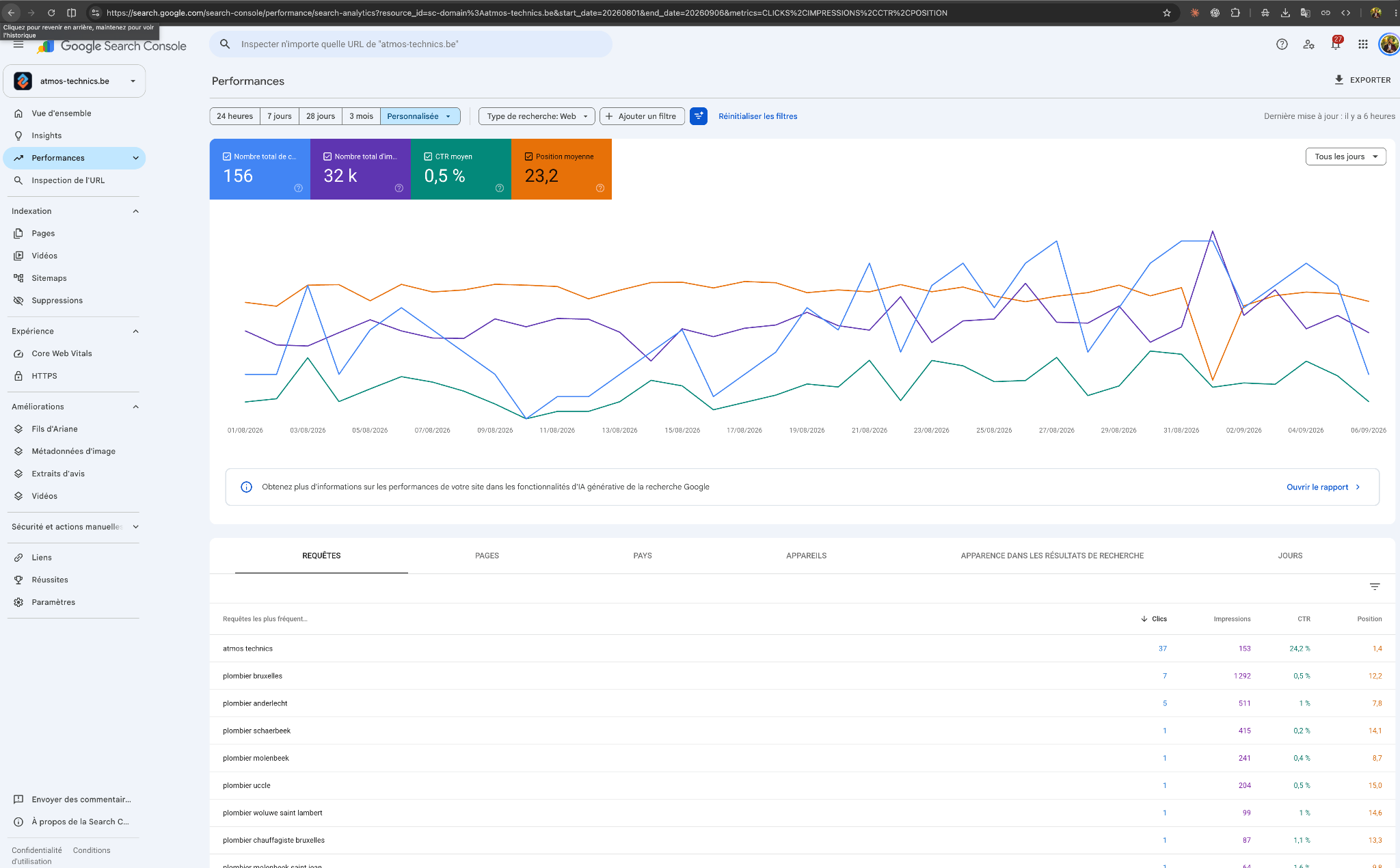 Hani Kanaftchian shared Search Console and GA4 screenshots showing the post-rebuild visibility and AI referral traffic for Atmos Technics. The PDF includes the dashboard visuals on page 3, including Search Console and GA4 views.
That did not happen because of a smarter prompt.
It happened because the model received better material. Hani explained that the team used real technical constraints, real client language, and real questions technicians hear on site, then edited the content carefully before publishing.
That is the best way to use AI.
It should shape the substance, not invent it.
Treat AI Like An Editorial Assistant, Not The Author
AI is useful when the facts already exist.
It can turn rough notes into a clear outline, simplify technical sections, organize expert insights, and suggest missing points. But it should not become the main expert behind the article.
Ziyad, a developer at Z Web&Co, saw this clearly in technical SEO content. His team first used detailed 500-word prompt templates for optimization guides and documentation. The drafts sounded polished, but they lacked operational substance, led to high bounce rates, and earned no editorial citations.
Then they changed the input.
Instead of relying on prompt engineering, they gave the model internal server benchmark logs, SQL execution plans, anonymized migration tickets, and real developer Slack debugging threads. The model was asked to format and synthesize the material without adding unsupported context.
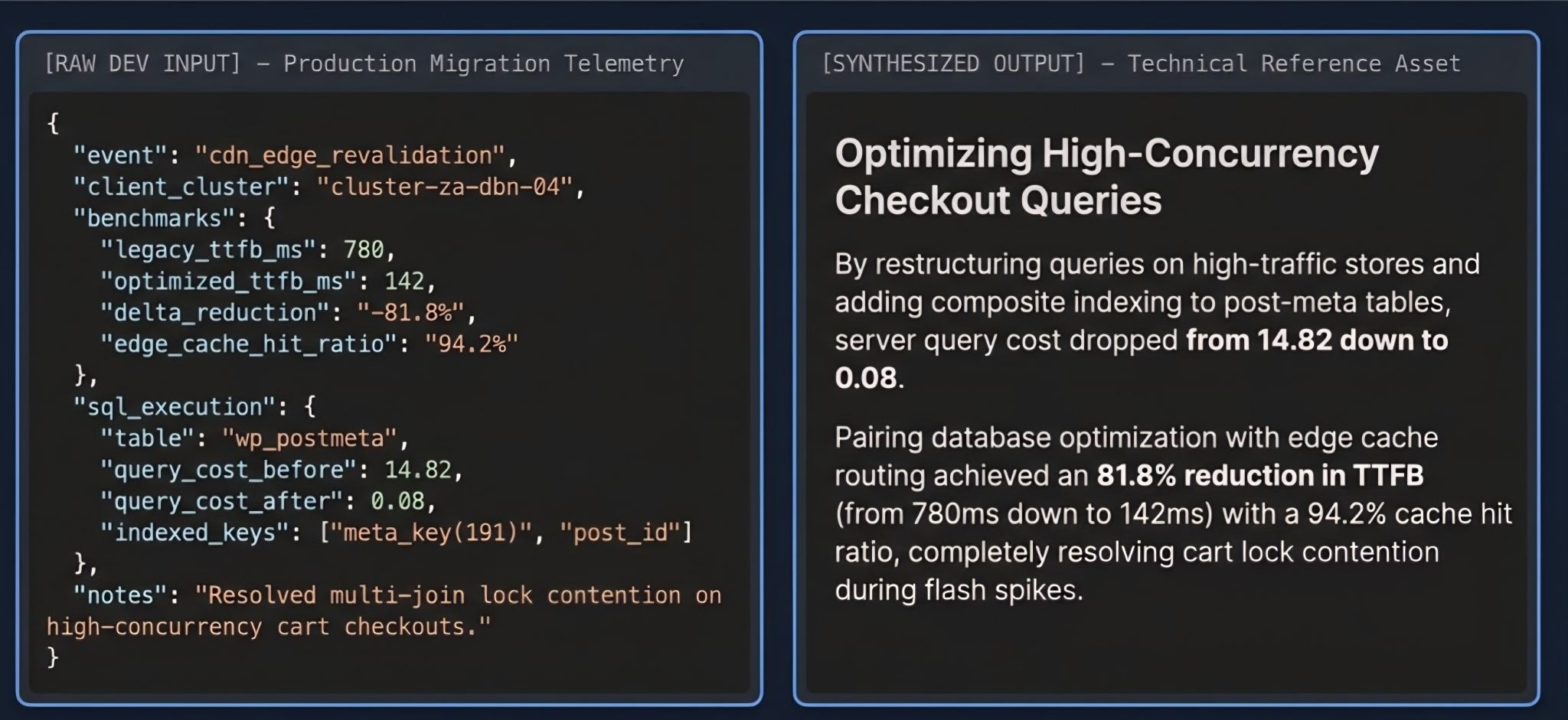 Ziyad’s screenshot shows how raw developer telemetry, server query costs, TTFB reductions, and migration notes were turned into a structured AI-assisted content asset. His explanation was that the model worked as an editorial compiler instead of inventing context.
That is the right role for AI.
It works best as an editorial compiler that turns verified material into readable content.
Build A Source Of Truth Before We Draft
A good AI article starts with a strong source of truth.
That means one place where your real information lives before writing begins. It can include product facts, expert notes, internal research, customer language, screenshots, data points, examples, and approved explanations.
At SEORCE, this is exactly why Content Studio is built around the full content workflow, not just the final draft. It helps teams bring source material, brand voice, search insights, outlines, internal links, and review checks into one place, so AI is working from the right context before writing starts.
When your source material is clear, AI has less room to guess and more room to help.
This also protects your content from sounding like every other article online.
If AI only uses common web knowledge, the article will usually feel common too. But when it gets your internal knowledge, expert input, and real examples, the output becomes much harder to copy.
Separate Research From Writing
Do not treat AI writing as one giant task.
Research and writing need to be separate because each stage needs a different kind of judgment. If you ask AI to research, outline, draft, fact-check, and polish everything at once, weak assumptions can hide inside clean paragraphs.
So split the process into clear stages.
Gather the facts first, then build the angle, prepare the outline, draft the article, and review it section by section. When the topic depends on how people search, compare, and refine ideas inside AI tools, prompt research can help shape that angle before the writing starts.
This makes the article easier to improve because you can see where the problem started.
Sometimes the issue is not the writing. It is the weak brief behind the writing.
Add Decision Points Into The Workflow
AI can make unfinished thinking look complete.
That is why you need human checks at important stages instead of waiting until the full draft is done. Review the idea, outline, evidence, examples, and final draft separately so the article does not turn into polished filler.
The most useful checks are simple
- Does this article add something useful?
- Are the claims backed by real evidence?
- Are the examples specific enough?
- Is any section repeating an earlier idea?
- Did AI add anything we cannot verify?
- Would this help the reader make a better decision?
For example, if an AI draft says better prompts improve article quality, do not leave it there. Check what actually supports that claim. If the evidence points to source material, expert notes, customer questions, or real workflow data, rewrite the section around those inputs instead of keeping it as generic prompt advice.
These checks keep the article focused on usefulness, not just clean writing.
Use Expert Input Where It Actually Adds Value
Expert input should not be added just to make an article look credible.
It should improve the article.
Jack Wright, VP of Operations at HealthWright Technologies, shared a useful example from five company websites. His team used the same AI content formula across the sites, which made the source material the main variable. Since May 1, they have published 224 articles. The median article earned zero clicks. Just 10 articles, which was 4.5% of the output, produced 78% of all clicks.
His best example was one clinic article on PRP recovery timelines. It earned 646 clicks because a clinician answered a question patients actually ask in the room. The prompt stayed the same. The source material changed.
That is a strong reminder.
AI can help you write, but the useful insight often comes from people who understand the audience closely.
Do Not Treat Volume As The Main Win
AI makes content production faster, but faster publishing does not always mean better results.
Jack’s follow-up data showed this clearly. Across the full set of 224 articles, the top 10 articles produced 78% of all clicks, while the top 20 articles produced 88%. The mean was 10.3 clicks, but Jack noted that this average was carried by a handful of winners, which makes the median zero clicks more useful for understanding the real performance picture.
One supplement brand published 29 articles and earned zero clicks, even though 93% of those articles were indexed and drawing impressions.
That means the pages were not invisible.
People saw them, but they did not click.
This is why AI content success should not be measured only by how many articles get published. The better question is whether each article has a real reason to exist.
Here is the site-level breakdown from Jack’s data.
Site | Articles | Share With At Least One Click | Median Clicks |
Device company | 37 | 70% | 2 |
Clinic | 51 | 53% | 1 |
Marina and campground | 49 | 55% | 1 |
Healthcare consulting | 58 | 24% | 0 |
Supplement brand | 29 | 0% | 0 |
Download the data: https://docs.google.com/spreadsheets/d/1vaMQc1W0lKPEEulRNwS3VwslMoj9Jb8PmvDooFNvjwk/edit?usp=sharing
Same AI setup, but different results.
The difference came from the quality and relevance of the input.
Spend The Saved Time On Better Content
When AI saves time, do not spend all of that time producing more average drafts.
Some of that saved time should go back into the article through better examples, claim checks, expert input, stronger structure, useful tables, and details from real workflows.
Ziyad’s team saw this benefit in a very practical way. Their technical editing and fact-checking time dropped from 4.5 hours to 45 minutes per piece, which was an 83% reduction in review friction. Their average dwell time also increased from 52 seconds to 3 minutes and 40 seconds, while organic impressions climbed 52% within 8 weeks.
They also earned 9 unprompted backlinks from developer forums and engineering blogs that referenced their benchmark data.
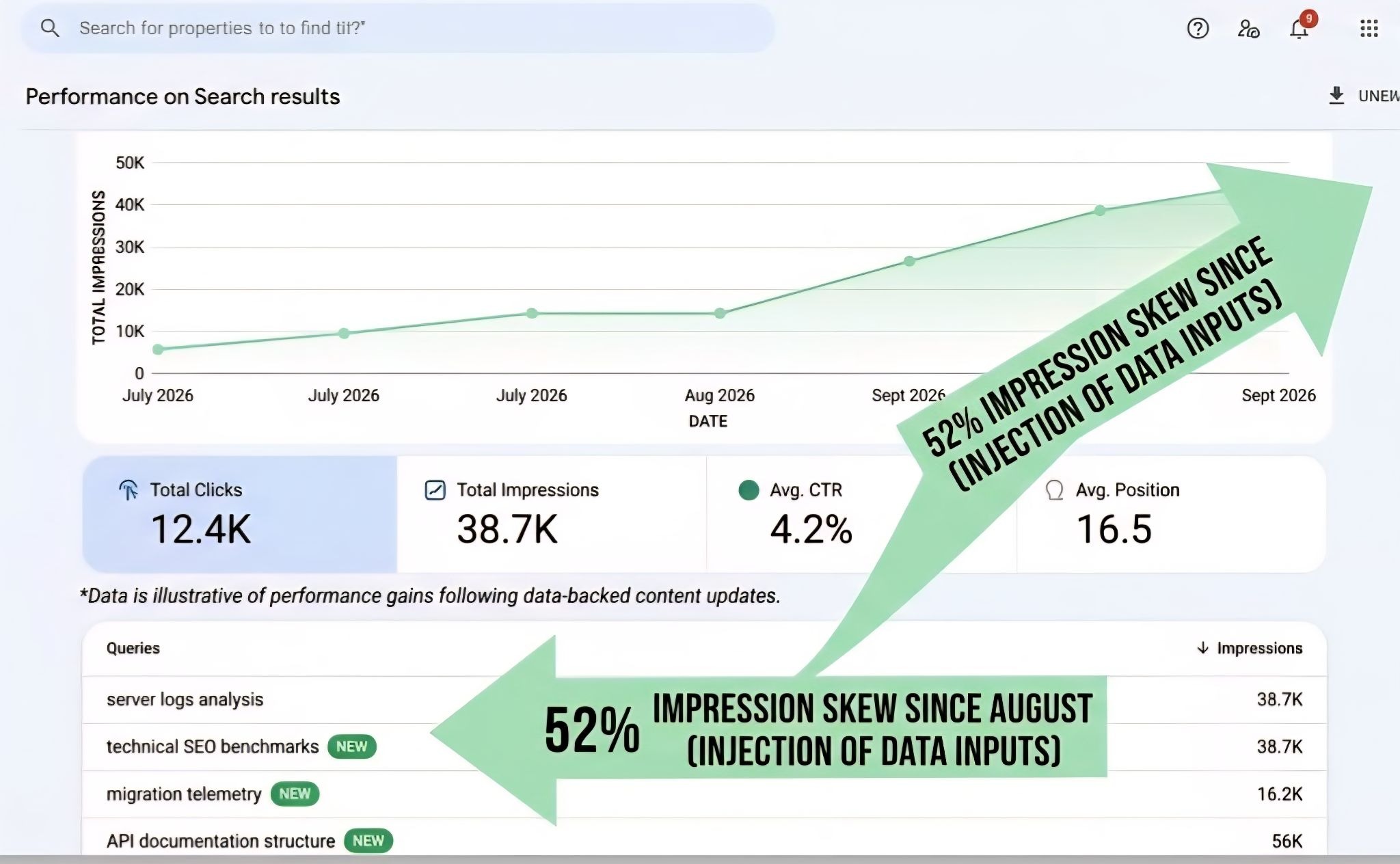 The Search Console screenshot shows the 8-week impression trend after Z Web&Co replaced generic advice with benchmark data and verifiable server logs. Ziyad described this as evidence that real benchmark figures and server logs performed better than generic advice.
That is the kind of AI workflow we like.
It does not replace quality control. It gives the team more room to improve quality control.
Keep A Human Owner And A Second Reviewer
Every article needs a human owner and a second reviewer.
The owner keeps the article focused on the reader, the topic, and the claims being made. That person should understand the subject well enough to remove weak sections, question examples, verify data, and decide whether the article is ready to move forward.
The second reviewer brings fresh eyes before publishing. They should check whether the argument is clear, the claims are supported, the expert input is used correctly, and the final draft is strong enough to publish.
A human review only matters when the reviewer can challenge the draft, not just approve it.
AI can support the process, but it should not own the final judgment. The article should still feel like it came from a team with a real point of view.
Edit For Meaning, Not Just Style
Style matters, but it is not enough.
You can remove obvious AI phrases and still have a weak article. You can make the tone more human and still publish something that adds nothing new.
This is where surface-level fixes can mislead teams. Clean formatting, better headings, and smoother wording help, but they cannot save an article that lacks evidence, judgment, and original input. The same problem shows up in SEO too, where surface-level tactics fail once search systems start looking for deeper usefulness.
A weak version might say that AI content performs better when the prompt is more detailed. A stronger version would explain what changed in the input, who provided the expertise, what data supported the claim, and how the final article became more useful for the reader.
During editing, check whether each section truly belongs, whether the claims are supported, and whether the examples are specific enough to help the reader. After that, polish the writing.
This order matters because better wording cannot fix weak thinking.
We Watch For The Same Prompt Different Result Problem
Jack’s data shows why prompts are only one part of the system.
His team used the same AI formula across five sites, but the results were very different. The supplement brand published 29 articles with zero clicks, while the clinic had one PRP recovery article earning 646 clicks.
That tells us something important.
The prompt did not decide the outcome by itself.
The audience needs, credibility of the input, topic selection, and usefulness of the answer all shaped performance. This is why prompts should not get all the attention.
We care more about what we feed the model.
A Simple Rule For AI Content
Use AI for speed, structure, and clarity, but not to avoid responsibility.
Before publishing, make sure the article passes a few checks
- It includes real examples
- It uses useful evidence
- It avoids repeated common advice
- It has human review
- It gives the reader something practical
- It is based on better input, not just better prompting
If an article fails those checks, it needs more work.
Not a better prompt.
Final Thoughts
AI can help with every article without turning the content into slop.
But only when it is used with the right workflow.
The real work starts before the draft. You need strong inputs, expert context, original examples, and a clear review process.
AI can help you move faster, but the quality still comes from what you know, what you verify, and what you choose to publish.
Frequently Asked Questions (FAQs)
Can AI Be Used For Writing Articles?
Yes. AI can help with research, outlines, drafts, and editing, but the article still needs human judgment, real inputs, and review.
What Makes AI Content Feel Like Slop?
AI content feels like slop when it repeats common advice, lacks real examples, and gives readers nothing practical to use.
Why Do Better Inputs Matter More Than Better Prompts?
Better inputs give AI real facts, examples, data, and expert context. A better prompt cannot replace weak source material.
Should AI Write The Whole Article?
No. AI should work like an editorial assistant. It can structure and improve content, but it should not invent the main substance.
How Can You Keep AI Content Useful?
Use expert input, real data, clear review steps, and human editing before publishing. Better content comes from better thinking, not just faster drafting.
Expert Credits
We appreciate the experts who contributed real cases, data, and practical lessons that helped bring more depth and credibility to this article.
Expert | Designation | Website | |
Hani Kanaftchian | Founder, Kanexio | ||
Ziyad Karrim | Developer, Z Web&Co | https://www.linkedin.com/in/ziyad-karrim-4a1b65390/ | |
Jack Wright | VP of Operations, HealthWright Technologies |