AI watermarks are back in focus as deepfakes and fake media grow. See how SynthID, C2PA, and provenance signals support content trust online today.
AI watermarks are no longer a quiet backend feature.
They are becoming part of the internet’s new trust system. When a realistic image, video, voice clip, or article can be generated in seconds, people need a better way to understand where that content came from.
That is why AI watermarks are back in the spotlight.
SynthID has already watermarked over 100 billion images and videos and 60,000 years of audio. This shows watermarking is not just an experiment anymore. It is already being used at a massive scale.
Regulation is also pushing this forward. Since 2 August 2026, EU AI Act transparency rules have required certain AI-generated or manipulated content to be marked in machine-readable ways.
To understand why this matters now, let’s break down what AI watermarks are, how they work, and where they still fall short.
What is an AI Watermark?
An AI watermark is a hidden or visible signal added to AI-generated content.
It works like a digital clue. You may not see it on the screen, but a tool or platform can detect it later and say, “Yes, this was likely created or edited by AI.”
AI watermarks can be added to different formats, including:
- Images
- Videos
- Audio
- Text
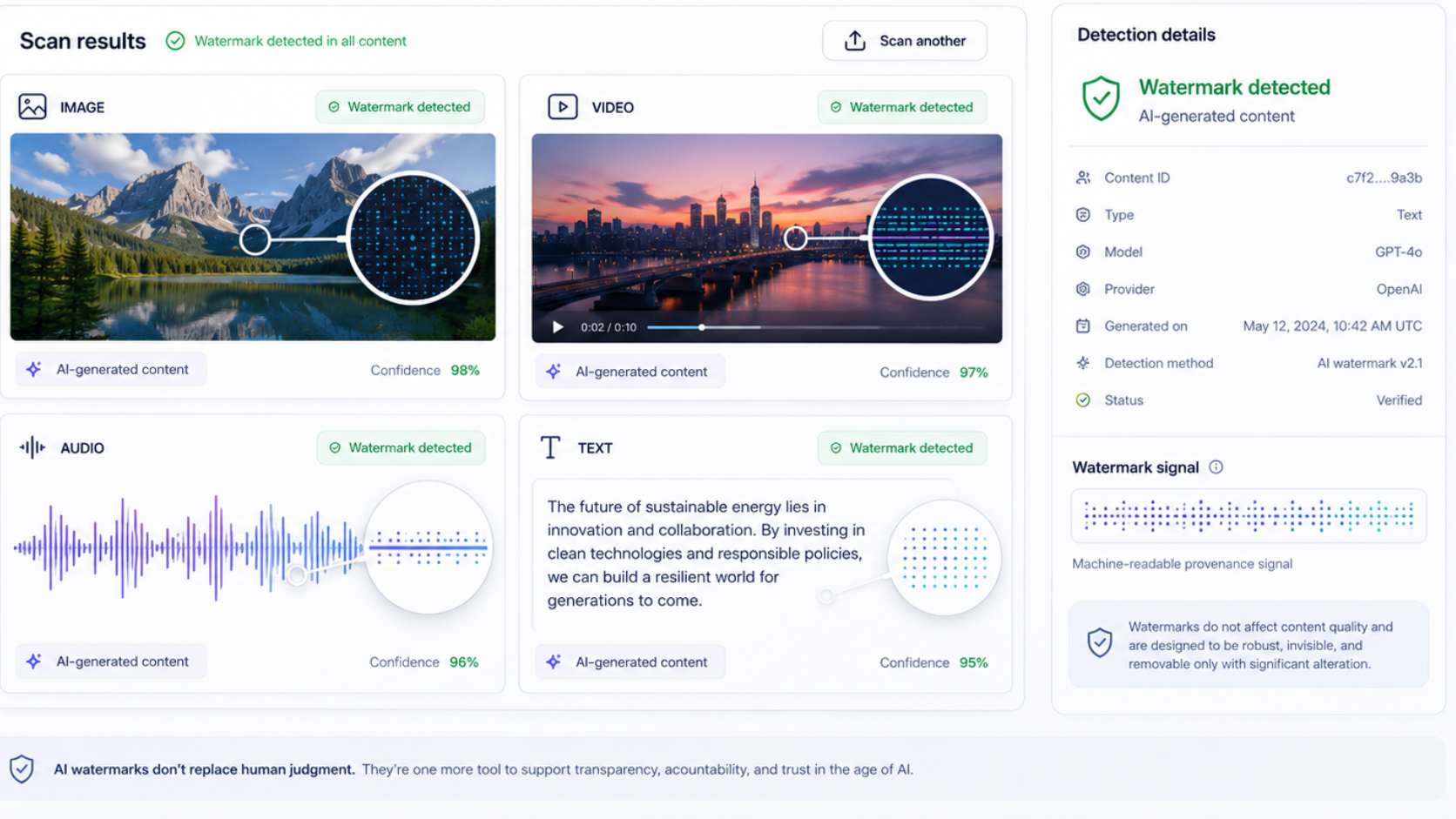 AI watermarks can be hidden inside images, videos, audio, and text, helping platforms detect whether content was created or edited by AI.
Some watermarks are visible, like a logo on an AI-generated image. Others are invisible and sit inside the file, pixels, audio pattern, or text structure.
So, an AI watermark is not just a label. It is a way to help people, platforms, and regulators understand where digital content came from.
Why AI Watermarks Are Back In the Spotlight
AI watermarks are getting attention again because the internet has a trust problem.
AI-generated content is not just being used for fun images or quick drafts anymore. It is now part of scams, impersonation, fake videos, synthetic voices, and misleading media. In one reported case, UK consumers lost an estimated £9.4 billion to fraud between February and November 2025, with deepfake-driven scams becoming a serious part of the problem.
Even the recent Nepal floods show how quickly this can turn real.
As rescue and relief work continued, social media also filled with AI-generated visuals, recycled clips, and fake flood videos. Nepal’s Press Council reportedly told 72 social media users to remove inappropriate content in just a few days. For some accounts, the disaster became a way to chase views, virality, and money.
That is why platforms and regulators are looking for better proof, not just better guesses.
AI detectors can be inconsistent. A watermark gives content a stronger signal. It can help show whether a file was created or changed using AI, especially when combined with provenance systems like C2PA and SynthID, which OpenAI says it is now using for supported generated media.
There is also growing pressure for common standards. The UN’s telecom agency has urged stronger deepfake detection and digital verification measures as synthetic media becomes harder to spot manually.
So AI watermarks are back because the problem has changed. This is no longer only about labeling AI content. It is about protecting trust before fake content travels too far.
How AI Watermarks Work in Simple Terms
AI watermarks usually work at the moment content is created.
The AI tool adds a small signal inside the output. You may not see it, hear it, or notice any change in quality. But a detection system can later scan the content and look for that signal.
It is like a digital fingerprint.
- For an image, the signal may sit inside tiny pixel patterns.
- For audio, it may be hidden inside sound details.
- For text, the system may slightly guide word choices in a way that looks natural to you
But all these still create a detectable pattern.
The watermark travels with the content.
So when the content is uploaded, shared, edited, or checked later, platforms may have a better way to verify whether it came from an AI system.
But watermarks are not unbreakable.
If someone crops an image, compresses a video, edits an audio file, rewrites text, or removes metadata, the watermark can become weaker or harder to detect.
For example, you may create an image in ChatGPT and then make a small edit in Canva, like changing the file format, resizing it, or improving the quality. That small change can still affect the original provenance signals. Even OpenAI says metadata can sometimes be removed by editing tools or file conversions, and a watermark may become degraded after changes.
For teams that regularly create AI-assisted content, this is where a proper content engineering workflow matters. It helps keep source files, approvals, edits, and publishing steps easier to track.
That is why watermarking works best as a trust signal, not as a perfect guarantee.
What AI Watermarks Can and Cannot Prove
AI watermarks can give you useful evidence, not final truth.
OpenAI’s verification tool checks for two main provenance signals:
- C2PA metadata
- SynthID watermarks
These signals can help show whether content came from supported AI tools.
AI watermarks can help prove | AI watermarks cannot fully prove |
The content likely came from a supported AI system | The content is 100% AI-generated in every case |
A file may contain provenance data, such as C2PA metadata | The content was never edited after creation |
A watermark signal was found by a detection tool | The watermark was never weakened or removed |
A platform has added a machine-readable trust signal | The person’s intent behind creating the content |
Edited media may still carry some detectable signals | That content without a watermark is definitely human-made |
This is where many people get it wrong.
A missing watermark does not automatically mean the content is human-made. It may come from a tool that does not use watermarking. Or the signal may have been weakened through editing, compression, rewriting, or file conversion. OpenAI also notes that metadata can sometimes be removed by platforms, editing tools, or file conversions.
This is also why brands need to understand the wider idea of AI visibility. It is not only about being mentioned by AI tools, but also about whether your content, claims, and brand signals can be trusted.
A safer way to understand an AI watermark is that it works as a strong signal, not a courtroom-level guarantee.
Why This Matters for Brands, Publishers, and Creators
For brands, AI watermarks can help protect content trust.
If your product image, campaign video, or brand asset gets copied, edited, or misused, provenance signals can help show where it came from and whether it was changed. That matters when fake visuals can damage reputation fast.
For publishers, the value is even clearer.
Readers want to know whether an image, video, or audio clip is real, edited, or AI-made. C2PA says its standard helps publishers, creators, and consumers establish the origin and edits of digital content.
Creators also benefit because watermarks can support ownership and transparency. They can show that a piece of content was made with a specific tool or workflow, instead of leaving people to guess.
This is becoming a serious ecosystem, not a small feature. The Content Authenticity Initiative now has over 5,000 members across media, tech, civil society, and creative industries.
So for brands, publishers, and creators, AI watermarks are not only about detection. They are about making digital content easier to trust, credit, and verify.
Final Thoughts
AI watermarks are not a perfect fix for fake or misleading content.
But they are becoming an important part of how we check where digital content came from, especially as AI-generated images, videos, audio, and text become easier to create.
The real value is not just detection. It is trust.
For brands, publishers, creators, and platforms, AI watermarks can help make content more transparent, easier to verify, and harder to misuse.
As AI content keeps growing, provenance will become less of a technical feature and more of a basic expectation.
Frequently Asked Questions (FAQs)
What is an AI watermark?
An AI watermark is a hidden or visible signal added to AI-generated content. It helps tools and platforms detect whether content was created or edited by AI.
Are AI watermarks visible?
Not always. Some watermarks are visible, like a label or logo. Others are invisible and hidden inside images, videos, audio, text, or metadata.
Why are AI watermarks important now?
AI content is becoming harder to identify. Watermarks help add a layer of trust, especially when fake videos, edited images, and synthetic voices spread online.
Can AI watermarks be removed?
Sometimes, yes. Editing, compression, resizing, file conversion, or metadata removal can weaken or remove watermark signals.
Are AI watermarks 100% reliable?
No. They are helpful signals, not perfect proof. A watermark can support verification, but it should not be treated as the only way to judge content authenticity.


.png&w=256&q=60)


.png&w=3840&q=60)


