Most SEO content has the same problem.
It answers the query, but it does not add anything new.
You see the same definitions, the same tips, the same examples, and the same rewritten advice across page one. That may have worked when content was harder to produce.
But now, AI can create an average “complete guide” in minutes.
Information gain is what separates useful content from repeat content.
It is the extra value your page brings to the search result. It could be original data, first hand experience, expert insight, customer questions, screenshots, tests, or a real example competitors cannot easily copy.
For brands, this is not just a writing tactic. It is how your content becomes harder to ignore, harder to replace, and more likely to be trusted in both search results and AI generated answers.
What Information Gain Actually Means in SEO
Information gain is the amount of new information your page adds compared with what a searcher has already seen.
The term comes from machine learning, but in SEO, it is often connected with Google’s patent called Contextual estimation of link information gain. The patent was filed in 2018 and granted in 2022, and it describes a system for estimating the additional information a document contains beyond documents already shown to a user.
In simple words, your page should not only answer the search query.
It should also add something useful to the conversation.
Think about a common topic like improving a credit score. Most ranking pages mention the same core factors such as payment history, amounts owed, length of credit history, new credit, and credit mix. That basic information is necessary, but it does not make your page special if every result already says the same thing.
This is where information gain becomes important.
A bank could add anonymized customer data about what actually improved credit scores. A finance writer could show a real before and after example. A credit advisor could explain patterns seen across client cases.
That is the difference between covering the topic and adding value to the topic.
Information Gain is About Meaning, Not Wording
This is the part many brands get wrong.
Information gain is not created by changing words.
A page can use different headings, different examples, and different sentences, but still say the same thing as every other page. Google’s patent describes semantic representation, which means a system can compare what documents mean, even when they do not use the same vocabulary.
So when a team takes the top ranking results, combines the headings, rewrites the points, and adds a polished intro, the article may look new on the surface.
But search systems are getting better at understanding whether the meaning is actually new.
That is why plain paraphrasing is weak SEO.
If your page lands in the same semantic space as the pages you copied from, it has not added real information gain.
You can still cover the expected points. You should. But the page needs one more layer.
That layer is your own evidence, your own experience, your own data, or your own angle.
For a deeper workflow on improving existing pages without making them bloated, you can also read our guide on content optimization tactics for SEO and AI visibility.
Is information gain a confirmed Google ranking factor
There is no official confirmation that Google uses a live ranking factor called an information gain score.
A patent proves that a system was described and granted, but it does not prove that the exact system is running in Google Search today. Google has not confirmed an information gain score as a live ranking or re ranking system.
Still, the direction is clear.
Google’s own guidance asks whether content provides original information, reporting, research, or analysis. It also asks whether content avoids simply copying or rewriting other sources and instead adds substantial value and originality.
Google also reported that after the March 2024 core update finished rolling out, search results had 45 percent less low quality, unoriginal content than before.
So we should not treat information gain like a magic ranking switch.
We should treat it like a practical quality standard.
Originality helps your content stand out, gives readers a reason to choose it, and helps AI systems see why it deserves to be cited.
Why Information Gain Matters More Now
AI has made average content faster to produce.
That is useful, but it also creates a problem. If every company can publish a complete guide in minutes, completeness alone stops being a differentiator. If you are building content at scale, this is where a smarter content optimization workflow becomes important.
Large language models often produce the most likely version of an answer. That usually means safe, generic, familiar content. It covers the consensus, but it rarely adds something only your brand could know.
Searchers do not need the same page again.
They need something that helps them make a better decision.
This is even more important in AI search. In a traditional search result, several similar pages can still appear and earn clicks. In a synthesized AI answer, repeated facts can be compressed, skipped, or blended into one response. That is why brands need to understand how AI visibility changes search behavior, not just how classic rankings work. Google’s patent also describes use cases involving automated assistants, chatbots, conversational agents, and voice assistants.
That means repeated information has less room to stand out.
The page that adds a distinct data point, a specific example, or a new angle has a stronger reason to be included.
Information gain is how your content becomes more than another rewritten guide.
This is not just theory.
In the expert examples we reviewed for this article, the strongest content gains came from the same pattern. Brands added something competitors could not easily recreate, such as proprietary campaign data, real client outcomes, crawler tests, or measurement based screenshots.
That is where information gain becomes practical. It moves from a content idea into something your team can actually build, prove, and repeat.
What Counts as Information Gain
Information gain does not always require a huge research report.
It can come from small, specific, useful proof.
- Original data from your product, clients, or campaigns
- First hand experience from work your team has actually done
- Real screenshots, templates, workflows, or before and after proof
- Sales call questions that top ranking pages do not answer
- Technical tests that reveal something others are missing
- Expert insight with numbers, examples, and context
- Fresh updates that change what the market already believes
The important part is not the format.
The important part is whether the information is useful and hard to reproduce.
If a competitor can recreate the section in ten minutes with AI, it probably is not strong information gain.
Original Data Creates the Strongest Moat
Original data is one of the clearest ways to add information gain because it belongs to you.
A study of 150 top ranking pages found that pages with 15 or more unique data points averaged an information gain score of 62, compared with 40 for pages with one or no unique data points. The same analysis also warned that random statistical stuffing does not help because the value depends on meaning, not decoration.
This is exactly why campaign data, customer data, product data, and internal benchmarks matter.
Yasmin, Digital PR Specialist at Yasmin Digital PR, shared a useful example of this. Her team updated a stagnating SaaS article about cold pitch response rates in tech PR. Instead of keeping broad advice, they added proprietary data from 1,200 pitches sent across 6 months, including a breakdown of pitch length versus journalist reply rate.
That changed the page from generic to useful.
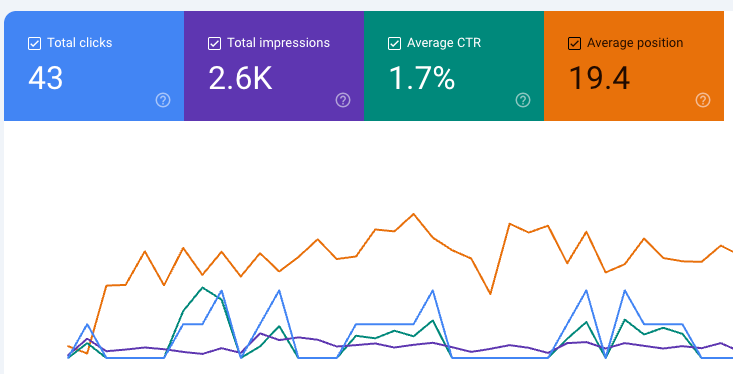
Within 45 days, organic impressions increased by 240 percent, rankings moved from position 24 to position 2, and conversions from the article increased by 38 percent because readers trusted the first hand data.
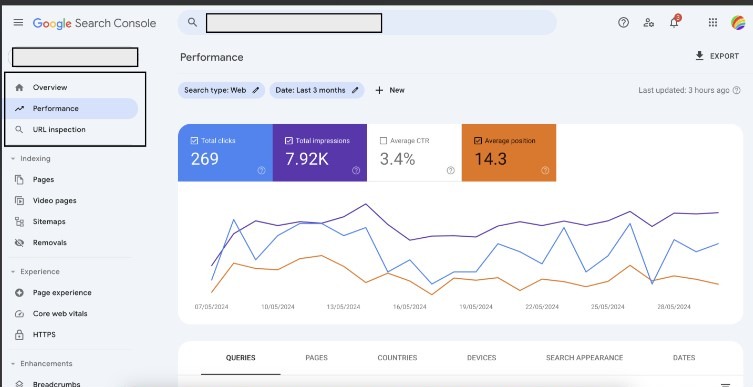 Yasmin Digital PR Google Search Console performance trend after adding proprietary 1,200 pitch experiment data. The dashboard should support the 240 percent impression lift and 180 percent click increase over 45 days.
In her follow up, Yasmin added that clicks increased by 180 percent over 45 days, while rank tracking showed the target keyword moving from Page 3 to position 2 within 6 weeks.
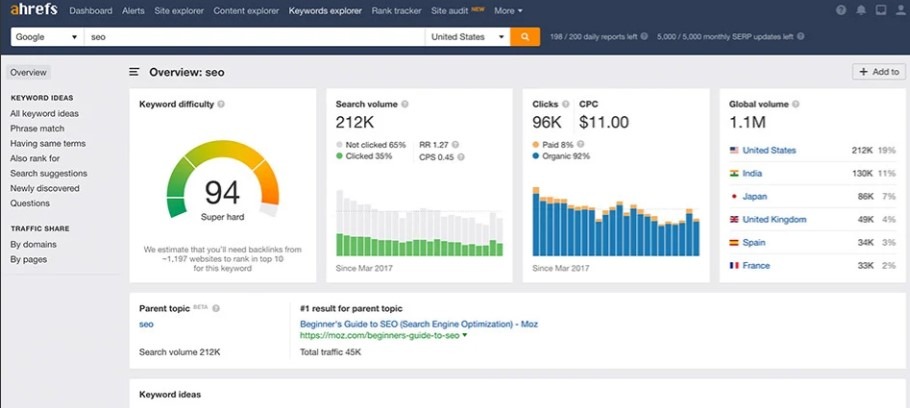 SERP rank tracking screenshot showing the main keyword moving from position 24 to position 2 within 6 weeks after adding first hand campaign metrics.
She also shared an important detail for content teams. The page became harder for competitor AI tools to copy because it included original campaign dashboard screenshots and actual pitch templates, not just generic advice.
The lesson is clear.
The article did not just say shorter pitches work better. It showed campaign evidence from real outreach.
That is what makes original data powerful. It turns a common topic into a page competitors cannot easily copy. Once that page starts moving, tools like SEORCE Rank Tracker can help you monitor both traditional ranking movement and AI search visibility shifts.
Start With Search Intent Before Adding Originality
Information gain only works after the page serves the main intent.
If someone searches for information gain in SEO, they still need a clear definition, how it works, whether it is confirmed, and how to apply it. If your article skips those basics and only tries to be original, it may miss the reason the searcher came in the first place.
So first, cover the core need.
Then find the underserved angle.
Most SERPs serve more than one intent, but not all intents get equal attention. One intent may dominate most of the ranking content, while a smaller intent is barely answered. That smaller intent can become your information gain opportunity. This is similar to how prompt research can reveal real discovery patterns before they show up clearly in standard keyword data.
For this topic, the obvious intent is learning what information gain means.
The underserved intent is learning how to prove it with real data, real examples, and AI visibility signals.
That is where your content can stand out.
Run a Real Content Gap Review
A content gap review helps you see what the current SERP already covers and where your page can add something better.
This is not only about finding missing headings.
It is about finding missing value.
Look for patterns across the ranking pages. Notice which points repeat, which examples feel generic, which stats are outdated, and which sections feel thin. Tools can help you compare topic coverage, competitor content, word count, referring domains, and missing subtopics, but the final editorial judgment still matters.
Coverage and information gain are not the same thing.
Adding what competitors already cover can improve completeness. Adding what competitors do not have creates originality.
Both matter, but they do different jobs.
If you want to turn those gaps into briefs, drafts, and refreshes, SEORCE Content Studio can help connect content planning with AI visibility needs instead of treating them as separate workflows.
First Hand Experience Makes Content Harder to Copy
Once you understand what the SERP already says, first hand experience becomes one of the cleanest ways to add something new.
Eric Wenning, Founder and CEO of Wenning Branding, explained this through his local SEO work. His team builds content around first hand client results and numbers only they have, instead of repeating what the top ranking pages already say.
His core point is simple. AI can rewrite consensus, but it cannot invent your case study.
That is a strong way to think about information gain.
Eric shared a case study of a regional SEO example from Talkin’ Signs, a sign company.
The company’s core service pages were sitting around page five for important commercial terms. Instead of publishing more generic posts about the benefits of signage, the team rebuilt the content around real projects, service area details, and specific problems the company solves. They also cleaned up on page SEO and Google Business Profile issues.
The priority pages moved from page five to page one, and that improved visibility led directly to a six figure contract. Eric also shared a Generator Supercenter example where a tighter offer and funnel produced more than 300,000 dollars in leads in 48 hours.
In a later follow up, Eric added that the SEO update focused on the proper keywords the client needed to rank for, and that the page moved from the fifth page to the first page within 15 days.
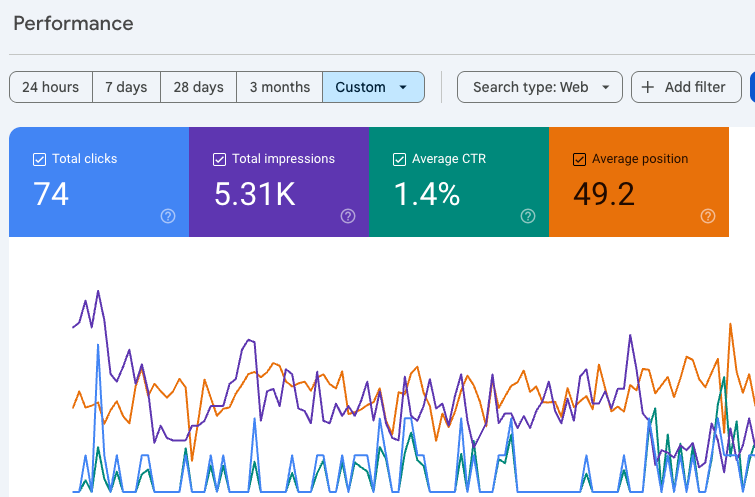 Talkin’ Signs Google Search Console screenshot supporting the SEO case study and the ranking movement Eric described, where the page moved from page five to page one within 15 days.
Talkin’ Signs website screenshot showing the real business page behind the case study, focused on digital signage and commercial sign services in Pittsburgh.
This fits naturally into SEO content because it shows the work, the context, the movement, and the business outcome.
Anyone can write a general local SEO article.
Not everyone can show what changed, why it changed, and what the result unlocked.
Use Customer Questions as Content Fuel
You do not always need dashboards to add something new.
Sometimes your best information is already inside your business.
Sales calls, customer emails, demo notes, onboarding questions, support tickets, and product feedback often reveal what the SERP ignores.
This is especially useful for B2B content.
The SERP usually answers the polished version of a topic. Customers ask the real version.
For example, a generic article may explain what AI visibility means. But customers may ask why one tool shows a strong score and another shows a poor score, why their site appears in ChatGPT but not Gemini, or whether AI crawlers can access their pages at all.
Those questions create stronger content angles because they come from real confusion.
At SEORCE, we think this is where many brands can win. Instead of only tracking keywords, you also need to track what AI systems cite, which pages get mentioned, what questions appear before conversion, and where your content fails to answer them. For B2B teams, this connects closely with how SaaS buyers use AI tools before visiting a vendor website.
That gives your content team a better map of what to create next.
How Information Gain Works During a Search Journey
Information gain is context dependent.
A page can feel useful to one searcher and repetitive to another depending on what they have already read. Google’s patent describes comparing new documents against information already presented to the user, then selecting or ranking documents based on the additional information they provide.
That makes the system dynamic.
As a searcher consumes more pages, the remaining unseen pages can be rescored and reordered based on what has already been covered. This is different from the first ranking order a searcher sees. It is closer to re ranking during the session.
Imagine a person reads five similar guides on the same topic.
If your page becomes the sixth article and repeats the same advice, it feels redundant.
But if your page adds a case study, new data, a missed risk, or a better explanation, it becomes useful again.
This is why content teams should not only think about ranking for the first click.
You also need to think about what your page adds after the searcher has already seen the obvious answers.
Information Gain May Become Output, Not Only Input
There is another important nuance.
Information gain may not only work as something that helps a page rank. It may also work as something search systems learn from after a trusted page proves useful.
One interpretation is that Google can absorb the original claims, entities, and patterns from a strong page and use them to improve broader topic understanding. That information may then become raw material for AI Overviews, entity coverage, or the next baseline of consensus for that topic.
This matters because originality can age.
A new data point may be rare today.
Once enough pages repeat it, it becomes common knowledge.
That is why information gain is not a one time content trick. It is an ongoing publishing habit.
Why Duplicate Facts May Disappear in AI Answers
Information gain becomes even more important when answers are synthesized.
Google’s patent describes systems where an automated assistant may extract and present selected information from documents. It also describes excluding information that has already been conveyed and presenting the new information instead.
That means overlapping facts can get compressed.
If one page contributes facts A and B, and another page contributes fact B plus a new fact C, the repeated fact B may not be needed again. The second page becomes useful because of fact C.
This is the practical SEO lesson.
Your content needs two things:
- First, it needs enough topical coverage to be understood and trusted.
- Second, it needs original value that gives search systems and readers a reason to use your page.
Coverage helps you enter the conversation.
Information gain helps you stand out inside it.
This also means every strong section should be written as if it may be extracted on its own. That is the thinking behind passage level GEO, where each important answer is clear enough for AI engines to understand, extract, and cite.
Technical Tests Can Create Original Insight
Information gain is not only about opinions or examples.
A technical test can add strong value when it proves something the market has not explained clearly.
Adev Aarons, Founder of Specularis, shared a study of 561 Florida businesses tested around how ChatGPT can read them.
Industry | Tested | Block the AI crawler | Invisible to AI |
Real estate | 443 | 25% | 51% |
Law firms | 35 | 43% | 49% |
Roofing | 40 | 30% | 45% |
Med spas | 43 | 28% | 37% |
All four | 561 | 26% | 49% |
As you can see the table, across four industries, 26 percent blocked the AI crawler and 49 percent were invisible to AI. In the study, invisible meant the site either blocked the AI crawler through a 403 or Cloudflare challenge, or had no structured data telling AI what the business is.
The industry split made the insight more useful. Law firms had a 43 percent crawler block rate, real estate had 25 percent, roofing had 30 percent, and med spas had 28 percent.
Adev also shared crawler block proof from three live Florida business sites. The examples included a law firm, a real estate site, and a roofer. Each page returned HTTP 200 for a normal Chrome browser user agent, but HTTP 403 Forbidden for GPTBot. The URL stayed the same. The only variable was the requester.
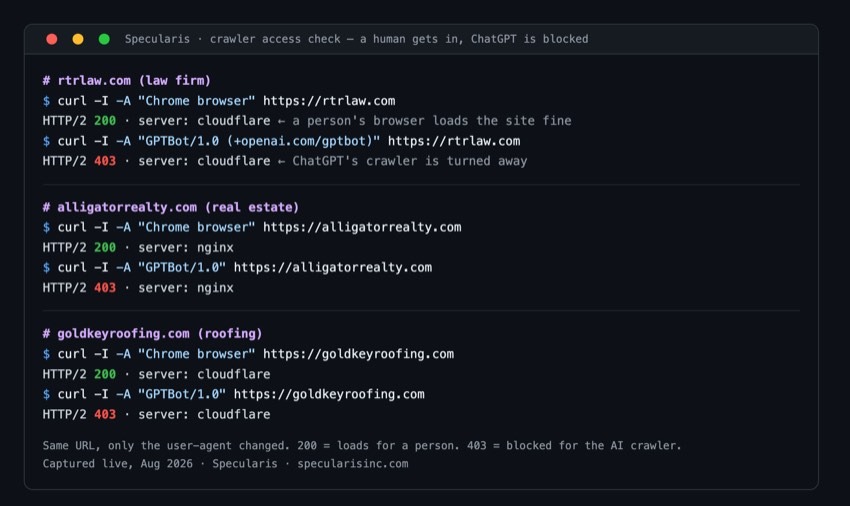 Crawler block proof from Specularis showing the same URLs returning HTTP 200 for a normal browser and HTTP 403 Forbidden for GPTBot. This visual supports the point that some pages are visible to humans but not readable by AI crawlers.
The proof was captured live in August 2026, which makes the example more useful because it is not a theoretical warning or an outdated crawler claim.
That is useful because it turns a broad AI visibility claim into a specific technical issue.
If an AI crawler cannot access your site, your content may not be readable by that system.
That is not a writing problem. Its rather a visibility problem.
This is where technical SEO becomes part of information gain. A page can have strong original content, but if crawlers cannot access it, the content may never become visible. Tools like SEORCE Technical Suite help teams audit crawlability, technical SEO issues, and site health before those issues limit visibility.
Find Unanswered Questions Before Competitors Do
Unanswered questions are one of the easiest ways to add information gain.
You can find them in search suggestions, People Also Ask results, Reddit threads, forums, sales calls, and customer support conversations. Keyword tools can also help you filter question terms and sort by recent growth over 3, 6, or 12 months to spot rising questions before every competitor covers them.
When Reddit ranks strongly on page one, it often means users are not fully satisfied with polished SEO pages. People go there to ask the version of the question that formal content does not answer well.
Do not copy Reddit answers.
Use them to understand the missing pain.
Then answer that pain with clearer structure, stronger proof, and better examples.
This gives you a real chance to create content that feels useful, not recycled.
Be Careful With Weak AI Readiness Scores
Information gain should come from clear evidence, not fear based scoring.
Gabriella Timea Sinka, Founder of TimeSaver, shared a useful example from AI visibility tools.
She tested the same site, timesaver.hu, in two commercial AI visibility scanners during the same period in July 2026. One scanner gave the site 26 out of 100. Another gave it 76 out of 100.
The first scanner showed a low AI recommendation readiness score with sub scores for visibility, accuracy, structure, and authority. It also showed paid packages directly under the result, with the cheapest option pre-selected.
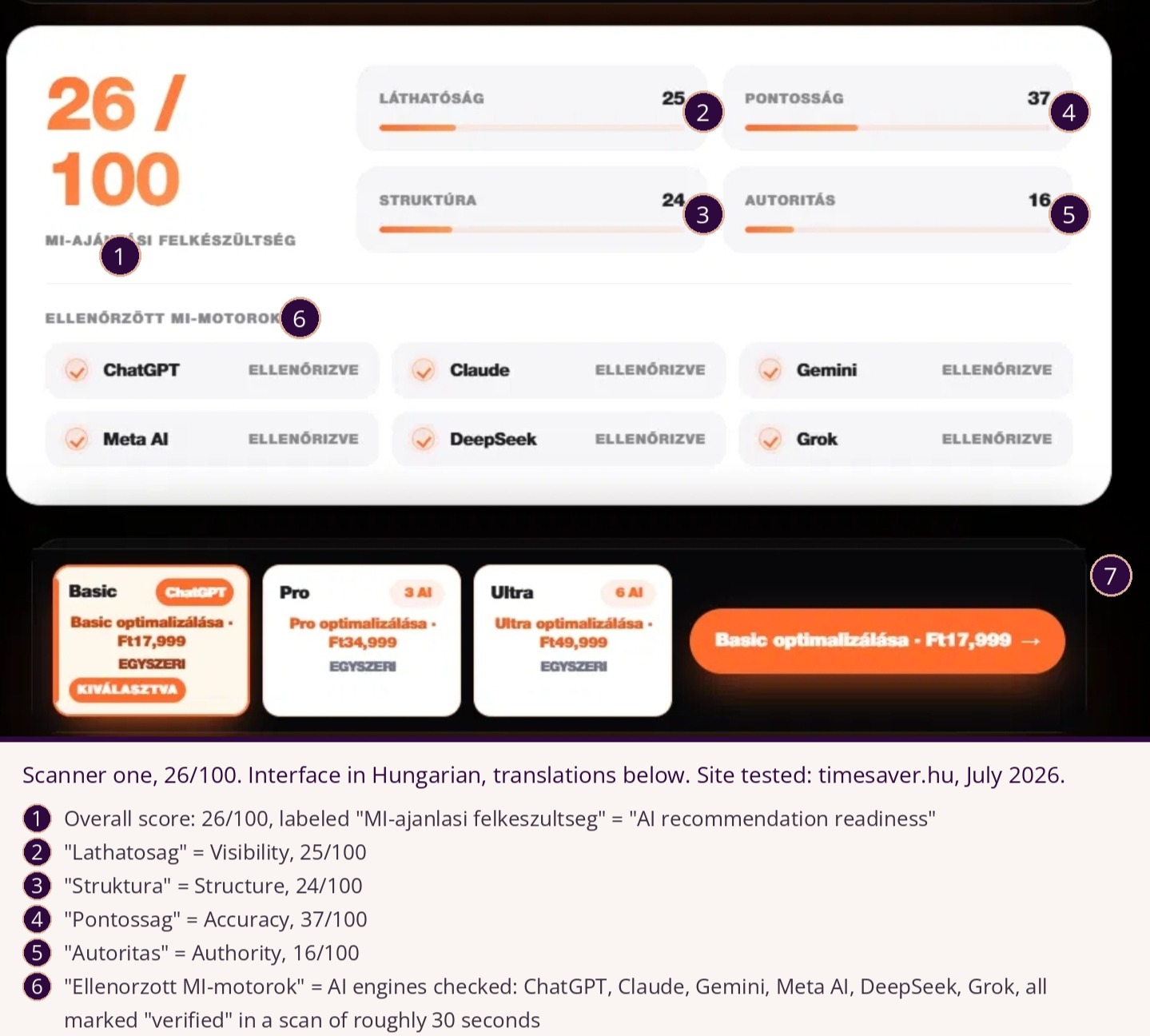 Scanner one screenshot showing a 26 out of 100 AI recommendation readiness score, multiple proprietary sub scores, six AI engines checked, and paid packages directly under the result.
The second scanner gave the same site a Grade B and used different sub metrics such as Structured Data and Schema, Semantic HTML, and Accessibility for Agents.
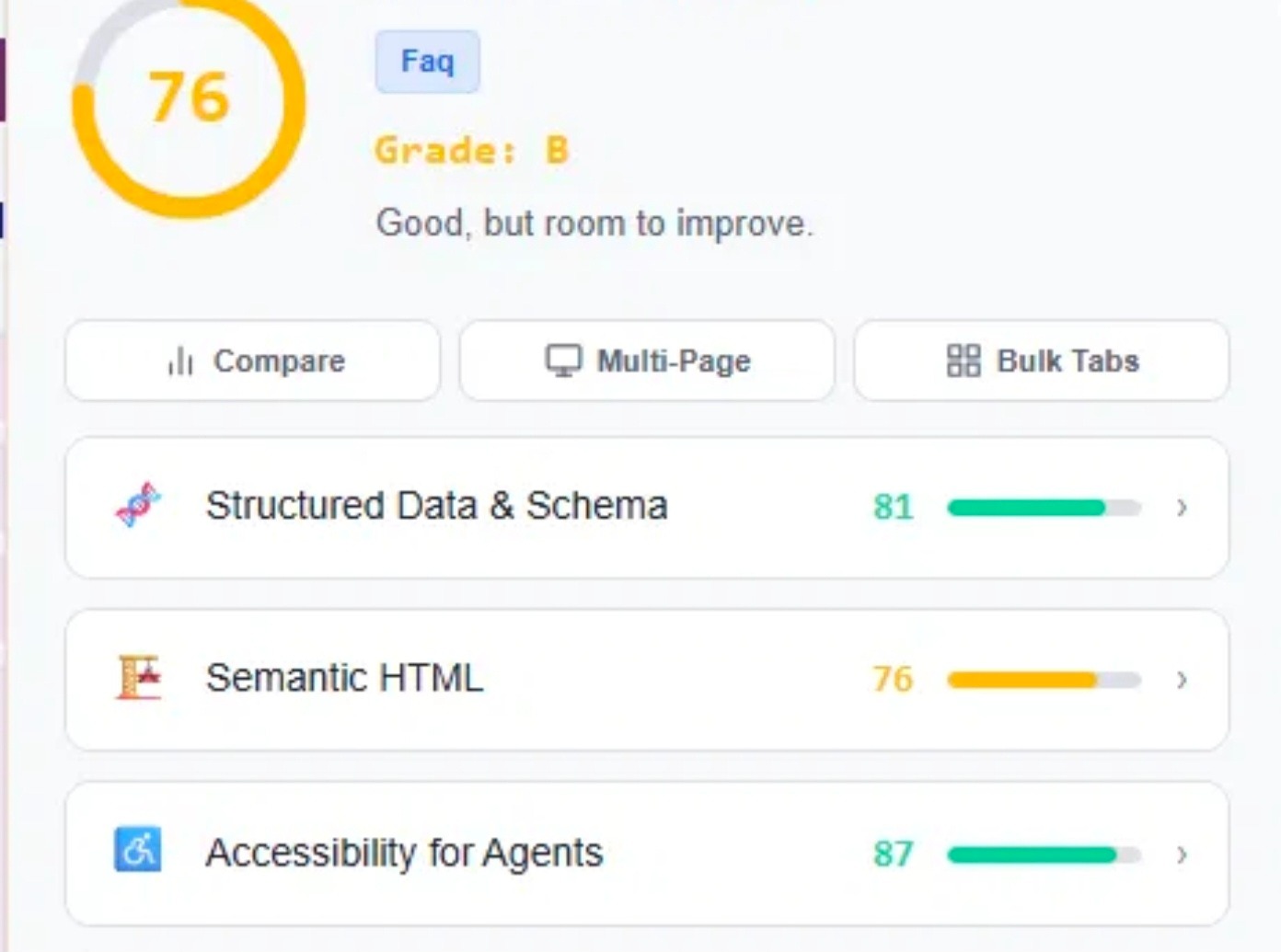 Image showing the same site scored at 76 out of 100 with a Grade B, different sub metrics, and no direct upsell attached to the result.
Gabriella’s interpretation is important.
She said neither tool is necessarily lying, but neither is measuring a shared industry standard. Since there is no universal metric called AI readiness, each tool’s own weighting creates its own number.
She also shared a bigger lesson from her own publishing experience. Her most cited pages are measurement based structured articles, not service pages. That is highly relevant for information gain because it shows how evidence based content can become more cite worthy than commercial pages.
This connects directly with information gain.
A score alone does not create trust.
A method creates trust.
Gabriella recommends looking at real signals instead, including bot activity in server logs, actual AI referrals in analytics, and citation tracking.
She also said the 50 point gap pushed her to start building her own audit tool with the opposite philosophy. The methodology would be published openly, scores that do not apply would show as n slash a instead of dragging the number down, and known non factors like llms.txt would be displayed at zero weight with an explanation.
That is a better way to talk about AI visibility because it gives readers something they can actually verify. It also supports a bigger point from the four pillars of AI search visibility where proof, clarity, and trusted signals matter more than surface level scores.
Add Original Proof Wherever Possible
The easiest way to make your content harder to copy is to show proof.
Proof can be simple.
It does not always need a large study.
It can be a dashboard screenshot, a before and after example, a small customer data set, a tested workflow, a template your team uses, or a technical check with clear steps.
This is the pattern we have seen across the expert examples in this article:
- Yasmin’s pitch data worked because it turned generic PR advice into evidence backed content.
- Eric’s Talkin’ Signs example worked because it showed real local SEO impact.
- Adev’s crawler test worked because it proved an AI visibility problem.
- Gabriella’s scanner comparison worked because it exposed a measurement gap with a real example.
Good information gain gives readers proof they did not already have.
Keep Your Content Fresh
Information gain changes over time.
A new insight today can become common knowledge later. Once everyone repeats it, it becomes part of the consensus.
Fresh updates can create new information gain when they add real changes, not just a new date in the title. Google’s guidance also warns against changing dates to make pages look fresh when the content has not substantially changed.
A strong refresh should add something meaningful.
- New data
- New screenshots
- New expert insight
- New customer questions
- New product examples
- New risks or changes
- New SERP or AI citation observations
This is where many content updates fail. They improve formatting, but they do not improve the information.
What Not To Do
Information gain can be misunderstood.
Adding random statistics does not make content original. If the numbers do not help the reader understand the topic better, they are just decoration.
Do not chase novelty so hard that you miss the search intent. A reader searching for information gain in SEO still needs a clear definition, examples, and practical steps.
Do not use generic expert quotes. A quote that says original content is important adds very little. A quote with a real case, a number, a test, or a named workflow adds much more.
Do not trust AI readiness scores without methodology. Gabriella’s 26 versus 76 example shows why you need to understand what a tool is measuring before treating the score as truth.
And do not confuse better writing with better information.
A cleaner version of the same article is still the same article.
A Practical Information Gain Checklist
Use this before publishing.
- Does the page clearly answer the main search intent
- Does it identify what top ranking pages already cover
- Does it add at least one useful point competitors do not have
- Does it include first hand experience, original data, or expert insight
- Does it answer a real customer question the SERP ignores
- Does it include proof such as screenshots, examples, templates, or numbers
- Does it explain the method behind any data or test
- Does it avoid repeating common advice without adding context
- Does it give readers something worth remembering or citing
- Does it stay close enough to intent while still adding a distinct angle
- Does it create value that could remain useful even if AI summarizes the basics
If your article cannot pass most of these checks, it needs more substance before publishing.
How SEORCE thinks about information gain
At SEORCE, we see information gain as a bridge between classic SEO and AI visibility.
Classic SEO asks whether your page can rank.
AI visibility asks whether your brand gets cited, mentioned, and trusted in AI generated answers.
Information gain supports both.
When your content includes original data, expert backed insights, technical proof, and real customer questions, it becomes more useful for readers and more cite worthy for AI systems.
That is why brands should not only track rankings.
They should also track which pages are cited in AI answers, which topics create brand mentions, which customer questions remain unanswered, and which content assets provide the strongest original evidence. This is where our AI Beacon fits because it helps teams track where brands appear across AI answers, citations, and emerging discovery surfaces.
This is where information gain becomes measurable.
Not as a vague content idea, but as a repeatable content system.
Final Thoughts
Information gain is not about making content longer.
It is about making content more useful, more original, and harder to copy.
Google has not confirmed a live information gain ranking factor, but Google’s public guidance clearly points toward original information, substantial value, first hand expertise, and helpful analysis beyond the obvious.
So the practical direction is to cover what the searcher needs. Then add what only your brand can provide.
That could be your data, your experience, your tests, your customers, your screenshots, your results, your expert network, or your measurement framework.
In modern SEO, the strongest content is not the page that says everything.
It is the page that adds something worth remembering.
Frequently Asked Questions (FAQs)
1. What is information gain in SEO
Information gain in SEO means adding something new and useful to your content that other ranking pages do not already cover. It could be original data, first hand experience, expert insight, screenshots, or a real case study.
2. Why does information gain matter for SEO
It helps your content stand out from generic and AI assisted content. When your page adds something readers cannot easily find elsewhere, it becomes more useful, more memorable, and more likely to earn trust.
3. Is information gain a confirmed Google ranking factor
Google has not confirmed a live ranking factor called information gain. But Google’s guidance clearly supports original information, first hand experience, helpful analysis, and content that adds more value than other pages.
4. How can you add information gain to content
Start by covering search intent, then add something only your brand can provide. Use internal data, customer questions, real examples, expert insights, technical tests, screenshots, templates, or fresh observations.
5.Can AI generated content have information gain
Yes, but only if it includes real value beyond generic answers. AI can help structure and draft content, but the information gain usually comes from your data, experience, research, customers, and proof.
Expert Credits
Special thanks to the experts who shared their first-hand experience and practical insights for this article.
Expert name | Designation | Website | |
Eric Wenning | Founder and CEO, Wenning Branding | ||
Yasmin | Digital PR Specialist, Yasmin Digital PR | ||
Adev Aarons | Founder, Specularis | ||
Gabriella Timea Sinka | Founder, TimeSaver |