Skip to content
1See where you stand
AI BeaconYour brand across 7 AI engines and Google AI Rank TrackerGoogle and Bing positions, by country Keyword Explorer87M+ keywords with volume and intent BacklinksEvery linking domain, scored from 0 to 100
2Fix what holds you back
Technical SuiteCrawl your site and find what's broken AutoFixPart of Technical Suite. Fixes applied on your live site. Content StudioContent in your brand voice, ready to publish
3Measure the uplift
Web AnalyticsVisits from search and AI, in one view Reports & DashboardsCustom dashboards and scheduled reports
On top of every engine
Ask SEORCEBetaYour AI agent. Ask about your project in the app or on WhatsApp.
Free to use
Browser extension Free tools API reference
Every engine reads the same project data.See the full platform →
By team
EnterpriseMany sites and markets, one method Global brandsYour brand in search and AI answers AgenciesA project for each client, priced per project ConsultantsRun client work from one account E-commerceProduct and category pages buyers can find D2C brandsVisibility for brands that sell direct B2B & SaaSBe there while buyers research
By industry
Automotive Baby & kids Beauty Consumer electronics Education Energy & utilities Fashion Financial services FMCG Food & beverage Health & wellness Healthcare Home & furniture Insurance IT services Legal Logistics Luxury Manufacturing Marketplaces Media & publishing Multi-location brands Pharma Professional services Real estate Sports & entertainment Telecom Travel & hospitality
A project for each site or market.See all solutions →
Learn
BlogGuides and notes from our team FeedAI and SEO news, as it moves The GEO guideGenerative engine optimisation, start to finish
Get the job done
Use casesHow to get a job done, topic by topic PlaybooksWhat to do when things change
AI visibility tracking Automated technical SEO Recover from a traffic drop Prove SEO ROI to leadership
Free resources
Free toolsSchema and content brief generators, and more Browser extensionFor Chrome, Edge and Firefox. Audits the page you're on, free.
Help and updates
Docs API API reference Changelog
Enterprise
Pricing
Log in Book a demo Start free
Platform
See where you stand
AI Beacon Rank Tracker Keyword Explorer Backlinks
Fix what holds you back
Technical Suite AutoFix (in Technical Suite) Content Studio
Measure the uplift
Web Analytics Reports & Dashboards
On top of every engine
Ask SEORCE (beta)
Free to use
Browser extension Free tools See the full platform →
Solutions
By team
Enterprise Global brands Agencies Consultants E-commerce D2C brands B2B & SaaS
By industry
Automotive Baby & kids Beauty Consumer electronics Education Energy & utilities Fashion Financial services FMCG Food & beverage Health & wellness Healthcare Home & furniture Insurance IT services Legal Logistics Luxury Manufacturing Marketplaces Media & publishing Multi-location brands Pharma Professional services Real estate Sports & entertainment Telecom Travel & hospitality See all solutions →
Resources
Learn
Blog Feed: AI and SEO news The GEO guide
Get the job done
Use cases Playbooks AI visibility tracking Automated technical SEO Recover from a traffic drop Prove SEO ROI to leadership
Free resources
Free tools Browser extension
Help and updates
Docs API API reference Changelog
Company
About us Careers Contact Partners Alternatives Comparisons SEORCEBot, our crawler Legal
Enterprise Pricing
Book a demo Start free Have an account? Log in
Theme
SEORCE. The source. An AI-native SEO and GEO platform for mid-market and enterprise brands, and the agencies that serve them.
#1 on Product Hunt
NVIDIA Inception member
Platform
  • AI Beacon
  • Keyword Explorer
  • Content Studio
  • Technical Suite
  • Backlinks
  • Rank Tracker
  • Web Analytics
  • Reports & Dashboards
  • Ask SEORCE · beta
Solutions
  • For B2B & SaaS
  • For e-commerce & D2C
  • For agencies
  • For global brands
  • For enterprise
  • All industries
Learn
  • Use cases
  • Playbooks
  • Blog
  • Feed
  • Browser extension
  • Free tools
  • Docs
  • API
  • API reference
  • Changelog
Company
  • Pricing
  • Alternatives
  • Comparisons
  • Partners
  • About us
  • Careers
  • Contact
  • SEORCEBot
  • Book a demo
  • Legal
© 2026 SEORCE, Inc. · Delaware, US · All rights reserved
Privacy Terms Cookies Billing & refunds

Cookies on seorce.com

We use cookies the site needs to work. With your permission we would also like to use analytics cookies to see how the site is used, and marketing cookies to measure our ads. You can change your choice at any time from Cookie preferences at the foot of every page. Read the cookie policy.

Your browser is sending a Global Privacy Control signal, so marketing cookies stay off.

Strictly necessaryRemember your theme and this choice. Always on.
On
Published Nov 2, 2026•by SEORCE Editorial, Search and marketing desk

AI Mode hurts Google search revenue growth in Q3 2026

Alphabet said on Oct. 28 that AI Mode monetizes below traditional Search even as Search & Other ads grew 12% year over year.

Add as a preferred source on Google

TL;DR

  • Google said Search & Other Ads revenue grew 12% year over year in Q3 2026, slower than earlier quarters.
  • AI Mode has lower monetization today, but Google also cited foreign exchange and category-specific advertiser changes.
  • Advertisers cannot opt out of AI Mode ads separately when they run eligible Search, Shopping, or Performance Max campaigns.
  • SEO teams should treat longer AI Mode queries as evidence that discovery content needs fuller answers and human perspective.
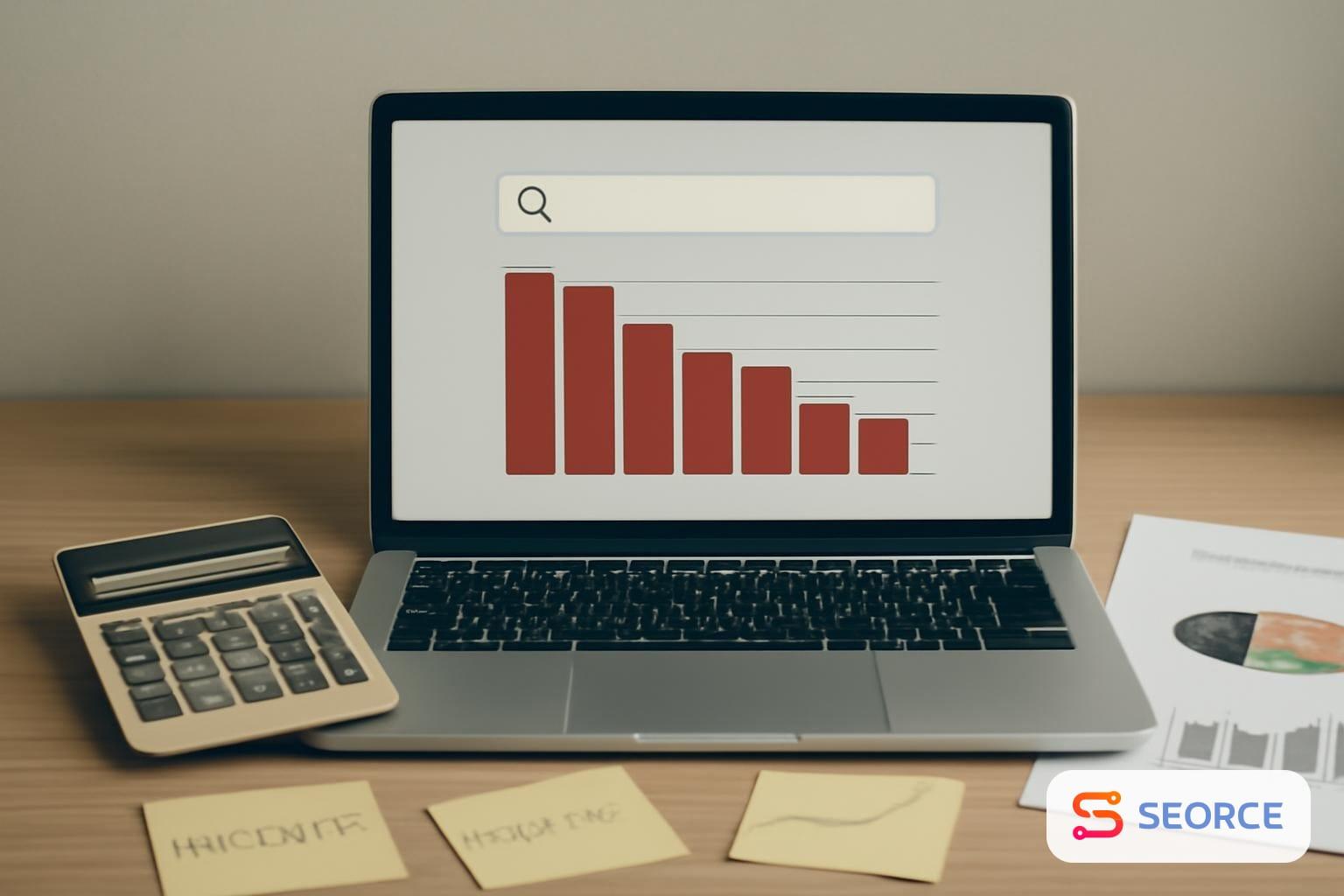
Laptop showing a search results page beside a calculator and ad dashboard charts

AI Mode hurts Google search revenue growth today because Google told investors on Oct. 28, 2026 that AI Mode has lower monetization, even as Search & Other ads grew 12% year over year in Q3.

Alphabet disclosed the Q3 2026 figures for the period ended Sept. 30, and Google's own earnings post said Alphabet revenue grew 25% year over year to about $128 billion. The change is that Google Search usage and AI search activity can rise while ad revenue growth cools, because Google has not yet monetized AI Mode at the same level as traditional search.

How AI Mode hurts Google search revenue

AI Mode hurts Google search revenue by moving more activity into a search surface where ad monetization is still lower than Google's mature results pages. Search Engine Journal reported on Oct. 28 that Google Search & Other revenue rose 12% year over year to $63.35 billion in Q3 2026, after growth of 19% in Q1 and 17% in Q2. StockAnalysis's transcript of the Alphabet call says Philipp Schindler, Google's chief business officer, identified foreign exchange as the single largest driver of the deceleration from Q2 to Q3, and also cited retail and media category dynamics.

Google's Q3 evidence supports a narrow claim: AI Mode monetized below traditional Search in Q3 2026, and that weighed on growth. It does not support the broader claim that Google Search revenue fell year over year, because Google's Search & Other ads line still grew 12%.

The mechanism is straightforward. When a user enters AI Mode, Google can answer with a generated response, follow-up paths, shopping units, and other AI-shaped surfaces rather than the older stack of text ads, product ads, and organic links. Schindler said strong growth in AI Mode queries had an impact because AI Mode had lower monetization, according to the StockAnalysis transcript, while The Motley Fool transcript says Google believes most AI Mode queries are incremental and can create more monetization opportunities over time.

What changed inside search behavior

Search behavior changed because AI Mode queries are longer, more conversational, and more likely to use non-text inputs than traditional searches. Google's own Q3 earnings post says AI Mode queries are on average three times longer than traditional searches, one in five AI Mode searches globally use voice, images, or documents, and visual searches have crossed 50 billion per month. Google CEO Sundar Pichai described Search's AI activity as "strong momentum" and said AI investments are driving increased usage and overall query growth, including commercial queries.

Longer AI Mode queries can raise usage without raising revenue at the same rate. A multi-step product research session may count as more query activity, but Google still has to place ads that fit the generated answer, the follow-up question, and the user's stage in the decision.

Google is already trying to close that gap. The Motley Fool transcript says Google is expanding ads in AI Mode into international markets and adding multiturn ads in AI Mode in the United States. Search Engine Journal reported that existing Search, Shopping, and Performance Max campaigns are eligible by default for those placements and cannot opt out separately.

Where the Q3 evidence conflicts

The conflict is over how to describe growth, not over whether AI Mode monetizes lower than traditional Search. Social Media Today reported on Nov. 1 that search volume grew 12% in Q3 and that search revenue was flat in Q3. Google's own Q3 earnings post says Search & Other Ads revenue, not search volume, grew 12% year over year, while Search Engine Journal described the line as essentially flat compared with Q2's $63.27 billion.

SourceWhat it supportsLimit
Google earnings postSearch & Other Ads revenue grew 12% year over year, and AI Mode queries are longer.It does not give an AI Mode revenue number.
StockAnalysis transcriptSchindler cited foreign exchange, category effects, and lower AI Mode monetization.It does not isolate the size of each factor.
Search Engine JournalSearch growth slowed for a second straight quarter, and AI Mode ads are expanding.Advertiser complaints about traffic quality remain partly unproven.
r/stocks discussionInvestors and practitioners are debating whether AI agents threaten Google Search demand.A Reddit thread is practitioner signal, not financial evidence.

The Reddit discussion on r/stocks shows the market narrative is broader than Google's disclosure. One poster argued that ChatGPT, Claude, Meta, Grok, and Chinese competitors make Google less central to discovery, while top commenters pushed back by pointing to search revenue growth and Google's other businesses. That discussion is useful as a signal of investor anxiety, but it does not prove user migration, ad price changes, or a Chegg-style collapse.

What advertisers should check now

Advertisers should check eligible Search, Shopping, and Performance Max campaigns because Google is adding AI Mode inventory without a separate opt-out. Search Engine Journal reported that all existing campaigns in those types are eligible by default, so the practical control points are campaign budgets, bid targets, match behavior, creative assets, product feeds, and conversion measurement. If AI Mode traffic starts to change mix, those settings are where the effect will show up first.

The specific check is a before-and-after comparison around the AI Mode ad rollout stage that applies to the account. In the United States, watch campaigns exposed to follow-up question ads in AI Mode. In markets included in the international expansion, compare cost, clicks, conversions, conversion value, cost per acquisition, and return on ad spend by campaign type. Search Engine Journal's advertiser analysis said marketers are already concerned about unwanted traffic, broader keyword matching, and rising costs, but it also said the earnings call supports only parts of that argument and leaves others unproven.

Google's position is that AI Mode ads can work. The Motley Fool transcript says Schindler told investors that Google's user research shows people are comfortable with ads on AI search surfaces and find them relevant, and that click-through rates are already similar between sponsored and organic product list items within AI Mode. That claim still leaves open the metrics advertisers care about most: conversion rate, margin, lifetime value, and whether AI Mode traffic changes assisted conversion paths.

What SEOs can infer safely

SEO teams can safely infer that AI Mode discovery is more conversational, but they cannot yet infer how Google selects citations or how many clicks AI Mode removes from organic results. Search Engine Journal's coverage of Google's Ads Decoded episode said Ginny Marvin and Shivani Mohan described longer AI Mode questions, follow-up behavior, voice and image use, and continued demand for human perspectives such as podcasts, video reviews, and firsthand experience. That supports content planning, not traffic forecasting.

The practical SEO response is to audit pages against full research tasks rather than single keywords. A page built only for a short commercial query may miss the longer comparison, constraint, and follow-up questions that AI Mode encourages. The evidence does not show that Google rewards any one markup format in AI Mode citations, so the safer work is to make first-hand experience, product details, comparisons, limitations, author identity, and media assets clear enough for both users and Google's systems.

What happens next in AI Mode ads

The next trigger is Google's expansion of AI Mode ads into international markets and follow-up question ads in the United States. Marketing Dive reported on Oct. 29 that investors questioned the gap between revenue and search activity as AI Mode ads moved outward. The next measurable test is whether those new placements lift Search & Other Ads growth without raising advertiser acquisition costs in Q4 account data and Alphabet's next earnings disclosure.

See more SEORCE in your Google results

Add us as a preferred source to see more of our stories in Google's Top Stories.

Add as a preferred source on Google

FAQ

Did Google search revenue fall in Q3 2026?

Google Search & Other ad revenue did not fall year over year in Q3 2026. Google's disclosed line grew 12%, although sequential growth was almost flat compared with Q2. The concern is that growth slowed from earlier 2026 quarters while AI Mode usage increased and monetized at a lower rate.

Can advertisers opt out of AI Mode ads?

Advertisers cannot opt out of AI Mode ads separately based on the supplied evidence. Search Engine Journal reported that existing Search, Shopping, and Performance Max campaigns are eligible by default. Account teams should therefore treat AI Mode as part of the broader Google Search inventory mix and monitor campaign-level performance changes.

Why does AI Mode monetize lower than regular search?

AI Mode monetizes lower because its ad formats are still developing around generated answers and follow-up interactions. Traditional search has mature ad auctions, placements, and measurement habits. Google is adding international AI Mode ads and U.S. multiturn ads to improve monetization, but the company has not disclosed an AI Mode revenue rate.

Is ChatGPT the reason Google search growth slowed?

The supplied earnings evidence does not show that ChatGPT caused Google's Q3 search growth slowdown. Google cited foreign exchange as the largest driver, plus retail and media category changes, and lower AI Mode monetization. Reddit users debated chatbot substitution, but that discussion does not quantify migration from Google Search.

What should SEO teams do about AI Mode?

SEO teams should expand content audits from short keywords to complete research paths. Google's own figures show AI Mode queries are longer and often use voice, images, or documents. The evidence does not prove a specific citation tactic, so teams should improve clear answers, original experience, product evidence, and media coverage.

Entities

AlphabetAI ModeSearch & Other AdsSundar PichaiPhilipp SchindlerPerformance MaxChatGPT

Tags

AI ModeGoogle SearchSearch RevenueAlphabet EarningsSearch AdsPerformance MaxSEO StrategyDigital Advertising

Topics

SEOArtificial Intelligence

Sources

Q3 2026 earnings call: Remarks from our CEO
Google
Alphabet Q3 2026 Earnings Call Transcript & Audio
StockAnalysis
Alphabet (GOOGL) Q3 2026 Earnings Call Transcript
The Motley Fool
Google says AI chatbots are hurting its bottom line
Social Media Today
Google’s AI overhaul of search hits snags as ad revenue growth cools
Marketing Dive

More like this