
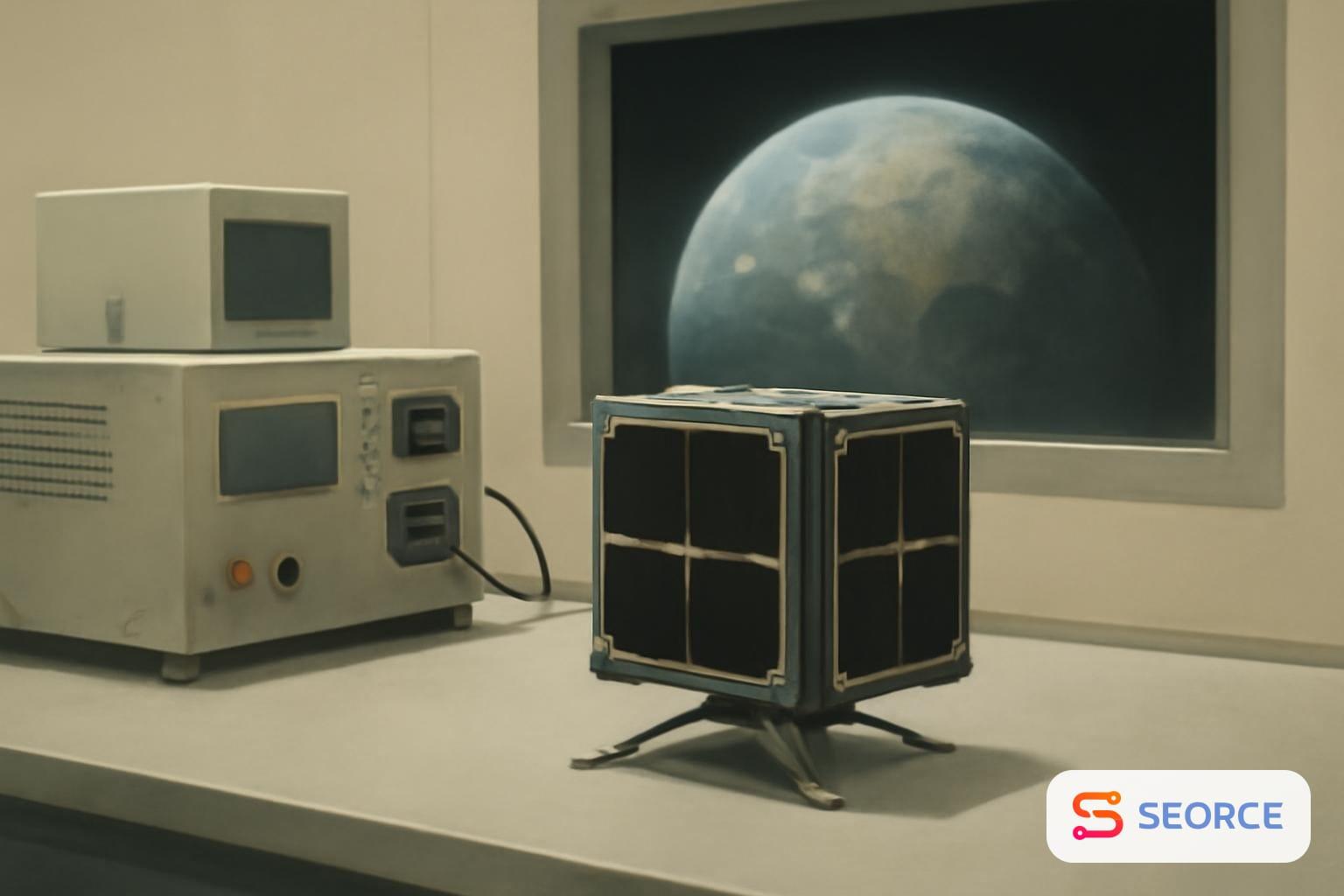
Google Project Suncatcher AI satellite is a prototype mission to test whether Google Trillium TPUs can survive launch, radiation and cooling limits in low Earth orbit before any orbital AI data center exists. Google announced the test on September 24, 2026, and The Verge reported the satellite is scheduled to launch on a SpaceX Falcon 9 rocket on October 1.
Google says the first Project Suncatcher test will fly on SpaceX's Transporter-18 rideshare mission and was developed with Planet. Planet Labs PBC said in a fiscal 3Q26 press release that Google partnered with Planet to support Project Suncatcher, that the work uses the same satellite bus as Planet's next-generation Owl satellite, and that Planet was contracted to deploy two prototype satellites targeting launch in 2027.
What Google Project Suncatcher AI satellite tests
The prototype tests hardware survivability, not a production AI service. Google's own September 24 announcement says the mission is designed to gather in-orbit data on how its TPUs handle the physical stress of spaceflight, radiation and thermal extremes, while The Verge reported that the chips can run for about 15 minutes before they need to be turned off to cool down.
Google identifies the tested chips as Trillium TPUs. Google's announcement says a rocket trip to low Earth orbit lasts about 10 minutes, the spacecraft can see sustained acceleration up to 10 g, and individual components such as TPU chips can experience 50 to 100 g. Google also says its team shook the satellite on all three axes to mimic launch frequencies before the orbital test.
Project Suncatcher is not an orbital Google Search machine, an orbital Google Ads system or a working Gemini data center. The October 1 mission is a hardware and thermal test for Trillium TPUs in low Earth orbit, with SpaceX providing launch capacity and Planet supporting the satellite platform.
How the orbital compute system works
The proposed system uses solar-powered satellites in low Earth orbit, Google TPUs and optical links between spacecraft. Google's 2025 Google Research post described Project Suncatcher as compact constellations of solar-powered satellites carrying Google TPUs and connected by free-space optical links, with the constellation likely operating in a dawn-dusk sun-synchronous low Earth orbit to get near-constant sunlight and reduce the need for heavy onboard batteries.
Google says the attraction is power availability in orbit. In the September 24 Google Blog post, Google said satellites in low Earth orbit can access near-constant sunlight and generate up to eight times more solar power than on Earth. The 2025 Google Research post reported a bench-scale optical interconnect demonstrator that achieved 800 Gbps each way, or 1.6 Tbps total, using a single transceiver pair.
Google's architecture depends on more than one satellite because large AI workloads need many accelerators to exchange data quickly. Google's 2025 research post described free-space optical links as the interconnect idea, while Google's 2026 announcement says future satellite designs would carry dozens of TPU chips each and communicate by lasers. The two-satellite laser-related test is planned for 2027, according to Google's September 24 announcement and Planet's fiscal 3Q26 release.
Where the evidence is still thin
The evidence is thinnest on cost, maintenance, workload type and operating lifetime. Google has published test results for vibration, g-force and radiation, but the supplied evidence does not show a launch cost model, a repair plan, a commercial timetable, or proof that a satellite cluster can run large AI workloads for customers.
Google's radiation evidence is stronger than its operational evidence. Google's 2025 Google Research post says Trillium, its v6e Cloud TPU, was tested in a 67 MeV proton beam, HBM irregularities began after 2 krad(Si), nearly three times the expected shielded five-year mission dose of 750 rad(Si), and no hard failures attributable to total ionizing dose occurred up to 15 krad(Si) on a single chip. That still does not answer how a deployed constellation would handle failures, replacement cycles or customer workloads.
Practitioner reaction is asking the same unresolved questions. In r/GenAI4all, one commenter asked whether solar power would be enough and how maintenance would work, while also using the term GPU even though Google names TPUs in its materials. That Reddit thread is useful as a signal of developer skepticism, but it is not evidence that the satellite will run Gemini queries or that Google has solved maintenance economics.
What changes for search teams now
No search ranking, crawler, Google Ads or analytics setting changes follow from the Project Suncatcher announcement. The sources describe an early AI infrastructure experiment, and none of Google Blog, Google Research, Planet or The Verge says the October 1 satellite affects Google Search ranking systems, Search Generative Experience style answers, Google Ads auctions, crawling, indexing or reporting.
For search teams, the defensible inference is narrower: Project Suncatcher belongs in monitoring of AI compute capacity, energy constraints and infrastructure narratives, not in tactical SEO or paid search workflows. If orbital compute matures after the 2027 prototype tests, it could affect how Google scales machine learning workloads, but the supplied evidence does not connect that future infrastructure to citation selection, ad bidding, crawling frequency or ranking.
Content teams covering AI infrastructure should update entity-level facts and avoid claims that outrun the record. The safe copy is that Google is testing Trillium TPUs in low Earth orbit under Project Suncatcher, with SpaceX Transporter-18, Planet support, an October 1 launch reported by The Verge, and two prototype satellites targeting 2027 according to Planet and Google.
What to check before October 1
Practitioners should check their content, paid media notes and internal briefings for the exact claims the sources support. The practical work is fact hygiene, because the public narrative can easily drift from a hardware survival test into unsupported claims about an operating space data center.
| Check | Use this supported wording | Avoid this unsupported claim |
|---|---|---|
| Product name | Project Suncatcher | A live Google space data center |
| Hardware | Google Trillium TPUs | GPUs, unless quoting a user's question |
| Mission | SpaceX Transporter-18 rideshare mission | A commercial AI service launch |
| Partner | Planet supported the satellite platform | Planet operates Google's AI service |
| Next milestone | Two prototype satellites targeting 2027 | A full constellation date |
Travis Beals, Project Suncatcher's senior director of product management, framed the October 1 launch as a failure-finding exercise rather than a finished system. In Google's announcement, quoted by The Verge, Beals wrote: "Exploring space as a viable location for scalable AI compute won't happen all at once. It takes methodical engineering, starting with proving our hardware can handle the physical and unpredictable realities of operating in orbit. This first launch is about seeing what works, identifying points of failure, and applying those findings to future missions."
The next trigger is the October 1 SpaceX Falcon 9 launch reported by The Verge. After that, the date to watch is 2027, when Google and Planet say two prototype satellites are targeted for the next Project Suncatcher test.