Skip to content
1See where you stand
AI BeaconYour brand across 7 AI engines and Google AI Rank TrackerGoogle and Bing positions, by country Keyword Explorer87M+ keywords with volume and intent BacklinksEvery linking domain, scored from 0 to 100
2Fix what holds you back
Technical SuiteCrawl your site and find what's broken AutoFixPart of Technical Suite. Fixes applied on your live site. Content StudioContent in your brand voice, ready to publish
3Measure the uplift
Web AnalyticsVisits from search and AI, in one view Reports & DashboardsCustom dashboards and scheduled reports
On top of every engine
Ask SEORCEBetaYour AI agent. Ask about your project in the app or on WhatsApp.
Free to use
Browser extension Free tools API reference
Every engine reads the same project data.See the full platform →
By team
EnterpriseMany sites and markets, one method Global brandsYour brand in search and AI answers AgenciesA project for each client, priced per project ConsultantsRun client work from one account E-commerceProduct and category pages buyers can find D2C brandsVisibility for brands that sell direct B2B & SaaSBe there while buyers research
By industry
Automotive Baby & kids Beauty Consumer electronics Education Energy & utilities Fashion Financial services FMCG Food & beverage Health & wellness Healthcare Home & furniture Insurance IT services Legal Logistics Luxury Manufacturing Marketplaces Media & publishing Multi-location brands Pharma Professional services Real estate Sports & entertainment Telecom Travel & hospitality
A project for each site or market.See all solutions →
Learn
BlogGuides and notes from our team FeedAI and SEO news, as it moves The GEO guideGenerative engine optimisation, start to finish
Get the job done
Use casesHow to get a job done, topic by topic PlaybooksWhat to do when things change
AI visibility tracking Automated technical SEO Recover from a traffic drop Prove SEO ROI to leadership
Free resources
Free toolsSchema and content brief generators, and more Browser extensionFor Chrome, Edge and Firefox. Audits the page you're on, free.
Help and updates
Docs API API reference Changelog
Enterprise
Pricing
Log in Book a demo Start free
Platform
See where you stand
AI Beacon Rank Tracker Keyword Explorer Backlinks
Fix what holds you back
Technical Suite AutoFix (in Technical Suite) Content Studio
Measure the uplift
Web Analytics Reports & Dashboards
On top of every engine
Ask SEORCE (beta)
Free to use
Browser extension Free tools See the full platform →
Solutions
By team
Enterprise Global brands Agencies Consultants E-commerce D2C brands B2B & SaaS
By industry
Automotive Baby & kids Beauty Consumer electronics Education Energy & utilities Fashion Financial services FMCG Food & beverage Health & wellness Healthcare Home & furniture Insurance IT services Legal Logistics Luxury Manufacturing Marketplaces Media & publishing Multi-location brands Pharma Professional services Real estate Sports & entertainment Telecom Travel & hospitality See all solutions →
Resources
Learn
Blog Feed: AI and SEO news The GEO guide
Get the job done
Use cases Playbooks AI visibility tracking Automated technical SEO Recover from a traffic drop Prove SEO ROI to leadership
Free resources
Free tools Browser extension
Help and updates
Docs API API reference Changelog
Company
About us Careers Contact Partners Alternatives Comparisons SEORCEBot, our crawler Legal
Enterprise Pricing
Book a demo Start free Have an account? Log in
Theme
SEORCE. The source. An AI-native SEO and GEO platform for mid-market and enterprise brands, and the agencies that serve them.
#1 on Product Hunt
NVIDIA Inception member
Platform
  • AI Beacon
  • Keyword Explorer
  • Content Studio
  • Technical Suite
  • Backlinks
  • Rank Tracker
  • Web Analytics
  • Reports & Dashboards
  • Ask SEORCE · beta
Solutions
  • For B2B & SaaS
  • For e-commerce & D2C
  • For agencies
  • For global brands
  • For enterprise
  • All industries
Learn
  • Use cases
  • Playbooks
  • Blog
  • Feed
  • Browser extension
  • Free tools
  • Docs
  • API
  • API reference
  • Changelog
Company
  • Pricing
  • Alternatives
  • Comparisons
  • Partners
  • About us
  • Careers
  • Contact
  • SEORCEBot
  • Book a demo
  • Legal
© 2026 SEORCE, Inc. · Delaware, US · All rights reserved
Privacy Terms Cookies Billing & refunds

Cookies on seorce.com

We use cookies the site needs to work. With your permission we would also like to use analytics cookies to see how the site is used, and marketing cookies to measure our ads. You can change your choice at any time from Cookie preferences at the foot of every page. Read the cookie policy.

Your browser is sending a Global Privacy Control signal, so marketing cookies stay off.

Strictly necessaryRemember your theme and this choice. Always on.
On
Published Nov 6, 2026•by SEORCE Editorial, Search and marketing desk

Google Search AI in schools will be tied to account controls

Google announced the change on Nov. 3, 2026, and districts must choose between Search access and AI Overviews.

Add as a preferred source on Google

TL;DR

  • Google said on Nov. 3, 2026 that K-12 student access to Google Search will be tied to its AI search features.
  • Schools can keep Search available with AI Overviews and AI Mode, or turn Search off for student accounts.
  • Guided Learning in Google Classroom began an extended global rollout on Nov. 3 for supported Google Education editions.
  • Search teams should watch whether school districts shift student research traffic toward DuckDuckGo, databases, or browser-level workarounds.
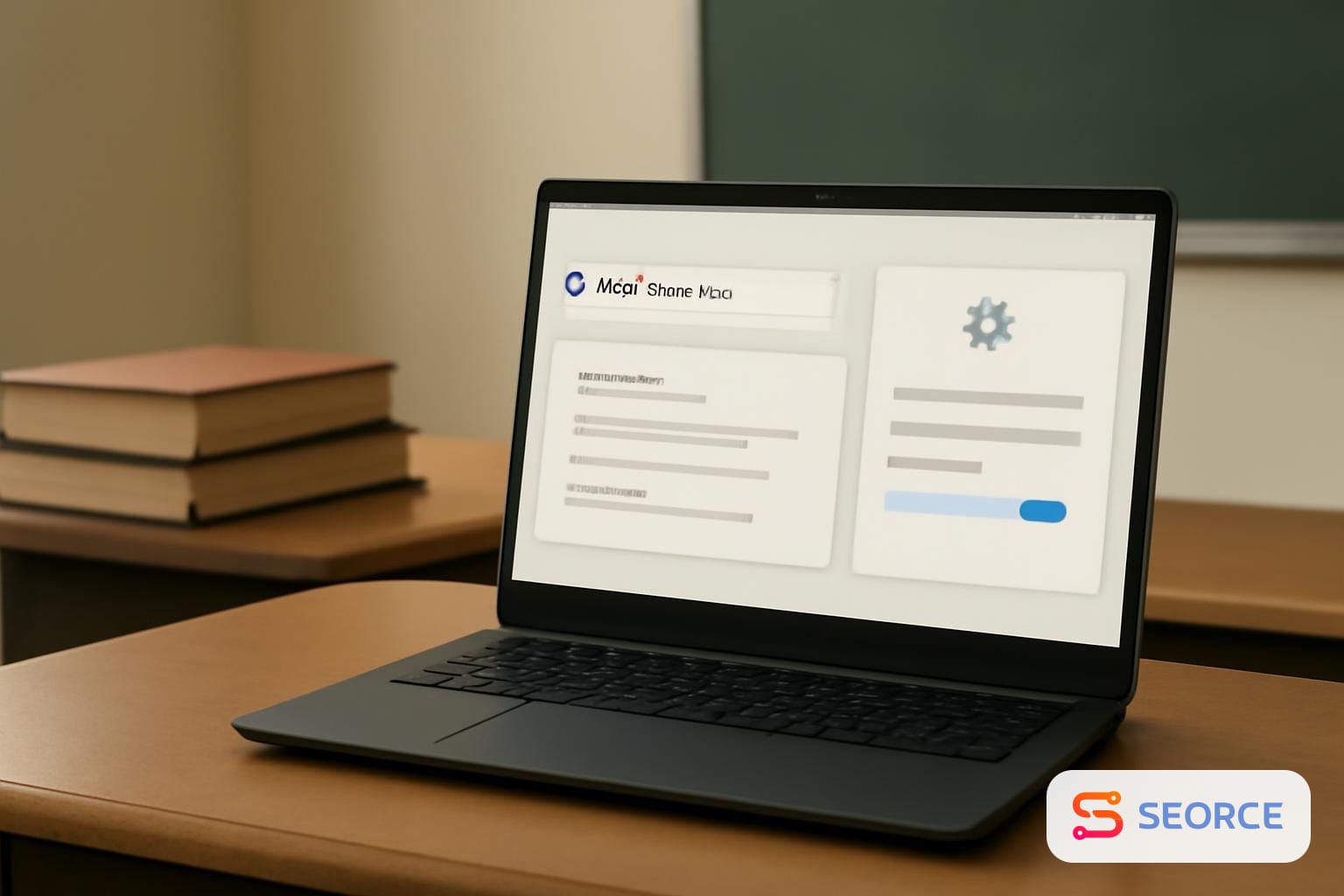
School laptop showing search results beside account settings on a desk

Google Search AI in schools will be tied to Search access for K-12 student accounts starting next year: administrators can leave Google Search on with AI Overviews and AI Mode, or turn Search off. Google announced the education changes on Nov. 3, 2026, and news coverage the same week reported the consequence for schools that want search without generative answers.

Google's own announcement on The Keyword called the package "major updates" for education and named Gemini, Gemini Notebook, Gemini in Classroom, and Google Search controls for K-12 student accounts. The Verge reported on Nov. 3 that Google would not give administrators a separate switch to disable Gemini-powered search features while preserving Search. Wired reported on Nov. 4 that schools will have to block access to Search altogether to remove AI Overviews.

How Google Search AI in schools works

Google Search AI in schools works by treating AI Overviews and AI Mode as part of the Search experience, not as separate education tools with their own disable switch. For K-12 student accounts, Google says Search, Gemini, Gemini Notebook, and Gemini in Classroom will be off unless administrators turn them on. The disputed part is that enabling Search also means accepting Google's AI search layer.

Chris Phillips, Google's vice president of education, told The New York Times, according to The Verge, "Search and AI are deeply integrated." The Verge reported that schools that disable Google's AI features "will not have access to Search, and they'll see a message from their school that indicates it's not available." Google did not immediately respond to The Verge's request for comment.

Google Workspace Updates adds one operational detail for the separate Guided Learning rollout. Guided Learning in Google Classroom is rolling out globally in all Gemini-supported languages for Education Fundamentals, Education Standard, and Education Plus, with an extended rollout longer than 15 days starting Nov. 3, 2026. Google says students get Guided Learning only if an administrator has teachers and students in a group or organizational unit with Gemini set to On.

Where Google and critics disagree

Google frames the change as more administrator choice because K-12 services are off by default unless schools enable them. Wired reported that Google said in a public response on X that schools will have "more choice, not less" because Search, Gemini, and Gemini Notebook can be enabled individually. Critics object because Google's choice set does not include traditional Search without AI Overviews or AI Mode.

Wired quoted Dominique Johnson of Lake Oswego Parents For Responsible Technology saying, "We were flabbergasted." Johnson added, "This move makes things even more difficult for school districts that have determined AI is harmful to foundational learning." Wired also reported that an IT administrator had asked in Google's support forums for a way to block AI Overviews because students need to navigate results, examine sources, and draw conclusions.

The technical dispute is partly about whether Google can maintain two versions of Search for schools. Nicole Kerson, a former senior Google Search product manager who runs Collected Company, told Wired, "It's very hard to maintain a forked product like that." Adeel Khan, a former teacher and principal who runs MagicSchool, told Wired it is "infuriating, insulting, and ludicrous" that Google is not offering a browser or account-level approach similar to Microsoft's Chrome extension for Bing summaries.

What school admins should check now

School administrators should audit the actual account controls before the next school term, because the effect depends on K-12 student accounts, groups, organizational units, and whether Gemini is set to On. The supplied evidence does not include the exact Admin console labels for the Search control, so districts should test with real student accounts rather than rely on policy language alone.

CheckWhy it mattersSource in evidence
K-12 student account access to Google SearchThis is the control that determines whether students get Search at all when AI search features are rejected.The Verge and Wired reporting on Google's education change
Groups and organizational units with Gemini set to OnGoogle Workspace Updates says students receive Guided Learning only when Gemini is enabled for the relevant group or organizational unit.Google Workspace Updates
Education edition in useGuided Learning availability is listed for Education Fundamentals, Education Standard, and Education Plus.Google Workspace Updates
Browser extensions and modified Search URLsWired reported that districts use these workarounds, but they could break if Google changes how results are delivered.Wired

Districts should also document alternatives before a forced decision arrives. Wired reported that Fairfax County Public Schools in Virginia developed its own extension, while smaller search engines such as DuckDuckGo see an opening with educators. In the r/CanadaRoom discussion of CBC's coverage, several commenters pointed to other search engines, journal databases, and school-paid database access, which is practitioner signal that some parents and educators are already thinking beyond Google's default.

What this means for search visibility

The search visibility effect is an inference, not a measured outcome in the supplied evidence: if districts disable Google Search or route students to alternatives, educational query behavior may fragment across DuckDuckGo, library databases, browser extensions, and Google's AI interfaces. Publishers and education sites should not assume the student research path remains a blue-link Google results page.

Wired reported that Wikipedia, news websites, and education tools have lost human visitors as people rely on AI Overviews, and it reported that Google uses the same bots to crawl the web for Search and AI products. For SEO teams, the practical issue is citation and answer inclusion, not only ranking. A student may see an AI synthesis first, a blocked Search message, or a non-Google results page, depending on the district control.

Paid search teams should treat the school setting as a watch item rather than a bidding signal. Wired reported that Alphabet shares had their worst single-day selloff after weaker-than-expected search ad sales, and said increased use of AI Overviews and AI Mode, which are not packed with many ads yet, was a major cause. The evidence does not show how much K-12 account traffic contributes to ad demand, so campaign changes based only on the school policy would be premature.

What happens next in the rollout

The next dated change is already in motion: Guided Learning in Google Classroom began an extended rollout on Nov. 3, 2026, for Rapid Release and Scheduled Release domains, and Google says feature visibility can take more than 15 days. The Verge reported that Google will begin testing Guided Learning inside AI Overviews in select US schools this month. The larger Search decision lands next year, when districts should watch for the first student-account notices saying Search is not available.

See more SEORCE in your Google results

Add us as a preferred source to see more of our stories in Google's Top Stories.

Add as a preferred source on Google

FAQ

Can schools turn off Google AI Overviews

Schools cannot turn off AI Overviews while keeping Google Search for K-12 student accounts, according to The Verge and Wired. The reported choice is Search with Google's AI search features, or no Search access for those accounts. Google frames the change as giving administrators controls because the services are off by default until enabled.

When does Google change school Search access

Google announced the education changes on Nov. 3, 2026, with the Search access consequence applying next year. A related Guided Learning rollout began Nov. 3 and may take more than 15 days to appear. The supplied evidence does not give a precise 2027 date for the Search cutoff behavior.

What is Guided Learning in Google Classroom

Guided Learning is a Google education feature that gives students extra support inside Google Classroom and Search. Google Workspace Updates says educators can add Guided Learning to assignments, and students receive it only when Gemini is enabled for the relevant group or organizational unit. It is available for listed Google Education editions.

Do schools need Gemini on for Guided Learning

Yes, Google Workspace Updates says students get Guided Learning only if Gemini is enabled by the administrator. The relevant teachers and students must be in a group or organizational unit with Gemini set to On. That makes the Gemini setting a control point for schools testing classroom AI access.

Will schools switch from Google Search

Some schools may evaluate alternatives, but the evidence does not prove a broad switch. Wired reported that DuckDuckGo sees an opportunity with educators, and Reddit commenters mentioned other search engines and databases. District capacity, filtering requirements, account management, and curriculum policy will determine whether alternatives replace Google Search.

Entities

Google SearchAI OverviewsAI ModeGeminiGoogle ClassroomK-12 Student AccountsGuided LearningGoogle Workspace

Tags

Google SearchAI in SchoolsK-12 EducationAI OverviewsGoogle ClassroomSchool ITSearch Controls

Topics

SEOArtificial Intelligence

Sources

AI in the learning era
Google / The Keyword
Educators can now add Guided Learning to assignments in Google Classroom to help students get extra support
Google Workspace Updates
Google Is Forcing AI Overviews in Classrooms. Schools Are Searching for a Way Out
Wired
Google is entirely disabling Search in schools that don’t want AI
The Verge
Google Brings UCP Direct Checkout To AI Mode In Canada via @sejournal, @brookeosmundson
Search Engine Journal

More like this