Your brand gets recommended by ChatGPT. Your content appears in AI-generated answers, and potential customers discover your products through those recommendations.
But when you check your analytics, the revenue attributed to AI search is surprisingly low.
That's because AI can influence buying decisions without generating a website visit. Someone might discover your business through ChatGPT and return through Google days later.
You won't be able to track every interaction.
However, you can still estimate your AI search ROI by combining costs, conversions, customer feedback, and AI visibility data.
Why AI Search ROI Is Harder to Track Than Traditional SEO
AI tools are becoming part of how people research products and make buying decisions.
Forrester's 2026 research found that 94% of business buyers use AI during their buying process. Meanwhile, NielsenIQ reported that 42% of consumers had used an AI tool for shopping within the previous month.
However, traditional analytics cannot always capture how AI influences those decisions.
For example, someone might discover your software through ChatGPT, research it independently, and visit your website through Google. Analytics may credit that conversion to organic search, even though AI contributed to the initial discovery.
Several factors make measurement harder.
- AI answers can influence customers without sending them to your website.
- Missing referral data can make AI-driven visits appear as direct traffic.
- Cookie restrictions, device switching, and long sales cycles can interrupt attribution.
- Customers may not mention that an AI recommendation influenced their decision.
Attribution can also work in the opposite direction. A customer might discover your business through traditional SEO but complete their journey through an AI referral.
This means a recorded traffic source doesn't always tell you which channel influenced the purchase.
You need to measure the revenue AI search directly generates while estimating the influence your analytics cannot capture.
Start With What AI Search ROI Actually Means
AI search can contribute to your business in several ways.
Some outcomes are measurable, such as purchases, subscriptions, and qualified leads. Others are harder to quantify, including brand awareness and product consideration.
For financial reporting, start with a revenue-based calculation:
AI Search ROI = [(AI Search Revenue − AI Search Cost) ÷ AI Search Cost] × 100
Here, revenue represents sales you can reasonably associate with AI search. Costs include the resources spent improving and measuring your visibility.
This provides a marketing return estimate. It doesn't necessarily represent business profit because product delivery and other expenses may not be included.
Keep visibility and engagement metrics alongside your calculation. They provide useful context, but shouldn't automatically be converted into revenue.
Step 1. Calculate How Much You Actually Spend on AI Search
You might already be investing in AI search through your existing SEO activities.
Your content team could be updating product comparisons, improving educational guides, or creating resources that AI assistants can reference.
Meanwhile, your marketing team might be monitoring brand visibility across ChatGPT, Gemini, and other platforms.
To understand your investment, separate expenses into two categories.
Identify Expenses Dedicated to AI Search
Some costs exist specifically because you're investing in AI visibility.
These might include AI monitoring subscriptions, specialist consultants, or agency services focused entirely on AI search.
You can count their full cost. Shared expenses require a different approach because they also support your existing marketing activities.
Allocate Your Shared SEO and Content Costs
Suppose your content team costs $40,000 per quarter and spends approximately 25% of its time on AI-related optimization.
You would allocate $10,000 toward AI search.
The same approach applies to freelancers, agencies, and shared subscriptions. Estimate their usage based on actual team activity.
Here's an illustrative quarterly breakdown:
Expense | AI Search Cost |
AI visibility monitoring | $1,200 |
Dedicated consultant | $2,500 |
Content team allocation | $10,000 |
Freelance content allocation | $2,000 |
Shared software allocation | $400 |
Total | $16,100 |
In this example, your quarterly AI search investment is $16,100.
If a subscription includes a separately priced AI feature, you can count that feature's actual price rather than allocating part of the full subscription.
Review your estimates each quarter as your AI-related work changes. Keep the allocation method consistent so you can compare spending and returns over time.
Step 2. Measure the Revenue You Can Directly Track
Once you know your costs, examine the revenue associated with visitors arriving through AI assistants.
Google Analytics 4 added a dedicated AI Assistant channel in May 2026, allowing recognized referrals from AI assistants to appear separately in default channel reports.
You can examine these visits through your Traffic acquisition reports. However, this only captures recognizable traffic. AI-influenced customers who arrive through other channels may still be missing.
Google's AI Overviews and AI Mode traffic is also classified under Organic Search rather than the AI Assistant channel.
Calculate Revenue From AI-Referred Conversions
Start by identifying meaningful conversions associated with AI referrals.
These might include purchases, subscriptions, qualified leads, or demo requests.
You can estimate their financial value using your average customer revenue.
Tracked AI Revenue = AI-Referred Customers × Average Revenue Per Customer
Suppose 25 AI-referred visitors become paying customers during a quarter.
If each customer generates an average of $800 in recognized revenue, your tracked AI revenue would be $20,000.
If your CRM connects those conversions to actual sales, use recorded revenue instead.
For B2B companies, keep qualified leads, open opportunities, and closed deals separate. Pipeline value indicates potential revenue, not completed sales.
Why AI Traffic Quality Deserves More Attention
Not every traffic source delivers the same engagement.
Braam Kotze, who operates TradeTestr and SaaSFilter, shared first-party analytics showing how AI referrals compared with other channels.
Between October 18 and November 8, 2026, TradeTestr recorded 125 sessions across three acquisition channels.
Traffic Channel | Sessions | Engagement Rate | Average Engagement Time |
Direct | 102 | 5.88% | About 1 second |
Organic Search | 18 | 55.56% | About 40 seconds |
AI Assistant | 5 | 80% | About 43 seconds |
Four of the five AI-referred sessions were engaged. They also averaged 8.2 events per session.
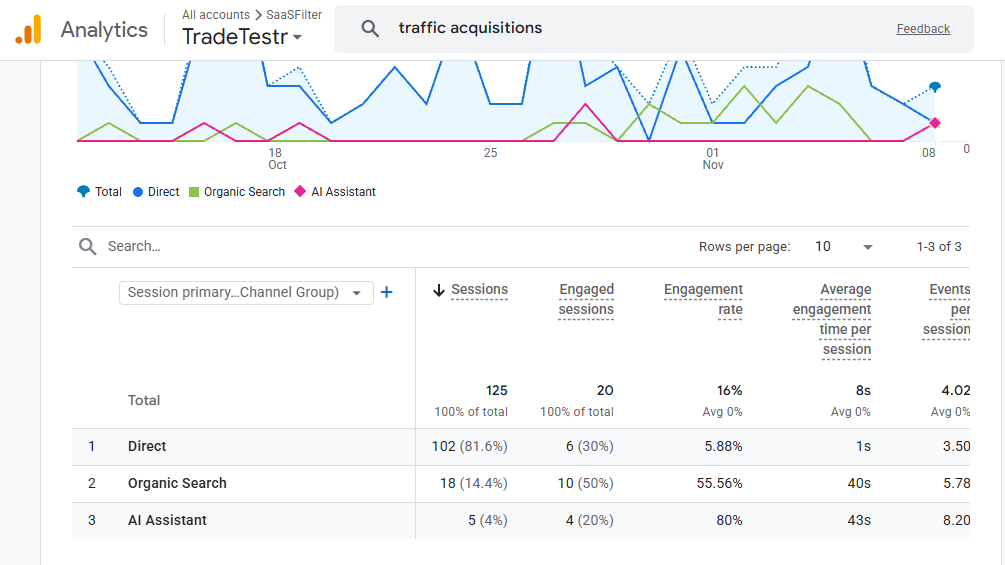
TradeTestr's GA4 report compares direct, organic, and AI Assistant traffic between October 18 and November 8, 2026.
Braam explained that he uses GA4's AI Assistant channel to distinguish identifiable AI referrals from direct and organic traffic. He also recommends checking this channel separately because its results can be easy to overlook in broader acquisition reports.
For him, the findings changed how he evaluated AI performance. Instead of focusing exclusively on citations, he started examining what referred visitors did after reaching his website.
His interpretation is that AI users may arrive with a clearer understanding of what they need after receiving a relevant recommendation.
However, five AI sessions are too few to establish a reliable performance trend.
The findings are an early signal, not evidence that AI traffic consistently performs better.
For your business, engagement can help identify promising traffic sources. But you still need conversion data to determine whether those visitors generate meaningful revenue.
Step 3. Ask Customers How They Discovered Your Business
AI referral reports cannot explain every interaction that contributes to a purchase.
A customer might first hear about your company through Copilot and return several days later by searching for your brand.
Your analytics could miss that discovery entirely.
That's where customer-reported attribution becomes useful.
During signup, checkout, onboarding, or an initial sales conversation, ask customers how they discovered your business.
Include AI tools such as ChatGPT, Gemini, Copilot, and Perplexity among the available options.
Allow multiple responses when possible because customers often use several sources before buying.
Use Customer Responses to Estimate AI-Influenced Revenue
Suppose customers who answered your attribution survey generated $60,000 in revenue during a quarter.
Of that amount, $9,000 came from customers who identified an AI assistant as a discovery source.
That represents 15% of respondent revenue.
Now suppose all new customers generated $190,000 during the same period, including those who never answered the survey.
Applying the 15% share produces an estimated $28,500 in AI-associated revenue.
This calculation helps account for customers whose AI interactions weren't recorded in analytics.
However, it assumes survey respondents represent your overall customer base. Multiple discovery sources also mean AI may share credit with other channels.
Treat the result as an estimate rather than verified AI-generated revenue.
Alston Antony's Experience Shows Where Attribution Breaks
Alston Antony, SaaS SEO and AI search ranking consultant and founder of zPlatform AI, encountered this problem while measuring his website's AI visibility.
For the 30 days ending October 24, 2026, he reported more than 400 sessions from AI assistants in GA4.
However, he also noticed that some users discover a company through ChatGPT or Copilot before searching for its name on Google.
Those later visits may be attributed to organic search rather than AI.
Alston therefore compares AI referral sessions with search performance and citation data instead of relying on one acquisition report.
His experience highlights an important limitation. Even when AI tools send identifiable visitors, your analytics may still miss customers who first encountered your brand through an AI recommendation.
For your business, customer surveys can help identify those otherwise hidden discovery journeys.
Just avoid adding tracked and self-reported revenue together without checking for duplicate customers.
Step 4. Use AI Citations to Understand Visibility Beyond Clicks
AI assistants can reference your content thousands of times without sending equivalent traffic to your website.
This makes citation tracking valuable, but it also creates a measurement problem.
A citation confirms that your content was referenced in a tracked AI answer. It doesn't prove that someone visited your website or purchased anything.
The distinction becomes clearer when you examine real company data. We have 3 different companies that will help you understand better.
Alston Antony Recorded 241,500 Microsoft AI Citations
In his published zPlatform AI case study, Alston reported approximately 241,500 citations across Microsoft Copilot and supported partner AI experiences over six months.
His Bing Webmaster Tools screenshot also shows an average of 24 cited pages per day over the selected reporting period.
His Bing organic search data showed 2,496 clicks, approximately 167,300 impressions, and an average click-through rate of 1.49% over a separate 24-month period.
These figures come from different reporting windows and measure different activities. They shouldn't be combined into a direct citation-to-click rate.
However, they demonstrate why citation activity and organic traffic need separate measurement.
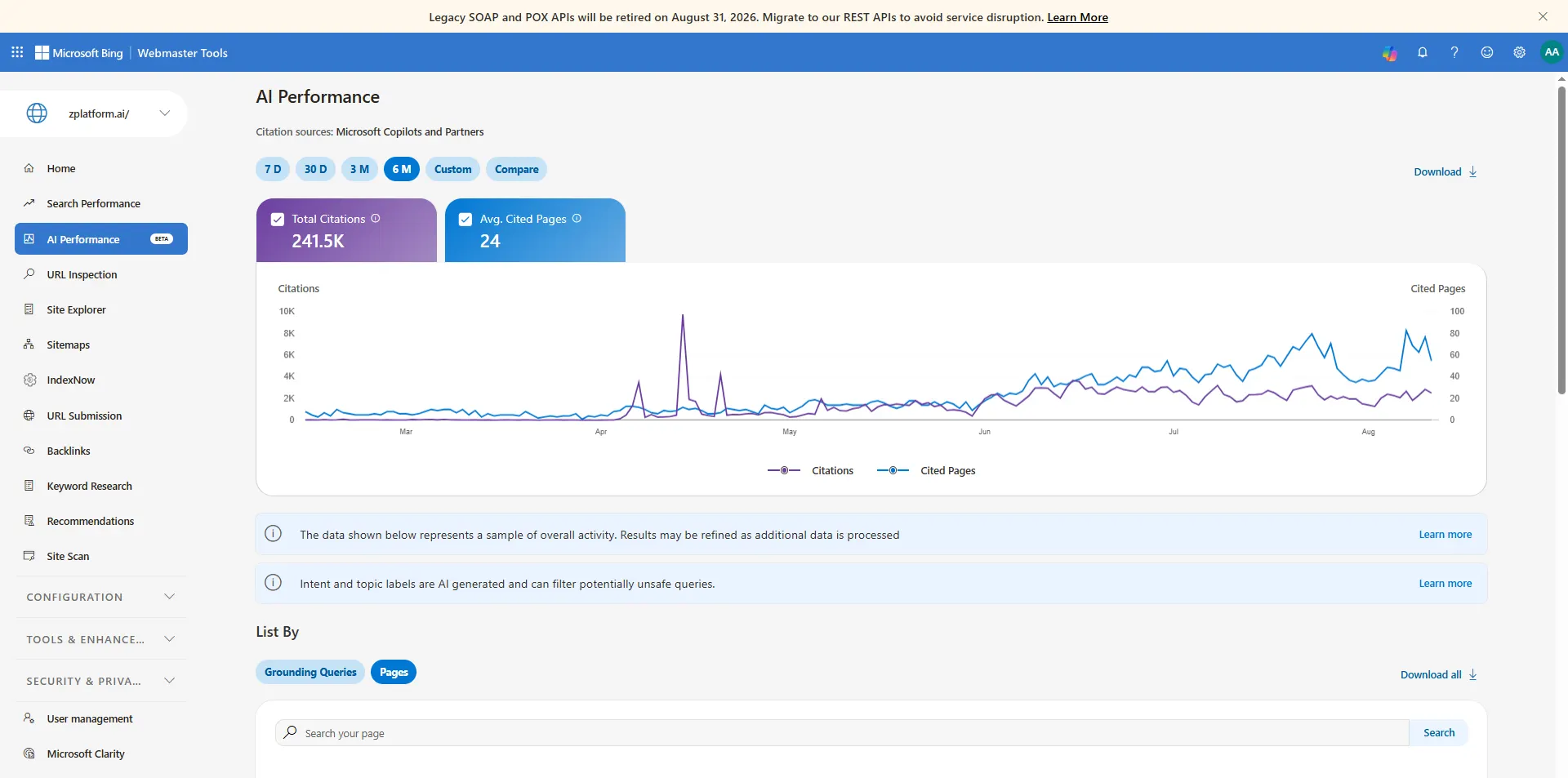
Bing Webmaster Tools reported approximately 241,500 citations across Microsoft Copilot and partner AI experiences over six months.
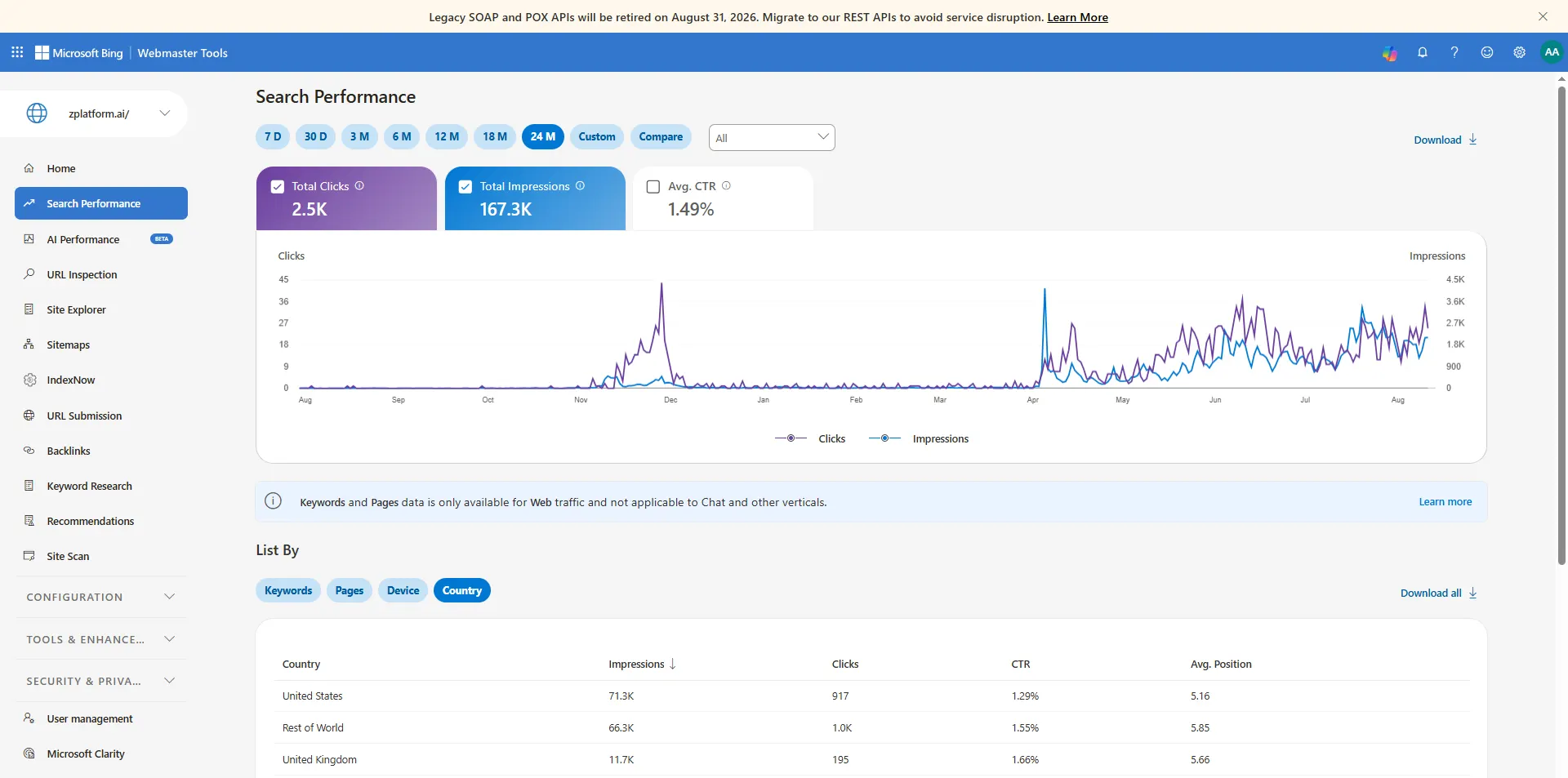
The separate Bing Search Performance report shows approximately 2,500 clicks, 167,300 impressions, and a 1.49% CTR over 24 months.
Alston's accompanying case study also provides additional findings about where his AI visibility came from.
- Approximately 51.7% of citations classified by Bing's query-intent labels were associated with commercial or comparison searches.
- One guide about free AI image generators reportedly received 108,546 citations.
- His published case study reported 70,618 Google generative AI impressions across 804 pages.
These additional details come from Alston's case study. They aren't all independently visible in the three screenshots supplied.
The Google Search Console screenshot displays the rounded figure of 70.6K impressions and shows a rising trend toward the end of its reporting period.
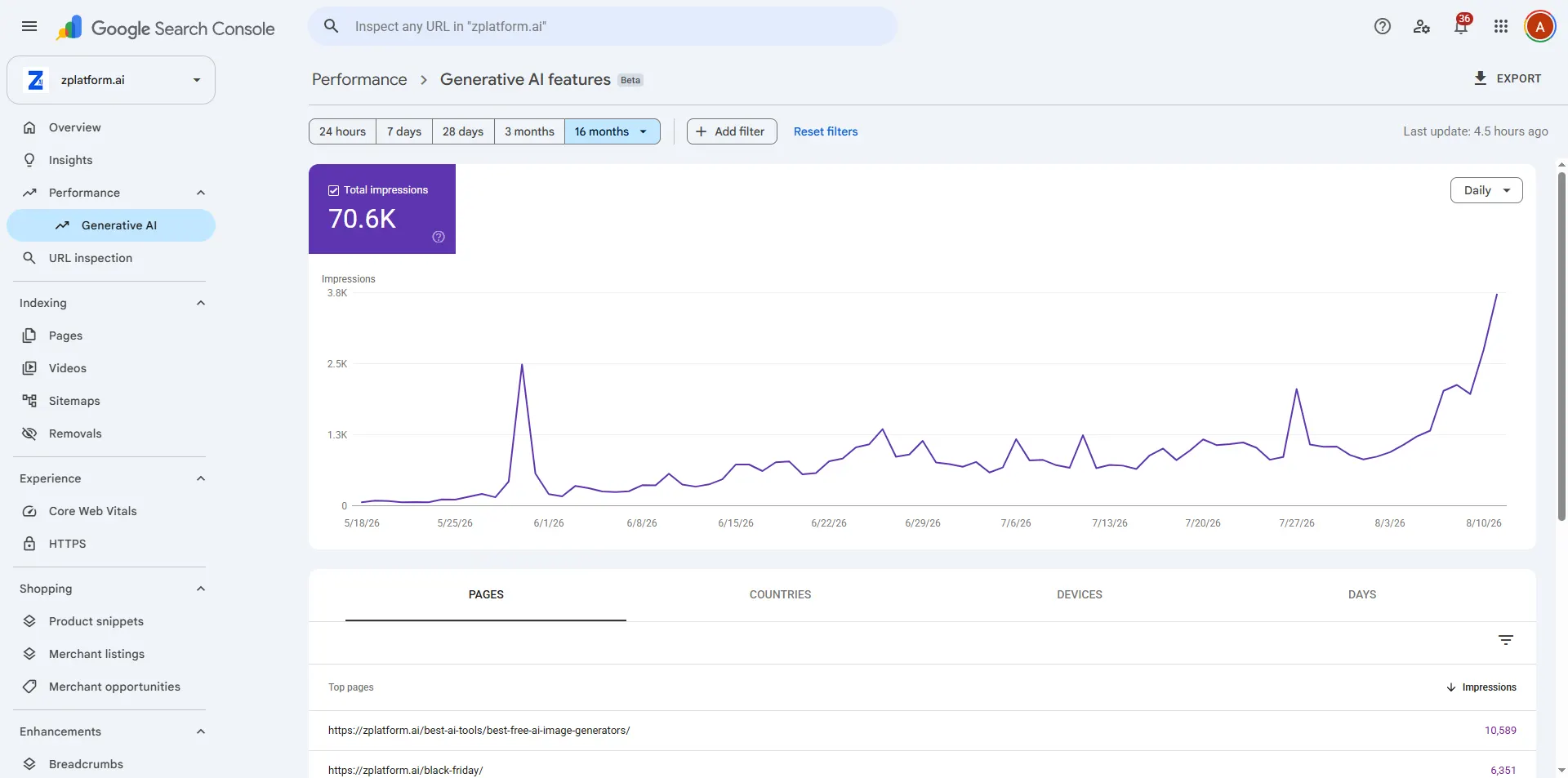
Google Search Console shows approximately 70,600 impressions in its Generative AI features report. The underlying case study reports 70,618 impressions.
Alston's content strategy focuses on hands-on software testing, detailed comparisons, and educational resources supported by firsthand experience.
He also makes supporting performance reports available through his public case study, allowing readers to inspect the reported figures.
His findings suggest that detailed, experience-based content can gain substantial AI visibility even without equivalent growth in recorded search traffic.
But commercial-intent citations aren't the same as commercial results.
A citation associated with a product comparison may expose your brand during a buying decision. Whether that exposure leads to a customer still requires separate evidence.
TradeTestr Shows Which Content AI Tools Cite
Braam's TradeTestr data provides another useful example.
Between August 9 and November 1, 2026, Bing Webmaster Tools recorded 186 citations from Microsoft Copilot and partner AI experiences for the website.
The citation trend increased toward the end of the reporting period.
The cited pages were primarily educational guides rather than commercial landing pages.
An Average True Range guide received 41 citations, while an Elliott Wave oscillator guide received 30. An EMA crossover strategy guide followed with 16 citations.
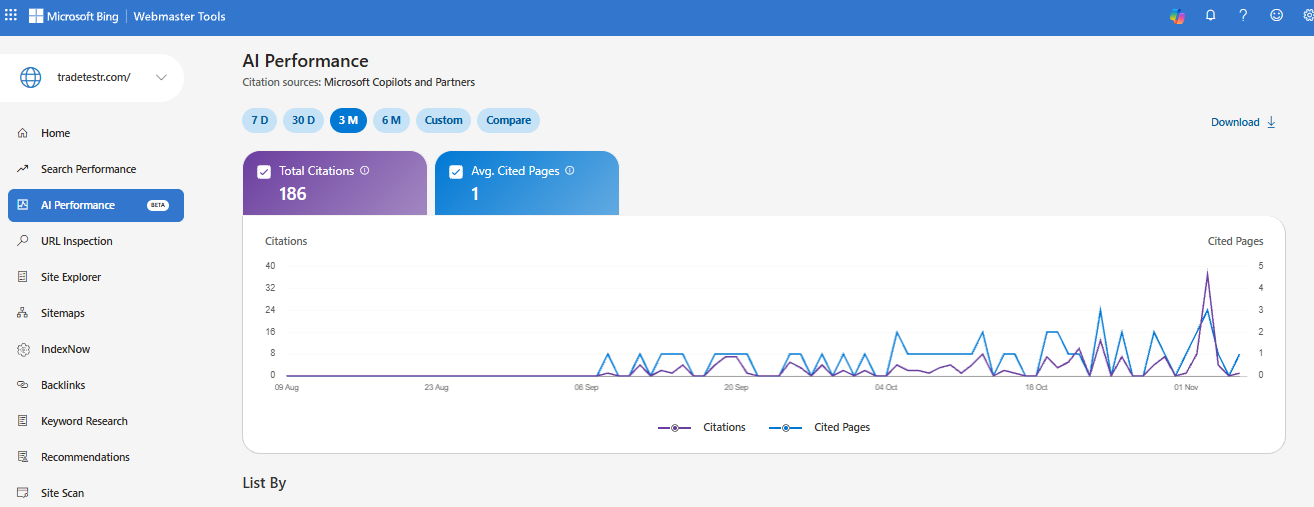
TradeTestr recorded 186 citations between August 9 and November 1, 2026, with activity increasing toward the end of the reporting period.
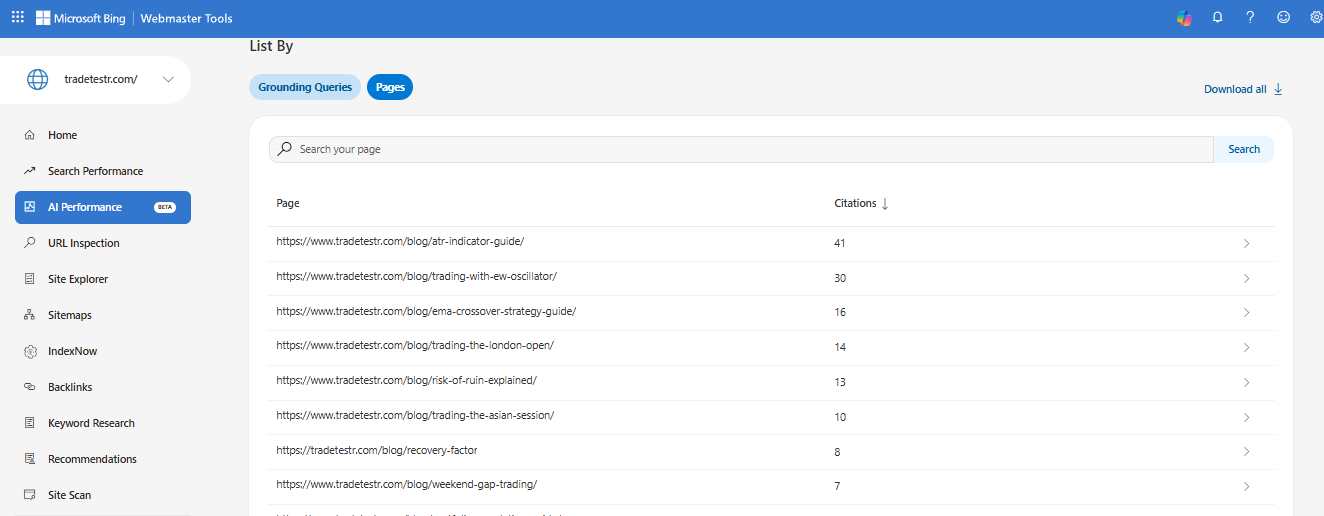
Bing's cited-page report shows 41 citations for the ATR guide, 30 for the Elliott Wave oscillator guide, and 16 for the EMA crossover guide.
These findings helped Braam identify which content AI tools referenced and compare that visibility with the engagement recorded in GA4.
He believes detailed educational content is valuable to AI systems because it provides specific information that can support generated answers.
His results suggest that educational resources can earn meaningful AI visibility even when they aren't designed primarily to generate immediate sales.
However, the data doesn't establish that content depth alone caused those citations.
For your business, this means educational pages shouldn't automatically be dismissed simply because they generate fewer immediate conversions.
Instead, examine whether frequently cited guides attract relevant visitors, lead to product-page visits, or appear in customer-reported discovery journeys.
These additional signals can help you assess their potential contribution without claiming a direct relationship that hasn't been established.
SaaSFilter Shows Why High Citation Counts Can Be Misleading
Braam's second website, SaaSFilter, produced a different result.
His Bing Webmaster Tools report showed 565 citations from Microsoft Copilot and partner AI experiences over the selected three-month period.
The citation graph showed a sharp spike early in the period, followed by little recorded activity for most of the remaining window.
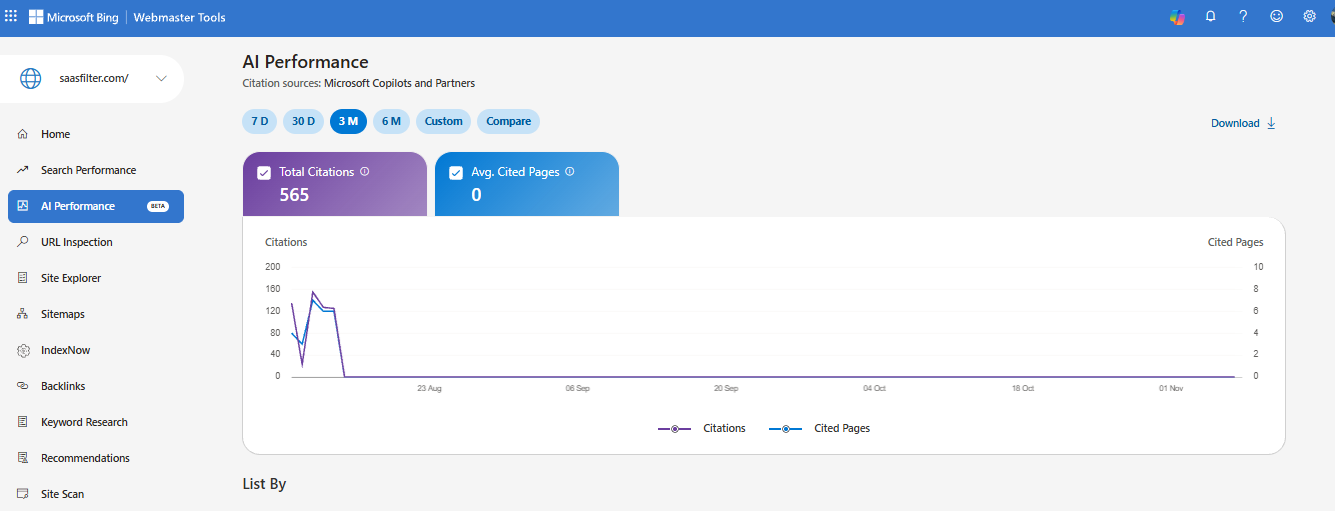
SaaSFilter recorded 565 citations over three months. Most of the visible activity occurred early in the reporting period.
Of those citations, 347, or approximately 61%, came from one detailed WordPress hosting comparison guide.
Another guide about choosing CRM software received 133 citations.
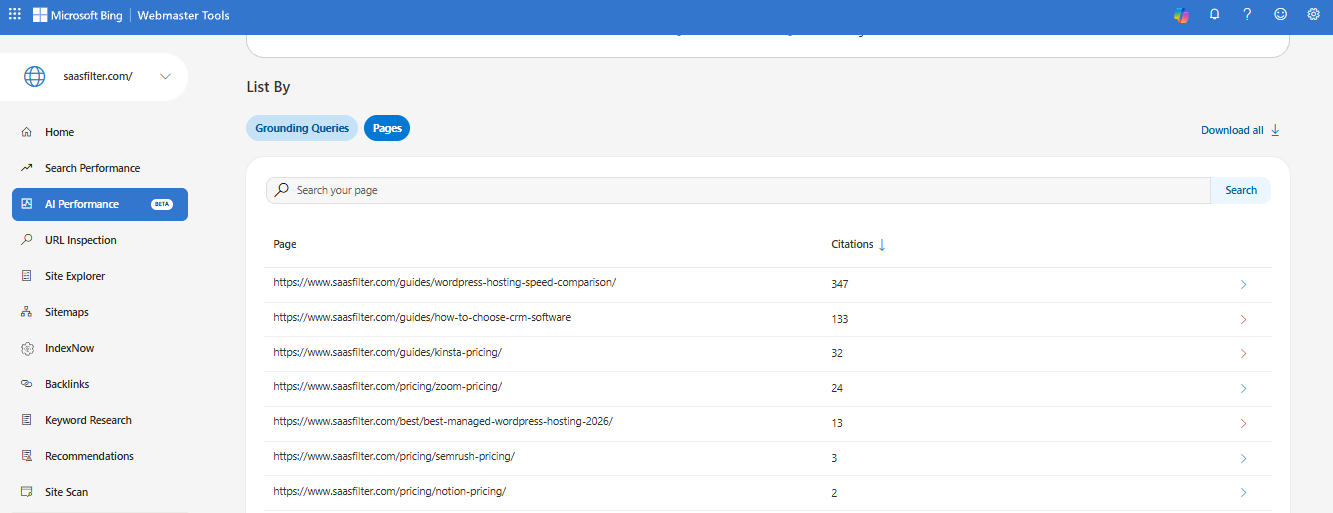
Bing's cited-page report shows 347 citations for a WordPress hosting comparison guide and 133 for a CRM selection guide.
Yet its GA4 acquisition report showed no separate AI Assistant channel.
The report recorded 673 total sessions, including 665 direct sessions, six referral sessions, and two unassigned sessions.
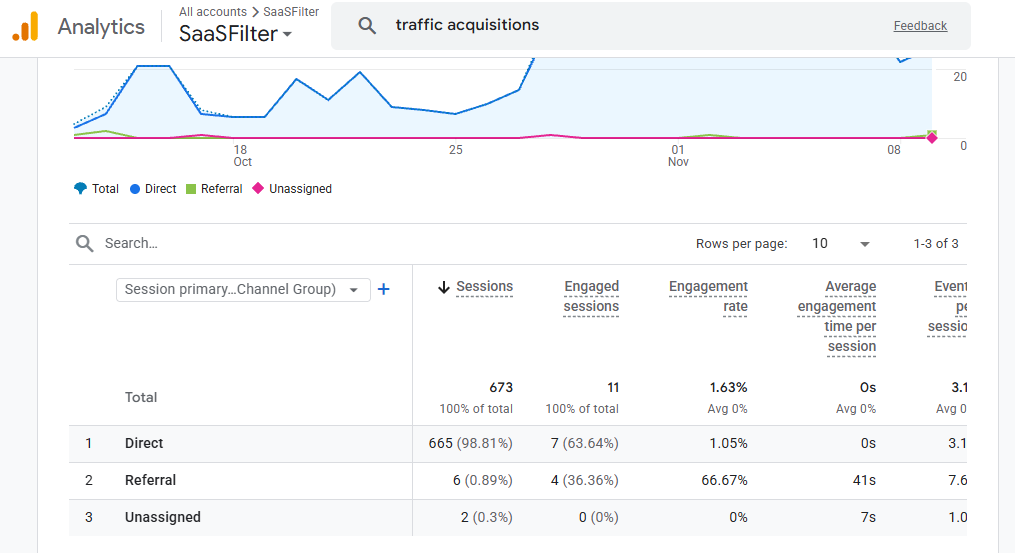
SaaSFilter's GA4 report shows 673 sessions without a separate AI Assistant traffic channel, despite citation activity recorded in Bing Webmaster Tools.
Braam's initial correspondence also mentioned 659 citations to date, representing a different reported total from the three-month figure.
This contrast shows how AI visibility can grow without producing clearly identifiable referral traffic.
It doesn't prove those citations had no commercial influence. It means the available analytics couldn't establish that connection.
What These Three Case Studies Reveal
Alston, TradeTestr, and SaaSFilter demonstrate three different measurement situations.
Alston's data shows substantial AI citation activity alongside identifiable AI referrals. TradeTestr shows a small number of highly engaged AI sessions. SaaSFilter demonstrates how citations can accumulate without a separately recorded AI referral segment.
None of these findings establishes a complete revenue return on its own.
Together, they show why businesses should evaluate AI search through several connected indicators.
- Visibility tells you whether AI systems reference or recommend your brand.
- Engagement helps you assess the behavior of identifiable AI visitors.
- Conversions connect those visitors with measurable business actions.
- Customer feedback helps uncover AI influence that analytics may miss.
Bing Webmaster Tools AI Performance can help you examine citations, cited URLs, and grounding queries.
You can also use our AI Beacon to monitor your brand's presence across AI platforms, identify citation opportunities, and examine the queries where competitors appear.
Combine those visibility signals with analytics and customer data. This helps you understand the possible business contribution of AI search without treating citations as revenue.
Step 5. Turn Your Revenue Estimates Into an ROI Percentage
Now you can compare your estimated AI revenue with your investment.
Using our earlier example, the quarterly AI search cost is $16,100.
If directly tracked conversions generated $20,000 in revenue, the calculation would be:
($20,000 − $16,100) ÷ $16,100 × 100 = 24.2% ROI
Now consider the customer-reported attribution estimate of $28,500.
($28,500 − $16,100) ÷ $16,100 × 100 = 77% ROI
These results represent different attribution methods applied to the same illustrative investment.
The first reflects identifiable AI-referred conversions. The second estimates broader AI-associated revenue based on customer responses.
Neither provides a complete picture of AI's actual contribution.
Instead of combining the numbers, present them separately and explain how each was calculated.
Keep Your ROI Estimates Comparable
Your calculations become more useful when you apply the same definitions each quarter.
For example, if you use recognized sales revenue in one report, avoid switching to projected customer lifetime value in the next.
You should also separate actual sales from estimated pipeline value.
For businesses with subscription products, it's especially important to distinguish revenue already earned from revenue customers might generate in the future.
A consistent estimate you can compare over time is more useful than a precise-looking number built from inconsistent data.
Step 6. Estimate the Advertising Value of AI Visibility
Revenue isn't the only useful measurement.
A potential customer might see your brand recommended repeatedly without visiting your website.
Those appearances may contribute to brand awareness and product consideration, although their financial impact is difficult to establish.
One optional approach is to compare your AI visibility with the cost of similar advertising exposure.
However, AI monitoring tools generally measure selected prompts and responses rather than every answer users actually see.
This distinction makes advertising comparisons highly approximate.
Start With Your Brand's Presence Across Relevant Prompts
Suppose you monitor 100 commercially relevant prompts across selected AI platforms.
You repeat each prompt ten times to account for variations in AI-generated answers.
That produces 1,000 monitored responses.
If your brand appears in 220 of them, your observed mention rate is 22%.
This gives you a repeatable visibility benchmark for those prompts and platforms.
However, it doesn't mean your brand appeared in 22% of all real-world AI conversations about your category.
Your monitoring sample may not reflect actual user demand, and answers can vary by location, personalization, and platform.
Compare Visibility With Advertising Costs Carefully
To estimate an advertising-equivalent value, you would also need a credible estimate of how often relevant AI answers are generated.
For example, suppose separate demand research suggests approximately 10,000 relevant AI answers during a month.
Applying your observed 22% mention rate would suggest around 2,200 potential brand appearances, assuming the monitored results reflect real-world responses.
At an illustrative advertising rate of $20 per 1,000 impressions, that would produce a $44 advertising-equivalent estimate.
This is only a scenario, not a measured financial result.
Unlike paid advertising, AI-generated answers don't provide complete impression reporting, standardized placement, or consistent evidence of user attention.
The calculation also assumes that an AI mention provides value comparable to a paid impression, which hasn't been established.
For that reason, advertising-equivalent estimates should remain separate from financial ROI.
You can use them as a rough comparison when discussing visibility, but don't add them to your sales figures or report them as advertising savings.
If your demand estimates aren't reliable, it's better to report your observed mention rate without assigning it a dollar value.
Step 7. Build a Quarterly AI Search ROI Report You Can Trust
Once you've collected your data, the next step is to use it for business decisions.
You don't need a complicated dashboard. A consistent quarterly report can help you understand whether your AI search investment is producing meaningful results.
We recommend organizing your reporting around five areas.
Area | Metrics to Include |
Investment | AI tools, team allocation, agencies, and content costs |
Revenue | AI-referred conversions and closed sales |
Customer feedback | Self-reported AI discovery and associated revenue |
Traffic quality | AI sessions, engagement, and conversion rates |
Visibility | Brand mentions, citations, cited pages, and prompt coverage |
Keep your reporting periods consistent and separate confirmed figures from estimates.
For example, you might discover that AI citations increased while referral traffic remained unchanged.
That tells you your content is appearing more frequently in tracked AI answers, but it doesn't establish whether those appearances influenced purchases.
You might also find that AI referrals produce few sessions but a relatively high number of qualified leads.
That would justify examining which pages and queries are attracting those visitors.
Use the Findings to Improve Your AI Search Strategy
Your report should help you decide where to invest next.
If educational guides receive citations but produce little measurable traffic, examine whether they address relevant commercial topics and support your customer's buying journey.
If specific product pages consistently receive qualified AI referrals, investigate their content and the queries bringing visitors to them.
You can use AI Beacon to monitor brand mentions, citations, and visibility changes across AI platforms. Pair those findings with your conversion and revenue reports to identify areas worth improving.
One useful reporting practice is to distinguish what each result actually proves.
A citation increase confirms greater exposure within the monitored AI experiences. An increase in engaged referrals shows that more visitors are interacting with your website. Additional closed sales provide stronger evidence of measurable commercial value.
When these indicators move together, they give you a reason to investigate a possible relationship. They don't automatically establish that AI visibility caused the revenue increase.
Repeat the process each quarter using consistent definitions and attribution methods.
That gives you a clearer view of performance without relying on citation growth or traffic increases alone.
Final Takeaway
AI search ROI cannot always be measured accurately through traditional analytics.
However, you can build a useful estimate by tracking your investment, measuring identifiable conversions, and collecting customer-reported attribution.
Use citations and brand visibility data to understand the activity happening beyond website visits.
You don't need to assign a dollar value to every AI mention. You need reliable evidence to understand what's contributing to your business and where your next investment makes sense.
Frequently Asked Questions (FAQs)
1. How Can You Calculate AI Search ROI?
Subtract your AI search costs from attributed revenue, divide by those costs, and multiply by 100. Use tracked sales and customer-reported estimates separately to avoid double-counting.
2. Why Doesn't GA4 Capture All AI Search Traffic?
Customers may discover your brand through ChatGPT or Copilot but return through Google or direct visits. GA4 may attribute those visits to other channels, making AI's influence harder to measure.
3. Do More AI Citations Mean Higher Revenue?
Not necessarily. SaaSFilter recorded 565 AI citations without a separate AI Assistant traffic channel in GA4. Citations indicate visibility, but conversions and revenue require separate measurement.
4. How Can You Measure AI Search Performance Beyond Clicks?
Track brand mentions, citations, engagement rates, conversions, and customer-reported discovery sources. Combining these metrics helps you understand AI search's potential business contribution.
5. How Often Should You Measure AI Search ROI?
Review your AI search ROI quarterly. Compare investment, tracked revenue, customer attribution, and visibility trends using consistent reporting periods and measurement methods.
Expert Credits
Expert | Designation | Website | |
Braam Kotze | Operator, TradeTestr and SaaSFilter | ||
Alston Antony | SaaS SEO & AI Search Ranking Consultant and Founder, zPlatform AI |